Close Menu
FSNN | Free Speech News NetworkFSNN | Free Speech News Network
  • Home
  • News
    • Politics
    • Legal & Courts
    • Tech & Big Tech
    • Campus & Education
    • Media & Culture
    • Global Free Speech
  • Opinions
    • Debates
  • Video/Live
  • Community
  • Freedom Index
  • About
    • Mission
    • Contact
    • Support
Trending

The Foilies 2026

20 minutes ago

Bitpanda bets on banks, tokenization to expand globally ahead of IPO plans

47 minutes ago

Bitcoin Turns Up the Heat on Lost Support for Its Latest Weekly Close

48 minutes ago
Facebook X (Twitter) Instagram
Facebook X (Twitter) Discord Telegram
FSNN | Free Speech News NetworkFSNN | Free Speech News Network
Market Data Newsletter
Sunday, March 15
  • Home
  • News
    • Politics
    • Legal & Courts
    • Tech & Big Tech
    • Campus & Education
    • Media & Culture
    • Global Free Speech
  • Opinions
    • Debates
  • Video/Live
  • Community
  • Freedom Index
  • About
    • Mission
    • Contact
    • Support
FSNN | Free Speech News NetworkFSNN | Free Speech News Network
Home»Cryptocurrency & Free Speech Finance»Why crypto bulls think AI agents will make stablecoins the default payment layer
Cryptocurrency & Free Speech Finance

Why crypto bulls think AI agents will make stablecoins the default payment layer

News RoomBy News Room3 hours agoNo Comments4 Mins Read892 Views
Share Facebook Twitter Pinterest Copy Link LinkedIn Tumblr Email VKontakte Telegram
Why crypto bulls think AI agents will make stablecoins the default payment layer
Share
Facebook Twitter Pinterest Email Copy Link

Listen to the article

0:00
0:00

Key Takeaways

Playback Speed

Select a Voice

Your AI just made several payments while you read that headline. You approved none of them. Visa processed none of them. And if the crypto industry’s biggest bulls are right, that’s not a bug — it’s the entire future of the internet economy.

Coinbase founder Brian Armstrong thinks there will soon be more AI agents than humans making transactions on the internet. Binance founder Changpeng Zhao went further, predicting agents will make one million times more payments than people, all in crypto. The posts landed on the same day last week and lit up crypto X.

The core argument is structural.

AI agents can’t open bank accounts because banks require identity verification that software cannot provide, whereas a crypto wallet only needs a private key. No KYC, no compliance review, no waiting — and that asymmetry is what Armstrong was pointing at.

But the wallet problem is only half the picture. The other half is economics.

Agents don’t shop the way humans do. When an AI agent is executing a task — such as researching a topic, coordinating a supply chain, building a report — it might call dozens of specialized APIs in a single session.

Each call might be worth fractions of a cent, where it pays for GPU compute time, real-time data feeds, web scraping services, or hiring a sub-agent to handle translation. None of these transactions resembles anything Visa or Mastercard was designed to process.

Consider, for a moment, that this story was written by an agent, requested by a “chief” agent at CoinDesk tasked with increasing the site’s authority.

To produce it, that agent would have queried a real-time news API to verify Armstrong’s tweet ($0.002), pulled onchain data to search for volume figures ($0.004), cross-referenced press releases ($0.001), and pinged a financial context model for Visa protocol details ($0.003). It would finally generate the article at an additional cost, paying credits to another AI tool to actually write the piece.

The total cost of reporting is under two cents with six transactions, at the current figures offered by protocols such as x402.
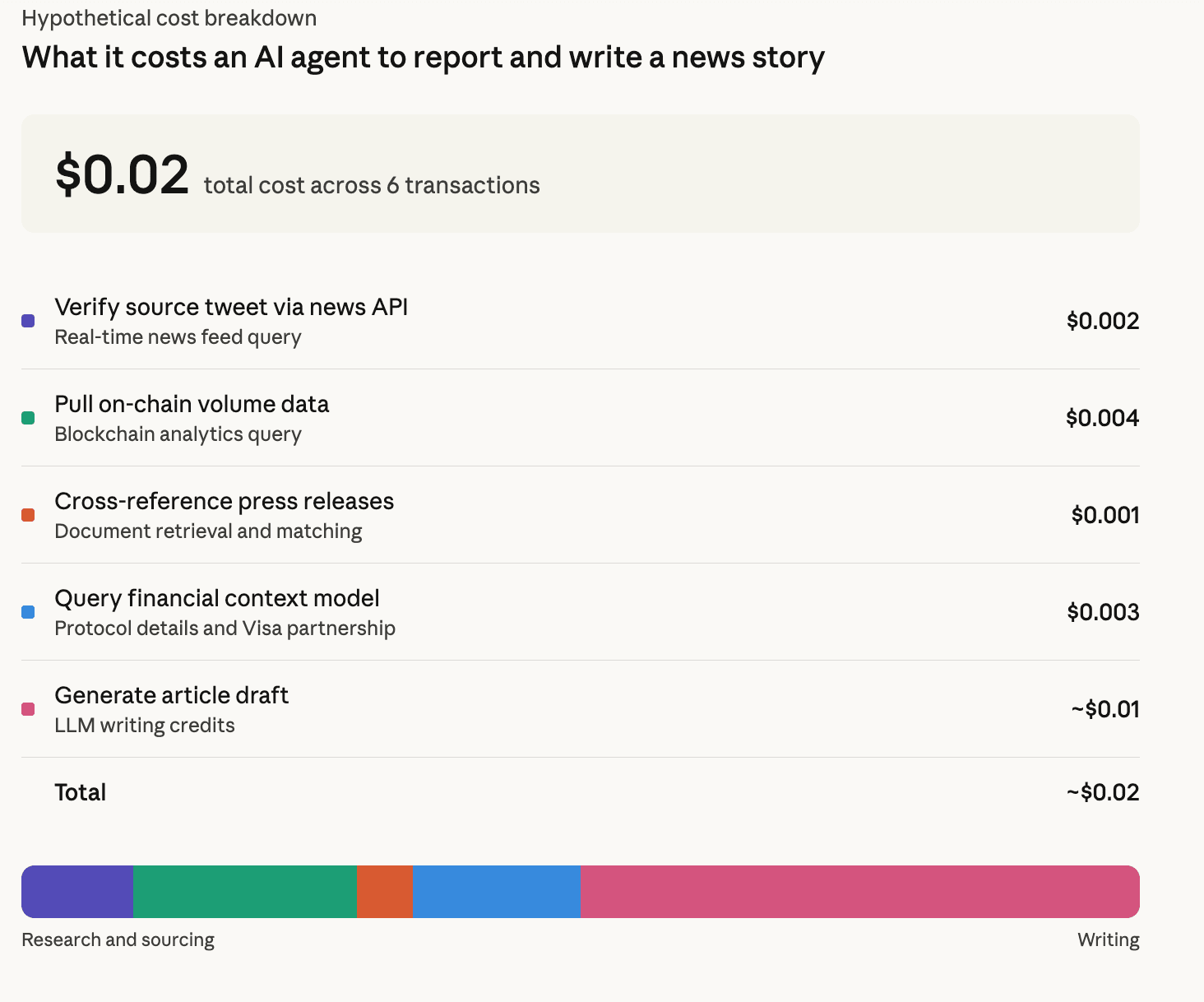
(CoinDesk)

In contrast, Stripe’s minimum processing fee on a single transaction is around $0.30. Running those six payments through a card network would cost more than 100 times the value of the payments themselves.

A human editor reviewing and publishing the piece might then be billed by a sub-agent that handled SEO optimization, another that ran plagiarism checks, and another that formatted for CMS software. Each micropayment is economically absurd on card rails, but trivial onchain.

This is the thesis behind x402, Coinbase’s open payment protocol that embeds stablecoin payments directly into HTTP requests — so an agent can hit a paywall, pay in USDC, and continue its task in the same interaction, no human required. Cloudflare, Circle, AWS, and Stripe are all backing it. Google’s open agent payments standard includes x402 as a settlement layer.

Every industry with high-frequency, low-value data exchange becomes a candidate.

In healthcare, an agent managing a patient’s insurance claim pays per document retrieved from a medical records API. In logistics, a procurement agent auctions freight slots across dozens of carriers in real time, settling the winning bid instantly. In the media, AI crawlers pay per article indexed rather than negotiating bulk licensing deals. In finance, a trading agent pays a specialist model fractions of a cent per risk signal consumed.

A caveat, however, is that the infrastructure is ahead of the demand.

CoinDesk reported this week that x402 currently processes around $28,000 in daily volume, with Artemis flagging roughly half of observed transactions as artificial activity rather than real commerce. The merchants x402 was built to serve are still rare.

Meanwhile, traditional finance is not standing still. Visa launched its Trusted Agent Protocol last October, and Mastercard completed Europe’s first live AI-agent bank payment inside Santander’s regulated infrastructure last week — both on existing card rails with cryptographic verification layered on top.

The most likely outcome is a split, where regulated commerce stays on card rails, while machine-to-machine payments — such as agents hiring agents, paying per API call, buying compute on demand — migrate to stablecoins because the economics demand it.

The open question is which bucket ends up bigger.

Read the full article here

Fact Checker

Verify the accuracy of this article using AI-powered analysis and real-time sources.

Get Your Fact Check Report

Enter your email to receive detailed fact-checking analysis

5 free reports remaining

Continue with Full Access

You've used your 5 free reports. Sign up for unlimited access!

Already have an account? Sign in here

Share. Facebook Twitter Pinterest LinkedIn Tumblr Email Telegram Copy Link
News Room
  • Website
  • Facebook
  • X (Twitter)
  • Instagram
  • LinkedIn

The FSNN News Room is the voice of our in-house journalists, editors, and researchers. We deliver timely, unbiased reporting at the crossroads of finance, cryptocurrency, and global politics, providing clear, fact-driven analysis free from agendas.

Related Articles

Cryptocurrency & Free Speech Finance

Bitpanda bets on banks, tokenization to expand globally ahead of IPO plans

47 minutes ago
Cryptocurrency & Free Speech Finance

Bitcoin Turns Up the Heat on Lost Support for Its Latest Weekly Close

48 minutes ago
Cryptocurrency & Free Speech Finance

How Florida’s Stablecoin Bill Mirrors ‘Big Brother’ Tools Outlawed Under Ron DeSantis’ CDBC Ban

58 minutes ago
Cryptocurrency & Free Speech Finance

Analysts weigh in on Bitwise CIO Matt Hougan’s $1 million bitcoin call

2 hours ago
Cryptocurrency & Free Speech Finance

How Bitcoin and Gold Reacted Differently to the Iran War Shock

2 hours ago
Cryptocurrency & Free Speech Finance

What Is AGI? The AI Goal Everyone Talks About But No One Can Clearly Define

3 hours ago
Add A Comment
Leave A Reply Cancel Reply

Editors Picks

Bitpanda bets on banks, tokenization to expand globally ahead of IPO plans

47 minutes ago

Bitcoin Turns Up the Heat on Lost Support for Its Latest Weekly Close

48 minutes ago

How Florida’s Stablecoin Bill Mirrors ‘Big Brother’ Tools Outlawed Under Ron DeSantis’ CDBC Ban

58 minutes ago

Analysts weigh in on Bitwise CIO Matt Hougan’s $1 million bitcoin call

2 hours ago
Latest Posts

How Bitcoin and Gold Reacted Differently to the Iran War Shock

2 hours ago

Why crypto bulls think AI agents will make stablecoins the default payment layer

3 hours ago

What Is AGI? The AI Goal Everyone Talks About But No One Can Clearly Define

3 hours ago

Subscribe to News

Get the latest news and updates directly to your inbox.

At FSNN – Free Speech News Network, we deliver unfiltered reporting and in-depth analysis on the stories that matter most. From breaking headlines to global perspectives, our mission is to keep you informed, empowered, and connected.

FSNN.net is owned and operated by GlobalBoost Media
, an independent media organization dedicated to advancing transparency, free expression, and factual journalism across the digital landscape.

Facebook X (Twitter) Discord Telegram
Latest News

The Foilies 2026

20 minutes ago

Bitpanda bets on banks, tokenization to expand globally ahead of IPO plans

47 minutes ago

Bitcoin Turns Up the Heat on Lost Support for Its Latest Weekly Close

48 minutes ago

Subscribe to Updates

Get the latest news and updates directly to your inbox.

© 2026 GlobalBoost Media. All Rights Reserved.
  • Privacy Policy
  • Terms of Service
  • Our Authors
  • Contact

Type above and press Enter to search. Press Esc to cancel.

🍪

Cookies

We and our selected partners wish to use cookies to collect information about you for functional purposes and statistical marketing. You may not give us your consent for certain purposes by selecting an option and you can withdraw your consent at any time via the cookie icon.

Cookie Preferences

Manage Cookies

Cookies are small text that can be used by websites to make the user experience more efficient. The law states that we may store cookies on your device if they are strictly necessary for the operation of this site. For all other types of cookies, we need your permission. This site uses various types of cookies. Some cookies are placed by third party services that appear on our pages.

Your permission applies to the following domains:

  • https://fsnn.net
Necessary
Necessary cookies help make a website usable by enabling basic functions like page navigation and access to secure areas of the website. The website cannot function properly without these cookies.
Statistic
Statistic cookies help website owners to understand how visitors interact with websites by collecting and reporting information anonymously.
Preferences
Preference cookies enable a website to remember information that changes the way the website behaves or looks, like your preferred language or the region that you are in.
Marketing
Marketing cookies are used to track visitors across websites. The intention is to display ads that are relevant and engaging for the individual user and thereby more valuable for publishers and third party advertisers.