

 Freedom Index
Listen to the article
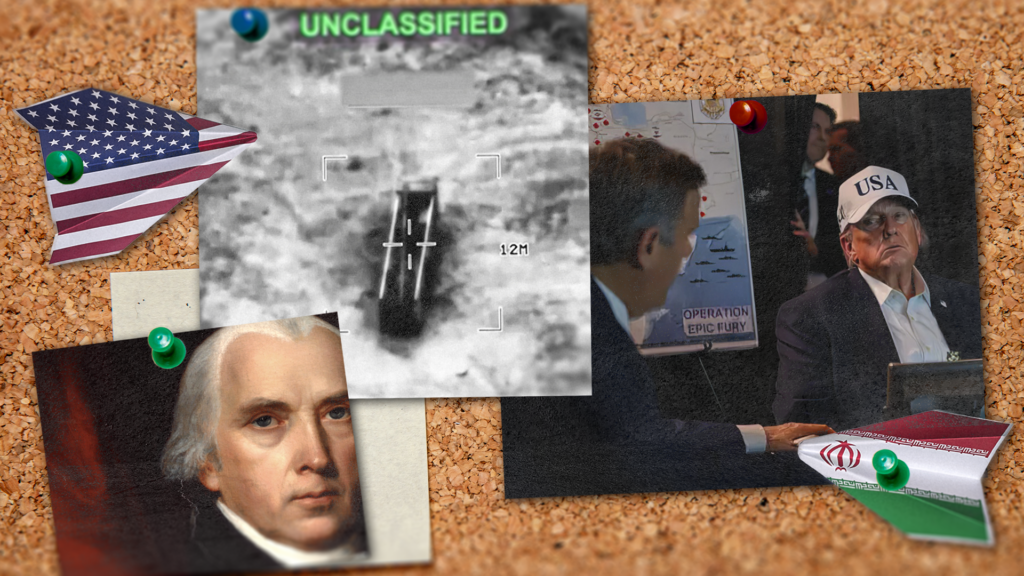
President Donald Trump has launched a massive military attack on Iran without first obtaining a declaration of war from Congress. Do Trump’s actions violate the terms of the U.S. Constitution?
In a word, yes. The president of the United States has no lawful authority to launch a war absent a congressional declaration of war.
You’re reading Injustice System from Damon Root and Reason. Get more of Damon’s commentary on constitutional law and American history.
To understand why this is so, consider the arguments of James Madison, who is sometimes called the “father of the Constitution” because of the important role that he played in the document’s drafting and framing at the 1787 Constitutional Convention in Philadelphia. “The constitution supposes,” Madison explained, “what the History of all [Governments] demonstrates, that the [Executive] is the branch of power most interested in war, & most prone to it. It has accordingly with studied care, vested the question of war in the [Legislature.]”
Madison was referring, of course, to Article I, Section 8, which vests the constitutional power “to declare War” exclusively with Congress. Madison and his fellow framers placed the war making authority in the collective hands of the legislature, rather than in the individual hands of the president, precisely because they understood the grave risks that would follow from assigning so much deadly power to the whims of a single person.
Madison’s sometime colleague, the Virginia law professor St. George Tucker, would expand on that explanation in his influential 1803 book, View of the Constitution of the United States. Today, Tucker’s View is remembered as the first extended analysis and commentary written about the new Constitution. To use a modern descriptor for it, Tucker’s View was, in effect, the original constitutional law textbook. Untold numbers of lawyers, judges, and scholars would reach for their copy of Tucker when facing a constitutional question during the early decades of the new republic. And it still remains a helpful guide today, especially if you hope to understand what the founding generation thought the founding document said and meant.
Just like Madison’s account, Tucker’s View supports the argument that Trump’s attack on Iran is unconstitutional. “In England the right of making war is in the King,” Tucker observed. “With us the representatives of the people have the right to decide this important question.” And “happy it is for the people of America that is so vested,” Tucker wrote. In a monarchy, “the personal claims of the sovereign are confounded with the interests of the nation over which he presides, and his private grievances or complaints are transferred to the people; who are thus made the victims of a quarrel in which they have no part, until they become principals in it, by their sufferings.”
To be sure, there are always going to be those cases in which the meaning or applicability of a particular constitutional provision is either unclear or open to more than one interpretation.
But this is not one of those cases. Whatever else might be said of Trump’s war with Iran, it was an unconstitutional war from the start because it was never declared by Congress as required by the text of the Constitution.
Read the full article here
Fact Checker
Verify the accuracy of this article using AI-powered analysis and real-time sources.