

 Freedom Index
Listen to the article
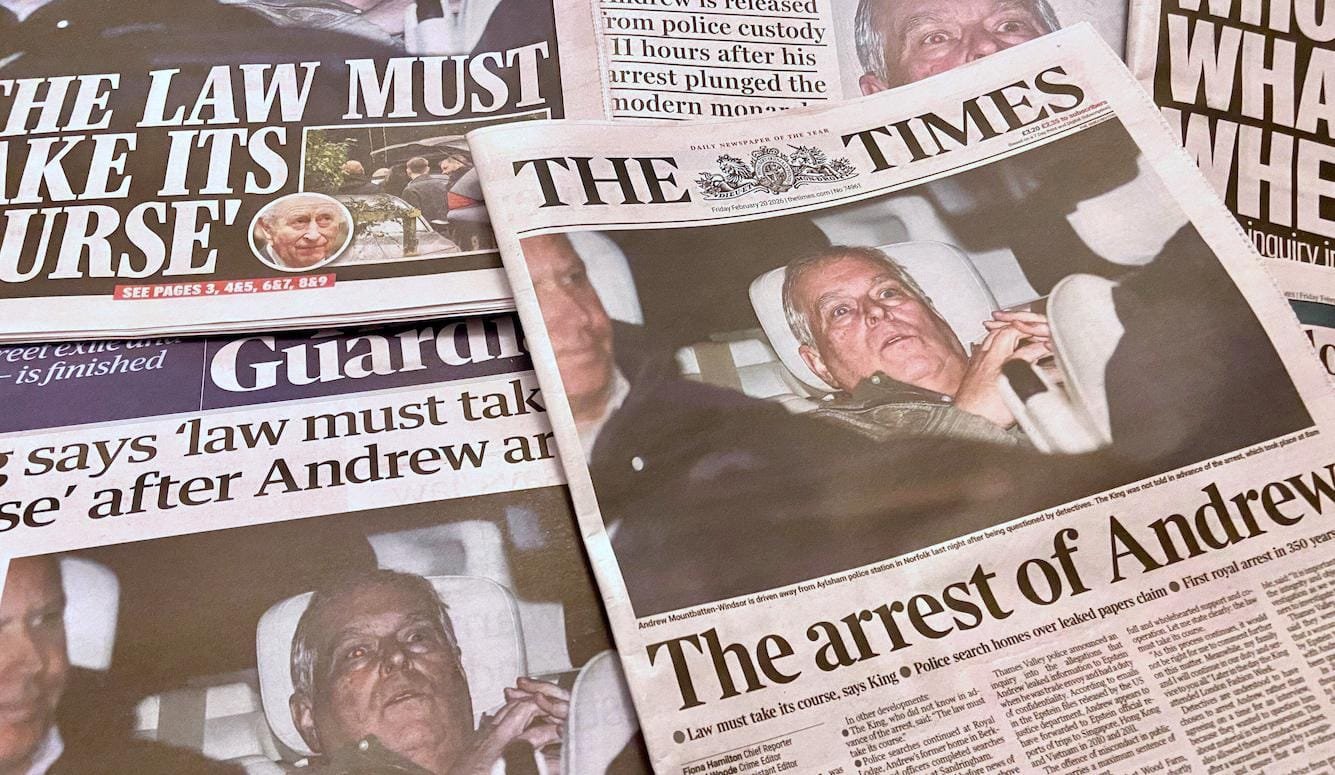
On 19 February 2026, Andrew Mountbatten-Windsor was arrested on suspicion of misconduct in public office, an accusation that arose from the recent Epstein files revelations. That it happened on his birthday lent the episode an almost operatic flourish. The news of the arrest sent shockwaves through Anglosphere media, but a single photograph taken by Phil Noble of Reuters encapsulated the indignity of this event in a way that words could not. The shot of Andrew being driven away from eleven hours of police interrogation betrayed no trace of royal status. Dressed in a casual khaki shirt and a beige cardigan, and slumped with his hands clasped against his collapsed chest, he stares vacantly into the middle distance, his nostrils and ashen face illuminated by the unforgiving glare of the flashbulb. Within hours, the image had been captioned, meme-ified, and swallowed up by the black hole of digital commentary.
For the art-history minded, this image summoned another epic arrest photograph: Richard Hamilton’s 1968–69 mixed-media canvas Swingeing London 67, now in the Tate’s collection. It was an ironic British Pop response to the commodification of celebrity already explored by Andy Warhol in his 1962–63 appropriations of Marilyn Monroe and Elvis Presley. Hamilton’s silkscreen was based on press photographs taken a few months after the 1967 drug raid of Keith Richards’s country house, Redlands, in which Mick Jagger and the art dealer Robert Fraser were handcuffed together in the back of a police van as they were driven from Lewes prison to Chichester court for sentencing.
In that image, the two men are raising their hands to shield their faces from photographers, inadvertently creating a butterfly-wing shape, as the flash bursts across the window, compressing the composition into a shallow, theatrical tableau. Hamilton colourised the black and white tabloid photos, outfitting Jagger with a bright turquoise blazer—an exaggeration of the sartorial detail that court reporters obsessively catalogued throughout the court case. But while the newspaper image was raw and immediate, Hamilton’s rendition is contemplative, neither mocking Jagger and Fraser nor absolving them. By translating newsprint into artwork, Hamilton introduces ambiguity where the tabloid had offered facile narrative closure.
The aesthetic subtlety extended to the title, which captured the cultural reversal at the heart of a moment when hedonism tipped into sanction. “Swingeing” means severe or punitive, but it also evoked the permissiveness of “Swinging London.” That term was so widespread that TIME magazine memorialised Swinging London on its April 1966 cover. Hamilton was instrumental in the emergence of British Pop as a member of the ICA’s Independent Group—a loose but highly influential circle of artists, architects, critics, and theorists. He was acutely aware of the power of images.
The Redlands raid was never merely about narcotics. It was prompted by the News of the World and staged by the government as a moral pageant. Jagger and Richards were cast as avatars of youthful decadence, louche rock stars who thought the rules did not apply. Fraser, the old Etonian, embodied aristocratic bohemia, and his eponymous Duke Street gallery stood at the centre of the capital’s reinvention as “Swinging London.” Its openings were notorious for dispensing recreational drugs as casually as other galleries dispensed pinot grigio. So when Jagger and Fraser were pictured handcuffed together, the image was a cautionary tale illustrating how cultural idols and aesthetic arbiters were subject to state authority just like anyone else.
Read the full article here
Fact Checker
Verify the accuracy of this article using AI-powered analysis and real-time sources.