Scientists created a biodegradable packaging film from milk protein, starch, and volcanic clay.
The material reduces water vapor permeability by nearly 1,000x compared to similar biopolymer films.
It fully degrades in soil in about 13 weeks—far faster than petroleum-based plastics.
The protein that keeps your yogurt thick and your cheese stretchy just got a new job: replacing plastic wrap.
Researchers from Colombia and Australia have published a study in Polymers detailing a biodegradable film made primarily from calcium caseinate—the same protein that makes up roughly 80% of cow’s milk—blended with starch, a dash of clay, and a synthetic binder to hold everything together. The result is a packaging film that degrades completely in soil in about 13 weeks, compared to conventional plastics that can take centuries.
Casein—the milk protein—naturally forms dense molecular networks when dissolved and dried, giving films a decent baseline structure. But on its own, pure casein film contracts and becomes brittle after drying, like a piece of dried glue. The researchers found that glycerol, a common food-grade plasticizer, acts like a lubricant inside the polymer, keeping it flexible.
Image: Polymers
They then blended in modified starch to bulk it up and PVA—a biodegradable polymer—to dramatically improve strength and compatibility between the other ingredients, and voilà.
But the key of the concoction is bentonite: a volcanic clay mineral ground down to nanoscale particles and suspended in the mixture. When the film dries, those tiny clay platelets arrange themselves in flat, overlapping layers inside the material—like a wall of stacked cards running through the film.
Water vapor trying to cross the packaging can’t go straight through anymore—it has to navigate a maze of these clay barriers, following a longer, winding path. That “tortuous diffusion” effect is why the film’s water vapor permeability dropped by nearly three orders of magnitude compared to conventional casein-starch films reported in the literature. That’s a thousand-fold reduction.
The final film stretches more than double its original length before tearing. Comparable casein-starch films without PVA or bentonite are a lot more rigid. Such improvement in strength comes from bentonite’s silicate layers acting as internal reinforcement, distributing stress more evenly across the material when it’s being pulled or bent. Think of it less like a standard plastic bag and more like a fiber-reinforced composite—just made from food ingredients instead of carbon fibers.
On the microbiology front, bacteria colonies on the film remained below the threshold set by ISO standards for non-sterile packaging applications. This means that these films don’t have explicit antimicrobial properties, but they don’t create a petri dish environment either. The researchers flagged this as a direction for future work, noting that incorporating silver nanoparticles or other active agents could push the film into genuinely antibacterial territory.
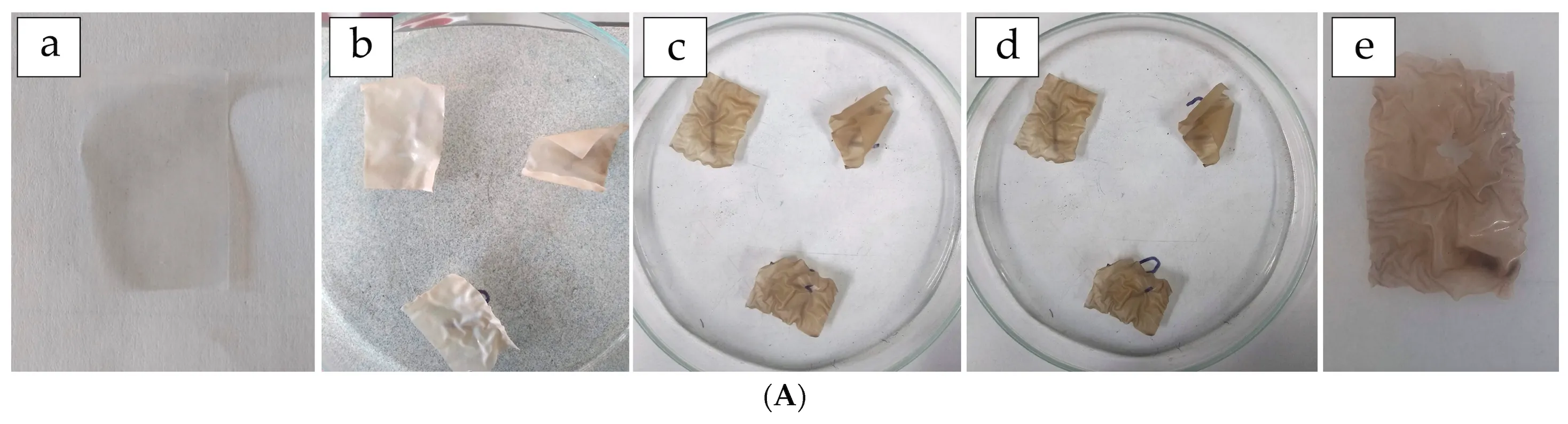
Biodegradation was tracked by burying rectangular film samples in soil for nine days and weighing them daily. The most aggressive breakdown happened in the first 72 hours—the casein and starch begin absorbing moisture quickly, swelling and fragmenting. After that, degradation continued at a steadier pace.
Extrapolating the curve puts full disintegration at around 13 weeks, which is longer than simpler casein-only films but significantly shorter than anything petroleum-based. That’s much shorter than the whole millenia it may take a plastic bag to go through the same process.
Image: Polymers
The researchers used a solution casting method to produce the films, essentially pouring the liquid mixture into molds and letting it dry in an oven at 38°C (about 100°F). It’s low-tech enough to scale without exotic equipment, which matters for adoption in developing countries where plastic waste management infrastructure is often limited.
There’s still work ahead. Thermal stability testing hasn’t been done, antimicrobial performance needs deeper validation, and the optical clarity drops slightly with bentonite added—though the researchers say the change is imperceptible to the naked eye.
These aren’t dealbreakers. They’re the kind of engineering problems that get solved as the formulation moves from lab to pilot production. The core proof of concept—that you can build a functional, genuinely biodegradable food packaging film out of milk protein and volcanic clay—is sitting right there in the data.
Daily Debrief Newsletter
Start every day with the top news stories right now, plus original features, a podcast, videos and more.
The FSNN News Room is the voice of our in-house journalists, editors, and researchers. We deliver timely, unbiased reporting at the crossroads of finance, cryptocurrency, and global politics, providing clear, fact-driven analysis free from agendas.
We and our selected partners wish to use cookies to collect information about you for functional purposes and statistical marketing. You may not give us your consent for certain purposes by selecting an option and you can withdraw your consent at any time via the cookie icon.
Cookies are small text that can be used by websites to make the user experience more efficient. The law states that we may store cookies on your device if they are strictly necessary for the operation of this site. For all other types of cookies, we need your permission. This site uses various types of cookies. Some cookies are placed by third party services that appear on our pages.
Your permission applies to the following domains:
https://fsnn.net
Necessary
Necessary cookies help make a website usable by enabling basic functions like page navigation and access to secure areas of the website. The website cannot function properly without these cookies.
Statistic
Statistic cookies help website owners to understand how visitors interact with websites by collecting and reporting information anonymously.
Preferences
Preference cookies enable a website to remember information that changes the way the website behaves or looks, like your preferred language or the region that you are in.
Marketing
Marketing cookies are used to track visitors across websites. The intention is to display ads that are relevant and engaging for the individual user and thereby more valuable for publishers and third party advertisers.


 Freedom Index