Close Menu
FSNN | Free Speech News NetworkFSNN | Free Speech News Network
  • Home
  • News
    • Politics
    • Legal & Courts
    • Tech & Big Tech
    • Campus & Education
    • Media & Culture
    • Global Free Speech
  • Opinions
    • Debates
  • Video/Live
  • Community
  • Freedom Index
  • About
    • Mission
    • Contact
    • Support
Trending

Today in Supreme Court History: March 2, 2016

4 minutes ago

Battered BTC price could find solace in ‘debasement’ trade: Crypto Daybook Americas

18 minutes ago

Crypto ETPs Post $1B Inflows as Bitcoin Leads Gains

23 minutes ago
Facebook X (Twitter) Instagram
Facebook X (Twitter) Discord Telegram
FSNN | Free Speech News NetworkFSNN | Free Speech News Network
Market Data Newsletter
Monday, March 2
  • Home
  • News
    • Politics
    • Legal & Courts
    • Tech & Big Tech
    • Campus & Education
    • Media & Culture
    • Global Free Speech
  • Opinions
    • Debates
  • Video/Live
  • Community
  • Freedom Index
  • About
    • Mission
    • Contact
    • Support
FSNN | Free Speech News NetworkFSNN | Free Speech News Network
Home»Opinions»Debates»Why Moral Culture Decides Great-Power Rivalry
Debates

Why Moral Culture Decides Great-Power Rivalry

News RoomBy News Room3 hours agoNo Comments4 Mins Read850 Views
Share Facebook Twitter Pinterest Copy Link LinkedIn Tumblr Email VKontakte Telegram
Why Moral Culture Decides Great-Power Rivalry
Share
Facebook Twitter Pinterest Email Copy Link

Listen to the article

0:00
0:00

Key Takeaways

Playback Speed

Select a Voice

As the post-World War II international order shows signs of strain, allied leaders have begun to reassess its durability. At the 2026 Munich Security Conference, German Chancellor Friedrich Merz warned that Europeans must be prepared to “sacrifice” to secure their freedom and that “a divide has opened up between Europe and the United States.” At the World Economic Forum in Davos, Canadian prime minister Mark Carney described the international world order as undergoing a “rupture, not a transition.” British prime minister Keir Starmer emphasised that Europe must increasingly be prepared to “stand on our own two feet” to secure a democratic way of life. These statements reflect a growing perception that the foundations of postwar cooperation are changing.

In the modern era, durable international orders have emerged not from harmony but from shared catastrophe. The 1648 Treaty of Westphalia ended the Thirty Years War, a religious conflict that devastated much of Europe and killed millions. By recognising the sovereignty of states to govern their own territories and religions, it laid the foundation of the modern state system, normalised diplomacy, and checked hegemonic ambition through an emerging balance of power order. After Napoleon’s defeat, the 1814–15 Congress of Vienna established norms of mutual restraint among great powers that contributed to a century of relative stability in Europe. Conflicts remained bounded; none produced the system-wide collapse that defined the Revolutionary and Napoleonic Wars. Similarly, after World War II, the United States and Soviet Union accepted limits against direct confrontation, even as they competed globally. These arrangements were sustained not only by deterrence but by a shared awareness of the catastrophic consequences of escalation.

Today, that shared memory has faded. The United States and China are engaged in structural rivalry spanning economic, technological, military, and geopolitical domains. Both countries remain embedded in global networks of finance, trade, and communication that neither fully controls and cannot easily abandon. This interdependence creates a paradox: states can neither achieve dominance nor autarky while relying on systems that require cooperation.

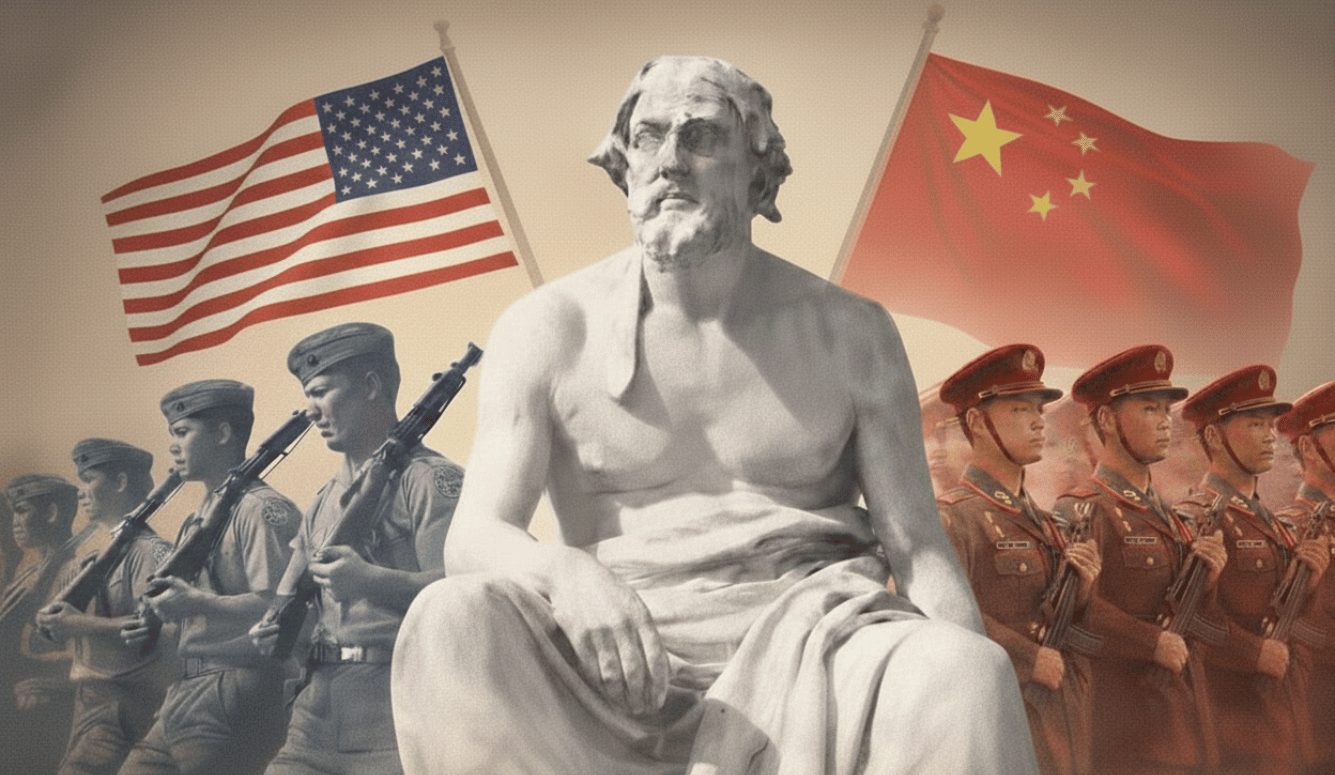
Realist theories explain this rivalry primarily in terms of the realpolitik of power, material interests, and strategic incentives. Offensive realism holds that in an anarchic system without a central authority, uncertainty about others’ intentions drives states to maximise power to secure themselves. This leaves little room for empathy, charity, or fairness, or what Abraham Lincoln called “the better angels of our nature.” Reflecting this view, senior US policy official Stephen Miller stressed in a recent interview that “You can talk all you want about international niceties and everything else, but we live in a world—in the real world—that is governed by strength, that is governed by force, that is governed by power. These are the iron laws of the world since the beginning of time.” In an interdependent world, however, efforts to dominate or exclude intensify rivalry and the likelihood of conflict.

At Davos, Carney framed the emerging environment in similar terms, invoking Thucydides’ observation that “the strong do what they can and the weak suffer what they must.” His remarks highlight concern among America’s allies that dependence on US power for security and goods leaves them vulnerable to coercion and subordination, underscoring the structural reality that power disparities shape political outcomes. Carney and other allied leaders, including French President Emmanuel Macron, propose a coalition of lesser democratic powers to counterbalance great-power rivalry, reflecting the logic of “defensive realism”: the view that states seek security primarily by balancing rather than maximising power, and that interdependence can serve as a stabilising foundation of order.

Yet psychological and anthropological research indicates that material interests alone do not determine political action or allegiance. Communities do not only respond to external pressures, but also to how those pressures are experienced. Authority perceived as legitimate is more likely to be accepted; authority perceived as coercive or degrading is more likely to provoke resistance. This response reflects “moral culture”: the shared framework of values, narratives, and expectations that defines legitimate authority and acceptable conduct. Moral culture shapes whether influence is experienced as leadership or domination, cooperation or coercion.

This psychological and cultural dimension is largely absent from offensive realism, which assumes actors pursue security and advantage through material interests and incentives, including coercion when necessary. Yet coercion can erode the moral culture that sustains cooperation. When external pressure threatens identity or dignity, actors may resist rather than submit, even when submission appears materially advantageous. Moral culture is likewise underdeveloped in defensive realist prescriptions emphasising balancing coalitions of lesser powers. The durability of these coalitions depends on more than converging material interests. Coalitions formed solely in response to threats remain psychologically fragile and ineffective unless they cultivate shared moral frameworks rooted in values that sustain willingness to bear the costs of resistance.


Read the full article here

Fact Checker

Verify the accuracy of this article using AI-powered analysis and real-time sources.

Get Your Fact Check Report

Enter your email to receive detailed fact-checking analysis

5 free reports remaining

Continue with Full Access

You've used your 5 free reports. Sign up for unlimited access!

Already have an account? Sign in here

Share. Facebook Twitter Pinterest LinkedIn Tumblr Email Telegram Copy Link
News Room
  • Website
  • Facebook
  • X (Twitter)
  • Instagram
  • LinkedIn

The FSNN News Room is the voice of our in-house journalists, editors, and researchers. We deliver timely, unbiased reporting at the crossroads of finance, cryptocurrency, and global politics, providing clear, fact-driven analysis free from agendas.

Related Articles

Media & Culture

Today in Supreme Court History: March 2, 2016

4 minutes ago
Media & Culture

The Secret Phone Recordings of Henry Kissinger, a ‘Habitual Liar’

1 hour ago
Media & Culture

Brickbat: Going Dutch

3 hours ago
Cryptocurrency & Free Speech Finance

Finance Minister Pledges Reform After Crypto Handling Failure in Korea

5 hours ago
Cryptocurrency & Free Speech Finance

Anthropic’s AI Used in Iran Strikes After Trump Moved to Cut Ties: WSJ

7 hours ago
Cryptocurrency & Free Speech Finance

Hyperliquid’s Token Rises as Weekend Iran Shock Finds Few Open Markets

9 hours ago
Add A Comment
Leave A Reply Cancel Reply

Editors Picks

Battered BTC price could find solace in ‘debasement’ trade: Crypto Daybook Americas

18 minutes ago

Crypto ETPs Post $1B Inflows as Bitcoin Leads Gains

23 minutes ago

The Secret Phone Recordings of Henry Kissinger, a ‘Habitual Liar’

1 hour ago

Bitcoin holds up after Iran strike, outpacing equities in risk-off session: Crypto Markets Today

1 hour ago
Latest Posts

Aave Proposal Clears First Hurdle After Split Vote

1 hour ago

Hong Kong links up with Shanghai trade authorities to put cargo data on blockchain

2 hours ago

Bitcoin Traders Warn of New Lows as BTC Weathers Iran Storm

2 hours ago

Subscribe to News

Get the latest news and updates directly to your inbox.

At FSNN – Free Speech News Network, we deliver unfiltered reporting and in-depth analysis on the stories that matter most. From breaking headlines to global perspectives, our mission is to keep you informed, empowered, and connected.

FSNN.net is owned and operated by GlobalBoost Media
, an independent media organization dedicated to advancing transparency, free expression, and factual journalism across the digital landscape.

Facebook X (Twitter) Discord Telegram
Latest News

Today in Supreme Court History: March 2, 2016

4 minutes ago

Battered BTC price could find solace in ‘debasement’ trade: Crypto Daybook Americas

18 minutes ago

Crypto ETPs Post $1B Inflows as Bitcoin Leads Gains

23 minutes ago

Subscribe to Updates

Get the latest news and updates directly to your inbox.

© 2026 GlobalBoost Media. All Rights Reserved.
  • Privacy Policy
  • Terms of Service
  • Our Authors
  • Contact

Type above and press Enter to search. Press Esc to cancel.

🍪

Cookies

We and our selected partners wish to use cookies to collect information about you for functional purposes and statistical marketing. You may not give us your consent for certain purposes by selecting an option and you can withdraw your consent at any time via the cookie icon.

Cookie Preferences

Manage Cookies

Cookies are small text that can be used by websites to make the user experience more efficient. The law states that we may store cookies on your device if they are strictly necessary for the operation of this site. For all other types of cookies, we need your permission. This site uses various types of cookies. Some cookies are placed by third party services that appear on our pages.

Your permission applies to the following domains:

  • https://fsnn.net
Necessary
Necessary cookies help make a website usable by enabling basic functions like page navigation and access to secure areas of the website. The website cannot function properly without these cookies.
Statistic
Statistic cookies help website owners to understand how visitors interact with websites by collecting and reporting information anonymously.
Preferences
Preference cookies enable a website to remember information that changes the way the website behaves or looks, like your preferred language or the region that you are in.
Marketing
Marketing cookies are used to track visitors across websites. The intention is to display ads that are relevant and engaging for the individual user and thereby more valuable for publishers and third party advertisers.