

 Freedom Index
Listen to the article
Can you insider-trade on an investigation into your own insider trading? Polymarket just turned that question from philosophical to practical.
Blockchain sleuth ZachXBT published findings Thursday morning naming Axiom, a crypto trading platform, as the company whose employees he believed had used non-public information to place profitable trades.
The investigation had been teased for days, and Polymarket had created a contract allowing users to bet on which company would be named, pulling in roughly $40 million in volume since Monday.
The problem is that someone clearly knew the answer before it dropped.
Lookonchain identified 12 wallets that bet heavily on Axiom before the reveal, netting a combined profit of over $1 million.
A separate analysis by Polysights, a data terminal that tracks suspicious activity on Polymarket’s public ledger, flagged five wallets that collectively wagered around $50,000 and walked away with $266,000.
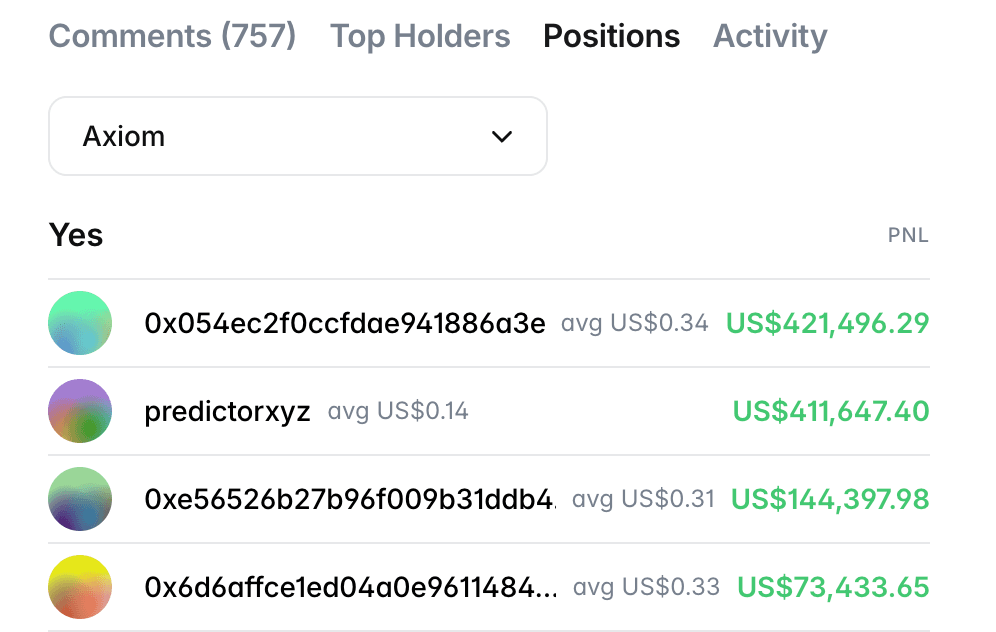
More on-chain data analyzed by CoinDesk tells the full story. The largest Yes holder on the Axiom market, an account called predictorxyz, accumulated 477,415 shares at an average price of $0.14 and is now sitting on $411,000 in profit.
That’s roughly a 7x return on a bet placed before the answer was public. The second-largest holder, an anonymous wallet, bought 109,450 shares at $0.33. The concentration is notable. This wasn’t a broad market full of informed guesses. A handful of wallets dominated the Axiom side of the book.
For most of the week, another platform called Meteora had been the market’s frontrunner at over 50% odds, as CoinDesk reported.
The odds swung to Axiom on late Wednesday, which peaked at 46.2%. Anyone buying Axiom shares in the window between that denial and ZachXBT’s Thursday morning publication was either reading the room extremely well or already knew what was coming.
ZachXBT acknowledged on social media that he had contacted Axiom for comment and conducted several interviews before publishing, making a leak “probably inevitable.”
That means multiple people at the company knew the report was coming before it went live. Any of them could have placed bets directly or tipped someone who did.
Polymarket’s offshore platform doesn’t conduct identity checks, making attribution difficult without cooperation from the exchange itself.
Axiom said it was “shocked and disappointed” by the findings and would continue to investigate. It didn’t respond to questions about whether it was aware of any employees trading on the Polymarket wager.
The structural irony here is that the mechanism worked exactly as designed. It just happened to reward the people who were the subject of the investigation rather than the ones conducting it.
Read the full article here
Fact Checker
Verify the accuracy of this article using AI-powered analysis and real-time sources.