

 Freedom Index
Listen to the article
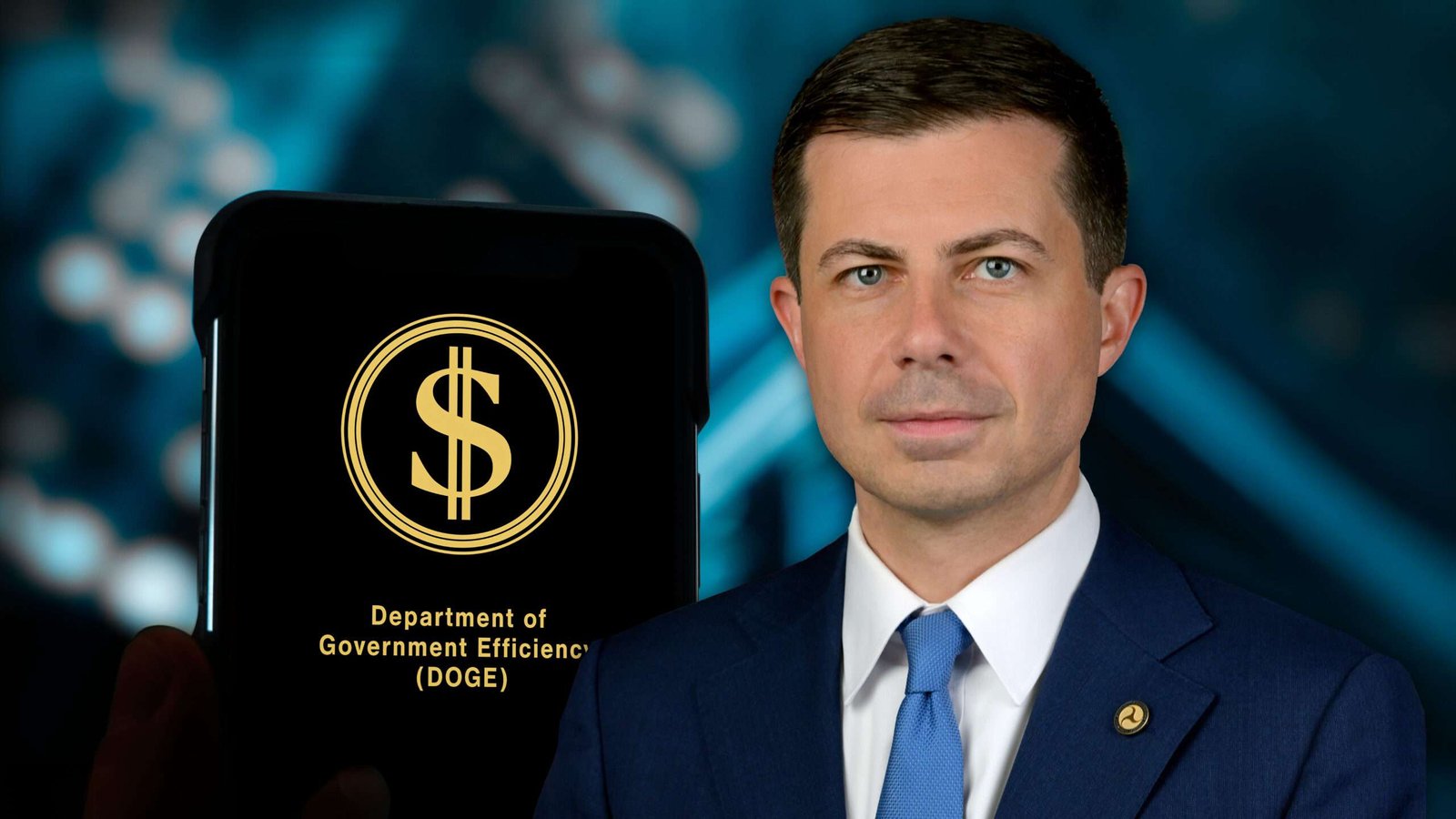
“There’s a real tragedy in what DOGE did,” former Biden administration Secretary of Transportation Pete Buttigieg tells me in a new Reason Interview podcast. “They missed a chance to make real change that could have made government run more efficiently.”
Such a sentiment may seem surprising coming not just from a progressive Democrat but from a former Cabinet member who championed a famously profligate infrastructure bill and who, per Axios, only managed to bring 25 electric vehicle charging stations online despite billions of dollars in funding from the bill. But Buttigieg is absolutely right about the Department of Government Efficiency (DOGE), which was a good idea even if it fell laughably short of its stated goal of cutting $2 trillion in spending (at best, its savings number in the single-digit billions).
Worse, DOGE and its principal public champion Elon Musk made people skeptical about shrinking government, as many of the targets seemed motivated more by a right-wing agenda than anything approaching actuarial seriousness, as its own “wall of receipts” was “riddled with errors and accounting gimmicks,” as Reason‘s Christian Britschgi put it in an eulogy for the shuttered initiative. Among the most memorable and characteristic screwups: tallying up an $8 million contract with Immigration and Customs Enforcement as costing $8 billion.
Why does it matter what Buttigieg thinks of DOGE—or of government more broadly? The former mayor of South Bend, Indiana, is a leading Democrat and is sizing up a run for that party’s presidential nomination. While he tells me he hasn’t made his mind up, he’s been traveling all over the country, including in well-worn campaign stops such as New Hampshire, where he recently topped all Democratic contenders in a recent poll. He’s just 44 years old and he is likely to be a major factor in Democratic Party politics for decades to come.
In 2020, he came from nowhere to win in the Iowa caucuses, partly based on his refreshing willingness to buck conventional Democratic wisdom on topics such as identity politics (he’s a critic) and “free” college. “I have a hard time getting my head around the idea of a majority who earn less because they didn’t go to college subsidizing a minority who earn more because they did,” he said back then.
At his best, he acknowledges that many of the institutions that President Donald Trump and the MAGA movement are busy torching are worth burning down. “As much as I believe it was criminally wrong to destroy USAID [the U.S. Agency for International Development],” he tells me, “anybody who worked in international development the last 10 or 20 years, none of them would’ve said, if you give them a clean sheet and a total fresh start, that they would’ve designed things the way that they looked in 2024 or in 2014.” More recently, he’s attacked Trump’s love affair with tariffs as not just bad policy but illegal. “The President owes you an apology—and a refund,” he posted on X after last week’s Supreme Court decision.
Given such positions, I was disappointed to hear that his default setting seems to be a federal government that gets bigger and bigger and does more and more. As a veteran who served time in Afghanistan, he’s keenly aware of Pentagon waste, and recalls “a building that was built at enormous expense, never used, and then torn down.” But when I mention that federal spending has skyrocketed in recent years—from $4.9 trillion in 2019 to $7.5 trillion in 2021 to $7 trillion in 2025—his reflex is to steer the conversation to taxes. “If we’re going to talk about spending, which we should, we also have to talk about revenue,” he explains. “I think there is a happy medium, a reasonable place where giant corporations aren’t paying zero, where very wealthy people aren’t paying less proportionately than schoolteachers and firefighters, [a policy] that is not so heavy in tax that it stifles innovation and growth, but is enough that we’re not looming this big debt.”
But given current and projected spending levels, spending cuts have got to be on the table, in a big way and from Day 1 of any new administration, whether it’s Democratic or Republican (both have contributed massively to the national debt). According to the Congressional Budget Office’s latest estimate, the federal government will spend $94.6 trillion over the next decade while taking in just $70.2 trillion in revenue under the best of circumstances. “Outlays reached 23.1 percent of GDP in 2025,” writes economist Veronique de Rugy, “nearly two full percentage points above the 50-year average, meaning annual spending growth is outpacing the economy itself.” There’s no way to close such a gap with higher taxes, or to reduce spending through marginal tinkering to cut down bureaucratic waste.
Yet Buttigieg’s philosophy of government is very much one of a massive role for the federal government. Trump’s tariffs are self-evidently bad because they raise prices, but when I ask him about tariffs or rules against, say, Chinese electric vehicles, this son of the post-industrial Midwest channels his inner protectionist and echoes the 1970s script against foreign cars. “It’s one thing if we’re talking about certain kinds of low-stakes consumer products,” he says. “We know [what] China is doing, which is not exactly a free market approach. They’re using enormous amounts of excess capacity so they can prop up an industry so that they can take it over from us because they know the economic stakes of dominating the future of the auto industry.” Well, maybe, but what about the consumer here, especially when it comes to big-ticket items? As economist Adam Ozimek wrote last summer for the Economic Innovation Group, when Trump slapped 25 percent tariffs on auto imports, “the protectionist argument for insulating the American auto industry from foreign competition…draws the wrong lessons from history.”
More profoundly—and especially absent any plans to address old-age entitlements or other major drivers of federal spending—Buttigieg seems to have no limiting principle when it comes to what might involve the government. Hence, his continuing support not just of California’s moribund, overbudget high-speed rail project between San Francisco and Los Angeles, but his insistence that the government was right to help pay for a proposed high-speed project that would connect L.A. to Las Vegas. “To me,” he says, “it makes most sense for the public to be involved when there is some kind of benefit that just isn’t going to be captured by the private investors.”
Given Trump and the Republican House and Senate majorities’ objectively unpopular tenure over the past year, it seems a foregone conclusion that the Democrats will do very well in November’s midterm elections. But it’s also true that a record-high percentage of Americans—62 percent, per Gallup—agree that the federal government has too much power.
What plays in the midterms won’t play in 2028, especially when presidential candidates will be vying to head up that same vilified federal government. “I think we allowed ourselves to be portrayed as the party of the status quo,” Buttigieg told me, explaining why Trump beat Vice President Kamala Harris in 2024. In many ways—his age, his sexual orientation, his willingness to talk across ideological divides—Buttigieg represents the possibility of something new and different in American politics. It will be interesting to watch if he changes his perspective about the size, scope, and spending of government as his political future draws closer.
Read the full article here
Fact Checker
Verify the accuracy of this article using AI-powered analysis and real-time sources.