

 Freedom Index
Listen to the article
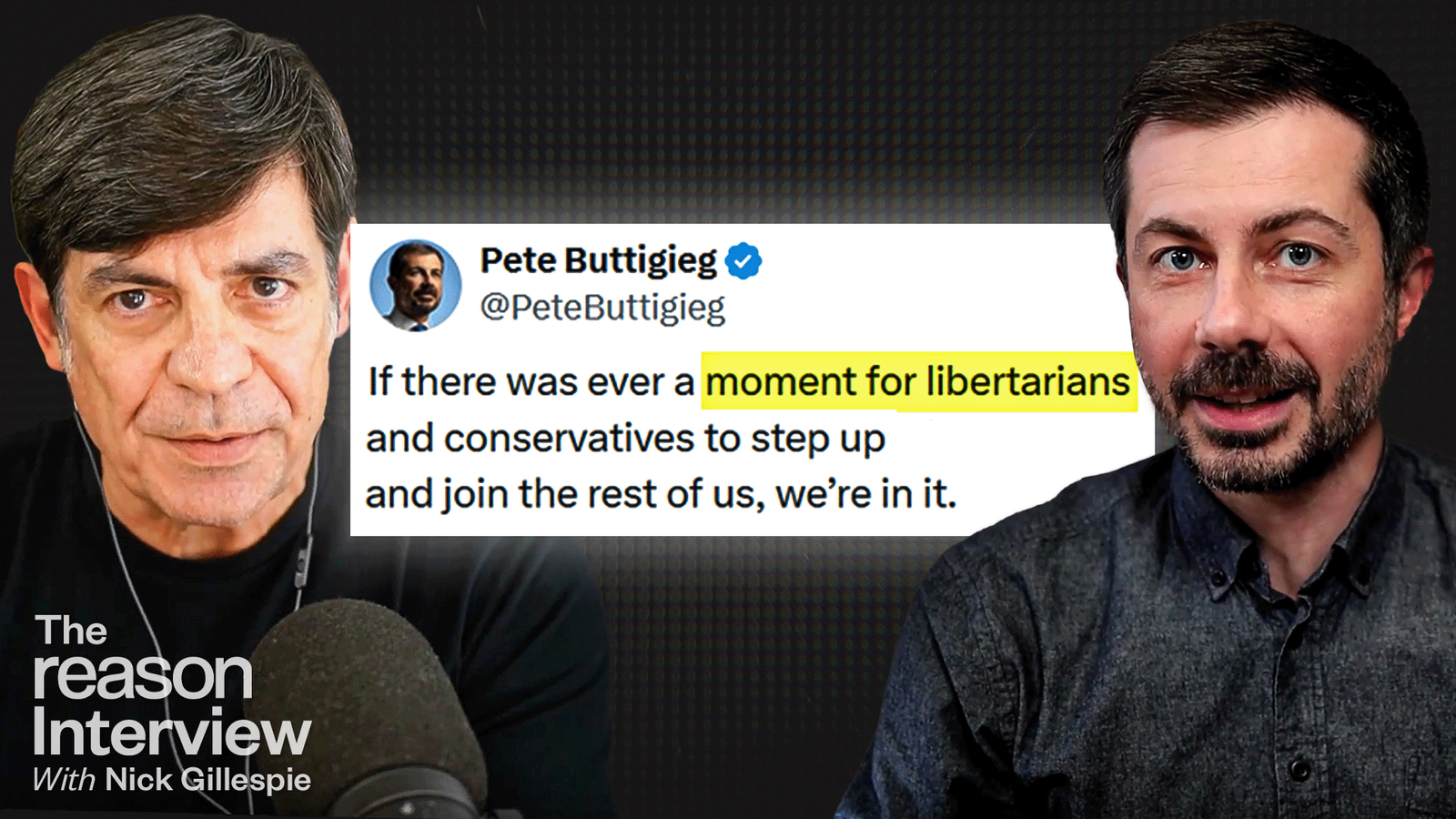
Today’s guest on The Reason Interview with Nick Gillespie is Pete Buttigieg, former secretary of transportation and already a leading, if undeclared, contender for the Democratic presidential nomination in 2028.
Buttigieg reflects on his time in government, his evolving views on federal power, and why he thinks DOGE was a good idea that was poorly executed. An outspoken critic of Immigration and Customs Enforcement (ICE) under Donald Trump, Buttigieg says that the use of masked agents and martial tactics against nonviolent immigrants contributes to a loss of trust and confidence among the public. That trust can be restored, he argues, through transparency and restraint.
“If you’re here and you shouldn’t be and you’re dangerous, you’ve got to go,” he says, “but it does not to follow from that that it’s okay to see all of this abusive behavior coming from federal immigration troops…in our cities.”
Gillespie and Buttigieg debate the role of government, federal spending, subsidizing high-speed rail, and the rate of social progress, and they explore possible areas of overlap between Democrats and libertarians.
0:00–ICE accountability and immigration policy
8:40–What can Democrats offer libertarian voters?
11:05–The national debt and federal spending
15:50–Automation and government efficiency
21:23–The private sector versus public benefit
26:31–Tariffs and free trade
34:20–Democratic Party failures in 2024
41:35–Identity politics
43:40–Responding to Kamala Harris’ comments
46:25–Perceptions of Millennial and Gen Z voters
49:00–Republican messaging around trans people
52:23–National service and shared identity
This is an AI-generated, AI-edited transcript. Check all quotes against the audio for accuracy.
Nick Gillespie: This is The Reason Interview with Nick Gillespie. Thanks for listening. Today I’m talking with former South Bend, Indiana, mayor and secretary of transportation, Pete Buttigieg, one of the most visible, nationally recognized Democrats.
He’s been making the rounds of colleges and podcasts and cable news shows over the past few months. He’s going all over the country. My producer tells me that he’s headed to New Hampshire soon, according to his mailing list. Which might be an indication that he’s running for president or thinking about it.
I’m talking with him today less because he’s one of the most prominent Democrats in the country, and more because he’s been reaching out to libertarians on issues recently such as holding ICE accountable. Pete Buttigieg, thanks for talking to Reason.
Pete Buttigieg: Thanks a lot for having me on. Glad to be with you.
So first up, are you running for president?
I’m a long way from any kind of decision like that. But I do know that as somebody who has a level of national visibility and really cares about the issues going on in the country, that I should be speaking out, traveling, trying to reach different kinds of audiences, and that’s what I’m doing.
And listening, right? You should be listening.
Yes, absolutely.
As much listening. Well, let’s talk a little bit about ICE because I think you recently, about a couple of weeks ago, you had a tweet. This was after Rénee Good and Alex Pretti were shot and killed by ICE agents.
You tweeted, “If there was ever a moment for libertarians and conservatives to step up and join the rest of us, we’re in it. Americans have to unite and stop this descent from a freedom-loving nation into the kind of place where masked, militarized government agents are sent to politically noncompliant areas to roam the streets, terrorize civilians, and deploy violence with impunity.”
To which I say, absolutely I would, for the record, Reason, which has been around since 1968, we don’t have house editorials, but all of our writers opposed the PATRIOT Act and then the Homeland Security Act of 2002, which created DHS and ICE. What should we be doing in terms of removing illegal aliens who are in the country? Just as a kind of starting point?
Well, look, I think there is a kind of common sense consensus among most Americans, left, right, and center, that if somebody is a danger to society, if somebody has a criminal record, then they need to be dealt with. They need to be deported and/or dealt with in our criminal justice system. And I don’t think there’s a ton of disagreement with that. And I think a lot of people who voted for this administration did so believing that they would prioritize the most dangerous, the people with the worst criminal records. After all, they said that they would.
The challenge, of course, is we’ve seen something that’s gone so far beyond that, where you have people who have been in this country, everything legal other than they don’t have permission to be here. Everything else, paying taxes, often having work permits, doing what they’re supposed to do, as well as people who are a hundred percent legal. People with some kind of asylum or refugee status. And even United States citizens, all being caught up in being on the abusive end, the business end, of this administration’s immigration policy. So I think we can start with a reasonably consensus place that says that, “Look, if you’re here and you shouldn’t be and you’re dangerous, you got to go.” And not have it follow from that, that it’s okay to see all of this abusive behavior coming from federal immigration troops, basically, agents in our cities.
How much is it? It’s stuff like the masking and the rush to hire thousands of new ICE agents. Clearly, the training couldn’t have been as good as it was going to be beforehand. You’ve talked a lot about this. I certainly do in my writings, about a loss of trust and confidence in government institutions. People don’t trust ICE; they don’t trust the police. They certainly don’t trust the government or the media or the church the way that they used to. How do you go about changing ICE quickly so that people are more comfortable actually helping it do its legitimate functions?
Yeah, this breakdown of trust has obviously been going on for a long time. I think it’s a huge problem. I wrote a whole book about it about 5 or 6 years ago now. And it’s only become more serious since then. And I thought a lot about how trust, in particular between law enforcement and citizens, is earned, because of my time as mayor. Where I oversaw a police force, we had a lot of challenges with that police force and its relationship to the community. And part of where trust was earned was that people knew each other, the members of the community and the members of the police department. The policing worked best when people trusted those in uniform, they’ll keep them safe, turned to them when they needed help, when they had information that could help solve a crime.
Was South Bend a sanctuary city by any chance?
We didn’t have that kind of formal policy. We did believe that there was a distinction between what our police were supposed to be doing and what federal immigration were supposed to do. And that was important because I was very worried that if local residents thought that our police were out there conducting immigration raids, they were going to be less likely to talk to us when we needed their help to solve a crime, including a violent one.
One of the arguments for a variety of sanctuary city policies is that it actually helps with local law enforcement substantially.
But another thing is, I think it’s inconceivable in at least any police department I’ve ever seen, that you would have your police officers at a community-level be unwilling to show their face. So that’s a good starting point to think about. Shouldn’t that community model have at least some relevance to what we expect from our federal law enforcement?
Another way to put it is, if we’re going to give you the power to use deadly force on American soil, potentially against citizen or non-citizen alike, there’s some really basic things we’re going to need from you in terms of, first of all, I think showing your face and identifying yourself and having a body camera, so there’s a record of what you’re doing. But also of course, more deeply, a level of accountability and a level of responsibility and a level of training, of course.
How do you respond to people? Conservative critics will say, “Well, ICE is uniquely doxxed all the time. That people are following them home, that they’re at a particular level of risk that no other type of law enforcement is.” You hear this quite often.
I think we should approach this in a fact-based way. So what I’ve seen in terms of people losing their lives and being physically harmed, is that happening much more frequently to people who are being abused by ICE than to members of ICE.
But let me be clear, it is completely wrong to harm or dox anybody, including anybody doing their job as a federal employee or law enforcement. But we have ways of dealing with that, right? Part of what the FBI does is if there is a threat or a physical attack directed against anyone federal, from federal law enforcement to a member of the US Cabinet, the FBI should be dealing with that.
But ICE has now been given more money than the FBI itself. And the question comes with, if you pump that much money and that much authority into a law enforcement agency that’s supposed to have a very specific, relatively narrow mission, what are they going to do with it? So I think it’s a real problem when this administration tries to make it sound like ICE is the victim, including trying to make it sound like they were the victim in cases where they killed somebody. And I think it shows you how removed from reality they are. But I also, I want to confess, as somebody who had many late-night arguments with conservative and libertarian friends over beers as a college student where they would invoke the idea of federal agents running amok through our streets. I never believed…
Jackbooted thugs. Jackbooted thugs.
Yeah. So I feel like in a way, I was right on one hand and they were right on one hand. I think they were right that that’s more real than I ever could have imagined. I still think I had a point in what might lead us there. Which turned out to be the kind of administration we have. But that’s precisely why I think people in my party ought to be reaching out to conservatives and especially to libertarians saying, “We’re not going to agree on everything, but there’s got to be some common cause here.”
Let’s talk about those common causes a little bit. More broadly, Reason’s motto is “Free Minds and Free Markets.” We like civil liberties and economic liberties. Being able to run a business the way you want, watch the kind of culture that you want to watch, things like that. What’s the Buttigieg agenda that will speak to libertarians who tend to be kind of politically—certainly in a partisan way—homeless. Often vote Republican, not my personal experience, but many of that. What do you have to offer libertarian voters who would definitely be enough to sway any kind of election that we’re going to be seeing over the next couple of years?
I think the core of what I have to say is that I am driven by a commitment to freedom, and I think as anyone libertarian views themselves as having that same core commitment. To me, there are three things, three categories of things, that the government has to do in order for us to be free. One, it has to provide basic services, because you’re actually not free if you can’t get clean, safe drinking water out of the tap or if you don’t have national defense. Two, it has to constrain anybody who could make you unfree. This is traditionally the thing progressives are more interested in. Right? I would say that means if your boss can make you unfree, if your neighbor can make you unfree, if your cable company can make you unfree, there can be a role for government.
But then the third part is, in order for you to be free, the third thing a government has to do is constrain itself. And this is the area that I think, honestly, it was conservatives and libertarians who paid more attention to, or talked about it more, for most of my lifetime in most of the kind of commentary spaces that are out there. But the now is a moment that I think all of us are alive to. So I guess what I have to offer is a politics where of course we’re going to have a push-pull tug-of-war on exactly what it means to make good on those three things.
Right.
But the result should be that if we get government right, make it maybe more powerful in certain ways where I think it should have more power to deal with monopolies, for example, or with inequality, but also make government less powerful when it comes to surveillance and intimidation and some of the other things we’re seeing on the streets of American cities right now that we would in fact enjoy more freedom as Americans.
Yeah. Let’s talk about some of the big-picture issues, which have to do with things like the national debt. Taxes get lowered incrementally, etc. But generally speaking, we are usually pulling in somewhere between about 15 and 19 percent of GDP as tax revenue. Spending has really skyrocketed from being close to that to now being in the 20, 25 percent range of GDP. I was watching a clip of you on a podcast recently, and you were talking about how like if there had been a legitimate Department of Government Efficiency, that would’ve been a good thing. How do we restrain spending where we’re spending $6–7 trillion where 5, 6 years ago we were still spending under $5 trillion?
Yeah, I mean, this is where I think there’s a real tragedy in what DOGE did, not just because they were very, in my view, very destructive, but because they missed a chance to make real change that could have made government run more efficiently. And here too, even though my federal government experience was running a very large agency with a very large budget, my original instincts were fashioned when I was mayor of a city with a comparatively small budget, about $300 million. We did our budget in cash. I couldn’t go print money. And if we wanted to do something more, we either had to do less of something else or to figure out a way to do it for less money.
And there are certainly opportunities. I saw them myself.
I saw, to take a very small example, our database for customer complaints about airlines running on 1980s technology that meant that the time, and therefore money, associated with running it for department staff was just overwhelmingly more than it had to be.
You go from there all the way up to things that we know happen, certainly in the DOD. My time in Afghanistan, I saw a building that was built at enormous expense, never used and then tore down over the years. We know there are many examples like that. Now, I also think if we’re going to talk about spending, which we should, we also have to talk about revenue. I think there is a happy medium, a reasonable place where giant corporations aren’t paying zero. Where very wealthy people aren’t paying less proportionately than school teachers and firefighters. That is not so heavy in tax that it stifles innovation and growth, but is enough that we’re not looming this big debt.
But what can be done to, as I was saying, tax revenue, and this is something… If you go back to the 1950s, even when the top marginal rate was in the ’70s or ’80s or even ’90s, the revenue that’s generated tends to be pretty stable because billionaires… Companies pass costs on to customers or employees. Billionaires, they’re the ones who are creating the new pathways to avoid taxes, even while the top 1 percent pays a massive amount of taxes, we have the most progressive tax system in the OECD, so there’s taxes, we can talk about that. But spending, we went from $4.7 trillion to $7 trillion. We peak in COVID and then nothing fully comes down. What are the big ticket items that we really seriously, I have to say, it’s not just a question of we’re going to squeeze a bunch of people to close gaps, we shouldn’t be doing this as a federal government.
Well, this is where I probably will part ways with a lot of conservatives, but I think there’s still some common ground to be found. I think if we really did a scan of wasteful contracts, I think we would find a lot, and not only in the national security side of the house. I think a lot of IT generally in the public sector, multi-billion dollar IT projects wind up becoming overwrought, unaccountable, or at least very difficult to connect the inputs to the outcomes. The money going into it, to the results you get out.
By the way, there’s a real opportunity here. I am concerned to the point of being skeptical about what AI could bring. But also recognize that AI could bring a chance to automate parts of our bureaucracy. A lot of things that are lumbering, whether it’s IT improvements or just the way paperwork moves in our government that could be made more efficient. I think that the underlying cost of providing a certain level of results in healthcare could be driven down if we use technology in the right, accountable way.
Let’s talk about that a little bit, because obviously automation is the great disruptor, not trade, not free trade and not foreign companies undercutting us. Manufacturing, mostly manufacturing jobs, which peaked as a percentage of the economy in the ’40s during World War II, it’s been going down since, and most of that was automated away. So there is a way that in healthcare, say something could be automated and it would be quicker and more efficient and ideally cheaper. What’s a case study of that? What could that actually be doing?
Well, if you look at the American health care system and the fact that we pay more per patient and get worse outcomes per patient than a lot of peer countries, that would suggest since the kind of state of modern medicine, the forms of therapy that are known to the medical community in different countries are relatively similar, that it has something to do with our system. Now, I’ve proposed a form of coverage that I think would help with that.
But whether we’re talking about public coverage or the private system we have or something in between, it’s very clear that a lot of this has to do with how claims are handled, which kind of tests and just procedures are used when they’re not needed versus when they are. A lot of things that would seem to suggest that a higher share of the healthcare dollar goes to administrativia than should. And a lot of…
That’s a difficult word to pronounce, but it’s an important one.
It’s one that I think about all the time, because we have…
Administrativia.
I’ve dealt with a lot of it. That’s definitely a big factor there. Again, thinking back to my time trying to deliver infrastructure projects. A lot of why the infrastructure dollar in the U.S. doesn’t seem to go as far as it does even in Spain or Germany, places that have strong environmental protection, strong labor standards, and still seem to be able to deliver more per buck than we can. That has to do, again, with that kind of bureaucracy.
But I don’t want to leave your earlier question about what we need to do less of, without making one other point. Which is, we have a lot of backdoor subsidies or just open subsidies that we probably need to think about. Fossil fuel being probably the one that I would point to the most. I can’t tell you how many times I was on Capitol Hill, we were talking about EVs. I talked to somebody who, from the right, who sounded like they had a principled objection to supporting a certain form of propulsion or energy or transportation in this country. That was why they were against our policy of using tax credits to make EVs cheaper. But seemed to have no interest at all in reconsidering the form of propulsion and transportation that we subsidize enormously, which is of course on the fossil side.
Do you see a role for just spinning certain things off from the government? As secretary of transportation, you oversaw the air traffic control system. You mentioned peer countries in Europe, places like Germany, England, closer to home, Canada, have privatized or corporatized their air traffic control system. Where they basically say, “OK, the airlines, you guys do this.” They upgrade the technology, they have a very vested interest in making things efficient and safe. They’re using new technology as opposed to the kind of Cold War technology we’re still doing.
Do you see either in something like the air travel control system, or then also they’ve privatized most of their airports and they’ve taken away the kind of fake national security warning, which is one of the reasons why we really can’t have companies that are owned by foreign—that are based in foreign countries do airports or ports here. Is there a role for instead of saying, “OK, the government can do this more efficiently,” is like, “Hey, maybe we actually give this to the private sector most affected by it”?
So I’d take that up in a results-driven way. And I wouldn’t be dogmatic about it. So air traffic control is one where I’m more skeptical of that idea. And to be clear, a lot needs to change in our air traffic control system, but I do want to point out that the system as it stands, has delivered an extraordinary standard where America went something like 15 years and billions and billions of passenger enplanements with zero crash fatalities. So again, I’m not saying that means we should be content with the status quo, especially some of the old technology that’s there. But I do think that there’s a very real risk of throwing out the results with the bath water.
But to your broader question, I definitely saw for myself a lot of models where there was opportunity. Ports is one area where there can be lots of different models. In L.A., Long Beach, the landlord, so to speak, is public, but then you have terminal operators kind of working within that. I think that it would certainly, we could certainly learn a lot from a place like the U.K., which has had airport models. Not perfect, but some pretty impressive project delivery, in the U.K. example. And then on rail, an area where we’ve really struggled to mobilize private capital. One of the projects that I was happy to support is set to bring high-speed rail between Las Vegas and Southern California. That was a public-private partnership, couldn’t have happened without private investment, without private leadership, really, to make that happen.
So then why should the public be involved in that? And I’m not trying to bust your chops, but we have a privatized freight rail system, which is incredibly good, and it’s virtually all maintained by private dollars. But if there’s a market for a passenger line—a high-speed line, or even a minimum, a decent sized line—why shouldn’t the private sector be doing that? Because they’re the ones who are going to benefit from it mostly and their passengers and things like that.
Why not take the public out of that partnership?
Yeah, well, I think I have maybe a dimmer view than you do about the freight rail system. I think it’s gotten so consolidated, there’s so little competition. Some of the people who were even madder at the railroads than I was were their customers. I would hear from companies that because they had to choose between, at best, two alternatives, and sometimes only had one to move their product, were sure that they weren’t getting a very good deal. And I think it’s something we should look at. Where do you have these areas where you’re just going to almost, unless there’s some intervention, almost inevitably wind up coming down to a monopoly or a duopoly. I’m worried that our airlines could eventually get to a scenario where it’s kind of Coke or Pepsi.
But to the philosophical question you’re asking. I guess to me, it makes most sense for the public to be involved when there is some kind of benefit that just isn’t going to be captured by the private investors. And I think passenger rail is an example of that. Which is why while I was happy to support a private-sector-led effort on the high-speed rail. It was also one that I think either party couldn’t have made it work without the others. You had to have a public part there too. If you look at Japan, there’s no question that there was a colossal return on investment on those high-speed rail lines. They put them in starting in the 60s, and the value of the real estate, the value that was created around them at a national GDP level was enormous.
But we’re not real… I mean, if you’re talking about connecting, first off, California’s high-speed rail, which has gotten a lot of federal money literally is a… I mean, we should have just been flushing that money down the toilet for all that it’s brought us.
But in Japan, there’s a different density of population in places. There has been a mostly privately funded rail system from Miami going up to Orlando. So in places where it makes sense. And Amtrak, the nation’s passenger rail system, it makes sense to run a line from Boston to D.C. and maybe a little bit further south. But then you have these other lines that go through multiple states where hundreds of dollars per customer are being held up for something that just seems to be pork-barrel spending really.
Well, I think that every geography, definitely every market, has its own characteristics. But I wouldn’t short America’s suitability for more rail. And I say that comparing places like where I live, the Midwest, to the kind of population patterns of Europe. Obviously, when you’re talking about the West, it’s a little bit different. But again, the West is what furnished this example of the high-speed rail from Las Vegas to Southern California.
I also think the more we can develop a domestic industry, the less it might need public intervention. High-speed rail has more in common with aviation than it does with regular speed rail, in terms of the intensity of creating the technology, the rolling stock, that kind of thing. And I do believe the more we’re actually in the habit of doing it on US soil, the better we’ll get at it. And in many markets you would hope, I mean this is what I hope will eventually happen with things like electric vehicles, the public touch can get lighter and lighter and the market can do what it does best more and more.
So let’s talk a little bit about tariffs. If we’re talking about electric vehicles, and again, I’ve seen you recently speak out about Trump’s tariffs, which are ridiculous. And I don’t know, can we say economically illiterate or whatever? But they were stupid ideas to begin with. And it was chilling to see how many economists, particularly people who, for decades even, were free market economists and then suddenly saying, “Oh, you know what? We should give a second look to tariffs.” They brought nothing but the best trade, biggest trade deficit with Japan and things, or with China. Manufacturing jobs have actually decreased since Liberation Day, all of this kind of stuff. You mentioned EVs. Should we be lowering… Should we be allowing more Chinese or foreign EV cars to come into the U.S., because they would be cheaper and that would be good for the environment and it would be good for consumers?
Well, I don’t think everything cheaper is automatically better without scrutiny. So Chinese technology is a good example. It’s one thing if we’re talking about certain kinds of low-stakes consumer products. It’s another, if we talk about what we know China is doing. Which is not exactly a free market approach. They’re using enormous amounts of excess capacity so they can prop up an industry so that they can take it over from us because they know the economic stakes of dominating the future of the auto industry. So this is one, I think a good example, where to me it makes sense not to be too dogmatic.
I think there are places where protection is appropriate because we have an industry of strategic importance. But that doesn’t mean that you do the kind of tariffs this administration is doing. As you pointed out, they haven’t even led to increased manufacturing employment. Manufacturing employment is down under this administration. So they’ve really been self-defeating according to their own stated goals. The one thing they have done is they’ve increased the prices all of us pay. The last estimates I saw said it was about a thousand bucks per household last year, set to be more than that this year. And that’s a very real cost despite the administration rhetoric making it sound as if somebody else pays that. We definitely pay that, right?
Oh, and you don’t need a lot of dolls at Christmas, right? You only need one or two dolls, or something like that.
Right. What was it? You get a pencil and a doll or whatever the president said.
But can I ask, what’s your kind of… You’ve said you don’t want to be dogmatic. And I think that comes through. But what’s the limiting principle to say, “Well, you know what? Generally speaking, free trade is good.” Or “We don’t want tariffs.” But then Chinese EVs, and in the ’70s, and certainly, obviously, you grew up in the South Bend area… So I spent much time in Ohio as well, and I went to graduate school in Buffalo. I know the Rust Belt pretty well. And I know the arguments against: “Well, these cheap foreign cars, these cheap Volkswagens, these cheap Japanese cars, these Korean cars are even worse.” Like ,there’s always going to be a moment where in order to protect an incumbent or a domestic industry, we’ve got to hold tariffs up.
But it always seems like all that does is it doesn’t save industries; it just kind of makes them bleed out longer. And then they kind of have to adapt more quickly at the end. So I guess what’s your limited principle in saying, “OK, this is a public benefit of X amount, so we should intervene in the market”?
Well, one way to think about it is that if there is an artificial attempt to distort a market by a foreign country, then we should have a countermeasure. So this is why I’m pointing to what we know China is doing. Now, to be clear, they are producing innovative and, in many ways, technologically impressive vehicles. Which is why they’re doing well in European and other markets. But we also know that they’re doing it with a big thumb on the scale of the economics of the whole thing.
And that’s an area where I think it makes a lot of sense in terms of fairness, philosophically, but also strategically, for the U.S. to play an active role. But to take your question very seriously, I think where it tips over into something counterproductive is if you over-index to the point that you are telling U.S. companies that they no longer have to innovate, that they no longer have to keep up. And I grew up, as you mentioned, in the industrial Midwest, seeing the effects of both.
Actually in the post-industrial Midwest.
Well, that’s just it. So all around us, our auto industry saw the effects of trade and automation in the ’90s. But the big employer in my hometown died in the ’60s, and it died because it…
Was that Duesenberg?
Studebaker.
Studebaker, excuse me.
The Studebaker car company, which was massive in its day. And I grew up…
I’m sorry to interrupt. I think a lot of people don’t know just how integral Indiana was to the car area. I mean, the Detroit Pistons were the Fort Wayne Pistons. Fort Wayne was cooking long before Detroit. And it is fascinating to see that rise up and then kind of rust out.
Yeah, absolutely. I mean, I grew up in a part of the state where there was the Haynes Apperson Festival. They celebrated some of the first ever engines. And if you go to the Studebaker National Museum, you can see the 1904 model horseless carriages they were working on, and it really goes back to that part of the country.
But the loss of Studebaker, which was kind of the foundational trauma of the city that I grew up in, I felt it everywhere, even though it happened 20 years before I was born. Part of it had to do with that company’s inability to innovate. And so I do think that the role of the state, to the extent that it has a role in these industries, is partly to protect companies, not from their own mistakes, but from unfair competition from abroad. And then also to provide some of those underlying things that don’t necessarily happen if industry’s left alone. And my favorite example of this comes not from the auto industry, but from the tech industry, where you have the internet literally created by the federal government. And without that, we don’t have all of these things like the smartphone, the computer, the app, that were created by industry. I would never want a smartphone that was designed by the federal government. I can’t imagine that would be…
Yeah, or by the Defense Department. I think your point is taken that there have been times, and ARPANET is an example of this. Where massive amounts of particularly defense spending gave yield to products that ended up being consumer-oriented and transformative. But I would disagree with the idea that the government created the internet. I think, and we don’t have to linger on this, but I think that’s overstating what happened. It’s like the private and kind of third space, particularly universities, started coming up with a way to build this out and to create it. And I mean, it’s been decades since the government has had anything to do with the infrastructure of cyberspace. And what I’m trying to get at is our kind of larger philosophical questions of, “Where do the interventions start?” And on a certain level, and I think you’re pointing to this, that oftentimes they are there before we even know markets exist. So that’s a point worth taking.
One of the things that is good for Democrats, whether it’s you specifically or certainly in the midterms, is that Trump’s first year has been disastrous enough where the Democrats are looking very good. They don’t have to work hard to win a massive victory in the midterms and potentially into 2028. But I want to go back to some things that you, on your latest kind of speaking jaunt, and your kind of political sprint, you’re going around to different places and talking, is that you have been insistent in a way that makes many, I think, many Democrats or progressives uncomfortable in saying, “Trump got elected because people were not happy with the status quo. And they were not happy with the institutions that he’s been burning down.”
You were in the Biden administration, which had the most bizarre ending in American history with him stepping out of the race and Kamala Harris getting put in. What did the Biden administration do to make Trump’s return victory possible, really? What were the big problems? Not Trump. Trump is almost self-evidently bad at this point. But what were the Democrats doing that made Trump Two possible?
Well, I think we allowed ourselves to be portrayed as the party of the status quo. Now, I could point to any number of important pathbreaking innovative things that certainly that I’m proud of having worked on in transportation. But the reality is, at a time when people were very frustrated with the way things worked, it seemed all too often like we were saying, without us having to say it out loud, that we would just represent a return or a continuation of what we have.
And that’s one of the reasons I’m really concerned about the future of the Democratic Party. We’re in a moment now where I do think the tailwinds are very encouraging for 2026. It’s a long way till November, but there are many reasons to believe that Democrats, if we keep working hard, will do well in 2026. But if we win, if we have a big success in these midterm elections, it’s very important that we not take that as some kind of indication that we should just set about having nothing to do but reverse all of the bad things that have just happened. Obviously, a lot of bad things have just happened. That doesn’t mean that the right answer is to go back to what we had before. I would take as one example USAID. I think it was criminally wrong to destroy USAID. I think one of the most blatant examples of a US official lying to Congress was Marco Rubio testifying that nobody had died because of this, when, thanks to good journalism, we know the names of some of the children who died.
Could you very quickly just explain why USAID was a vital program that should have continued?
Yeah. Well, I think two reasons. One strategic and one moral. The strategic reason is that the United States works with friends and allies and needs to demonstrate, through deed as well as word, that we care about improving conditions of people around the world and setting them up for greater autonomy, freedom and well-being. And moral, just because we shouldn’t let children die of preventable disease if we can do something about it, for example.
But this brings me to the broader point. As much as I believe it was criminally wrong to destroy the U.S. Agency for International Development, anybody who worked in international development the last 10 or 20 years, none of them would’ve said, if you give them a clean sheet and a total fresh start, that they would’ve designed things the way that they looked in 2024 or in 2014. That we could have a system for international development that is more geared toward the autonomy and the success of the different countries, groups, children, people, and places that we think it’s worth committing some sliver of the U.S. taxpayer dollar to support versus doing things the way that we always did.
And we have so many institutions, globally and domestically, that were fashioned really based on the way the world looked in the ’30s, ’40s, and ’50s. And served us well for a time, then began to show their age. And I think we really need to think twice before we assume that the mandate for a future Democratic Party is to go in and just make everything look the way it was. If Donald Trump… Trump seems to be trying to turn back the clock to the 1950s, which I think is wrong. I want to make sure that my party isn’t trying to turn the clock back to some earlier point in the 2010s or the 2020s which we don’t want either. I don’t think it’s the right answer, and I certainly don’t think it’s good politics.
Is that landing with your audiences? I mean, I hope it is, but it’s also very abstract, in a sense. But how are your audiences responding to that idea that, “You know what, we don’t want to go back to 2022 or whenever, we want to go forward into the future?”
People are more prepared for that than I would’ve guessed. I think that it still takes a lot of pushing on my part to make that case, but when you ask people to reflect on, “Would you just want to go back to the way the world looked a few years ago?” I think most people recognize that something was wrong, many things were wrong, and that even the possibility of a Trump era reflects that a lot of things were wrong. I mean, to put it another way, if our social and economic and political systems were healthy or if they were working well, if they were representative and responsive, I don’t think we’d be here in the first place. And I think actually that is something most people get. The challenge will be coming to terms with what that actually means for a governing agenda going forward, including, in my opinion, making sure we’re willing to undertake some structural reforms so that our democracy is in fact more representative.
So what does that mean? What’s a structural reform that would make democracy more representative?
Well, for one thing, doing something about the way our districts are drawn so that elections are more fair. We have 435 seats in the House. About one in 10 of them are actually competitive. And this year we went through, last year, we went through an arms race of redistricting and gerrymandering. And I can make all the points why if one side does it then the other side…
Of course.
The point is nobody should feel compelled to do it. And fair districts would make a big difference. I think there are other ways we could look at electoral reforms, lots of different flavors from ranked choice voting to multi-member to open primaries, anything that would…
How about increasing the number of congressmen?
Well, yeah, I’ve seen a lot of research that suggests that… Look, I understand and share the instinct that takes a look at the United States Congress and thinks the last thing we need is more of this. But it is the case that the number 435 is not in the Constitution. Kind of reached it because, I think, because the room got full. I mean, we just stopped adding. Now, I don’t think we want thousands and thousands of members of Congress, but…
No. And Lord knows it’ll take a thousand years to build a slightly larger capital building.
Some of the other issues. You have kind of criticized the Democratic Party for being too heavily invested in identity politics. Last fall at the Texas Tribune Festival—it’s a good progressive publication that holds an annual festival. You said, “There were expressions in the Democratic Party that suggested all that matters to where you fit now is based on your identity, and therefore, the only things we can do for you have to do with your identity.” Can you kind of elaborate on that? What are you getting at there and what needs to change?
I think that there’s a real risk, especially for my party, of losing a vocabulary that it can speak to many different identity groups at once. So of course, people based on their particular experience might have particular policy concerns. And the reality is people in many different ways have been treated differently based on issues of identity. But all of us have certain things in common, not because we were this or that group, but because we were people. And if a political party tries to cater to different groups with totally different messages. A black message that’s supposed to connect with black audiences, and a Latino message that’s supposed to connect with Latino audiences, and an LGBTQ+ message that’s supposed to… And so on. Then you run the risk of forgetting what the bigger things are that are supposed to thread through across that. And I think part of how the Trump campaign succeeded in eroding many of the constituencies where Democrats had a lot of strength was that bigger message. Obviously, I think a lot of it was lying to people.
He’s giving it back. Like the gains that he seemed to gain or…
No question, especially among young people who said, “Look, I’m not sure about this guy, but—”
Young black men and Latinos.
Yeah. I think a lot of people said, “I’m not sure about this guy. I might not even like him, but I’ll give him a chance, because he says he’s going to make my life less expensive.” And he’s come in, he’s done the opposite. But again, to me, that’s not the solution for Democrats. That’s an opening for Democrats. How we use that opening is what I’m concerned with.
Can I ask: Kamala Harris, who you campaigned for, you supported her candidacy and everything. But she wrote in her book that she would’ve picked you to be her vice president if she were a straight white man. And I really read that as, she would’ve picked you if you were a straight white man because she ended up picking a straight white man. I’m just curious, when you read that, how does that kind of thing make you feel? Because we profoundly should be passed that kind of in and out box for who’s legitimate or who’s going to be good to fill the role or whatever.
But I’m just curious your emotional response when you hear something like that. But then also within Democratic retail politics, how do you get past that? Because Kamala herself, Joe Biden very infelicitously, but I think honestly, said, “I’m going to pick a black woman for a vice presidential candidate.” How does the Democratic Party get past that? And hopefully then lead the Republican Party beyond whatever reaction they have to that kind of stuff?
I mean, I wouldn’t have run for president myself a few years ago if I weren’t willing to give voters credit for seeing a candidacy in terms of the effect it’s going to have on their lives. In my experience, there’s no controlled experiments in this sort of thing, but I have the closest thing to one, which is I ran for mayor of South Bend once as a young single bachelor mayor. And then 4 years later I had come out and I was running again for the same office in the same place as someone who was out and had a boyfriend. And I got more votes the second time around in a quite socially conservative community, I believe, based on the results we were able to deliver during my time as mayor.
When I ran for president in Iowa, the margin that helped me just by the smallest sliver win the Iowa caucuses was provided by a lot of independents and some conservatives who were permitted to caucus in that system, helping to put me over the edge. And so what that taught me is that it is possible for a campaign to reach people in terms that have less to do with my identity and more to do with their experience. And look, I get that we as a country, in our politics, it is not past all of the things that we should be passed. But I do believe that when you give voters that kind of credit, you can reach them in a different way.
Yeah. Is that something… I mean, you were also, if I’m not mistaken, you were the first Millennial to kind of run a serious campaign for president. Is there something about younger people, and I guess I’m saying Millennials and Gen Z, there’s an unwillingness to…
I’m sorry. I don’t know if that was on my end, but the question broke up.
You were the first Millennial to run for president with a serious candidacy that got pretty far. But I’m also thinking as you were talking, I’m 62, so just in my lifetime, and then if I think about my parents who were born in the ’20s, the amount of social progress that has been made where equality… Like really, there are still problems as you were alluding to, but it’s like really people are fucking over the worst elements of American society as it was within the semi-recent past.
But it also seems to me a particular issue with many Millennial voters and Gen Z voters that they do not see social progress. So that your experience and your success like somehow doesn’t lead to a larger understanding that we’re actually gaining ground in ways that I… This is certainly, I think most libertarians believe, that people are increasingly judged on the content of the character, not the color of their skin or any other kind of ethnic or racial identity.
I think we’ve always been a three-steps-forward, two-steps-back kind of country. And I could point to extraordinary opening. Certainly, the fact that when I ran for president as an out candidate, that was only 5 years after it was impossible to get married in my state. And it was only 10 years after I could have been fired as a military officer for who I was. At the same time, we’ve seen a lot of ups and downs in acceptance. And you could certainly point to the same in terms of racial justice and attitudes in this country. I think a lot of folks greeted the election of President Obama as a sign that we had put away racism, conquered that demon as a country, because he was going to the White House. And some 15 years later we’ve got nakedly racist imagery sometimes emanating from the White House itself.
So I think part of that has to do with the kind of zig-zaggy nature of the social progress. I think part of it is the passage of time. The younger you are, the less you’ve seen much unambiguous wins in this country. On the policy level, I would say if you’re any younger than me, then the Affordable Care Act is one of the only unvarnished policy wins. I’d like to add the infrastructure bill to that. But there haven’t been a ton.
And I do think that that leaves a lot of people cynical about the possibility of any progress where if you telescope it out a little further and look over many decades instead of a few years, you see a lot more grounds for hope.
How are you dealing with the transgender issue? Which is something that Donald Trump and the Republicans use very effectively. And I think even among many people who are liberals, even some self-described progressives, have said that transgender rights, when it was applied to adults and it was equal opportunity and kind of social equality, that’s all great. And then things went overboard when talking about trans women competing in…trans men rather, I’m sorry, natal men who have transitioned to being women, being in women’s sports, or youth surgeries and things like that. Is that going to be an issue that continues to bedevil the Democratic Party?
I think that Republican campaigns will invest a lot in trying to have that divisive issue be front and center again. But I think that the Democratic Party has already applied a lot of lessons about how to reach people where they are. We saw that in campaigns that succeeded in 2025 that continued to defend the rights of transgender people not to be discriminated against. But also took seriously where people are coming from when they have concerns or questions. I think that’s the biggest thing that we need to do is take everyone seriously and understand why.
There are parents who are hearing a lot of different things, wondering what this could mean at their school. A lot of people who have reached some concern by a very honest path, that we should have a good-faith dialogue about that concern while standing steadfast on the idea that you shouldn’t be harmed, discriminated against, made worse off just because of who you are. I really think there’s a way for people to come together around this rather than be pulled apart. And again, I draw hope from the recent election results that that can be done, because we certainly saw that a unifying message prevailed over a divisive message in the fall of last year.
I have two quick questions for you. First, just to linger on transgender issues. As a libertarian, I’m actually very disturbed by state laws that say doctors and parents or patients, you can’t have this type of treatment. That’s probably a minority position, even among libertarians. But how do you feel about laws that ban transitioning or puberty blockers or hormone treatments for minors? Is that an overreach of the state or is that, OK, that’s a common sense kind of compromise? Or how do you feel about that?
I guess my bottom line is that when it comes to anything in the medical field, I’m much more inclined to trust medical professionals and individuals and families working together than I am politicians. Especially when you see how politically motivated some of these things have been. I mean, again, we saw in some states, on the sports question, an entire legislature tying itself up for days in order to pass a bill that wound up applying to one athlete. And that really raises questions about whether this is making people better off or whether this is about politics.
Yeah. OK. A final question, and this goes back to these large questions about, “OK, Pete Buttigieg, libertarian-ish, or not.” You, in a conversation last October with David Leonhardt of The New York Times, you said—and you were talking about what’s going on with the pessimism, the darkness in America and the polarization—“I think part of what has to happen is a sense of a shared national project. It’s simpler to do that in the context of something like a war—which we hope will not be the future of this country. If we think back to periods when there was a shared national narrative, the World War II generation is the example that shines most clearly from the last century.”
My question because— And I say this as the son of a Purple Heart–winning World War II veteran. He was the first person to say, “I don’t want any of my kids to be in the military.” Certainly if it was a draft military, “I don’t want them to be forced to do public service.”
How do we get to that sense of a shared, maybe it’s not a national purpose, but a national meaning that doesn’t force people in ways that I think would really turn off a lot of Americans? How do we build that sense? In the past, you’ve talked about national service as a potential program. I mean, just to be fair, obviously I’m too old and out of shape to be worried about that, but I have kids. And that kind of makes my skin crawl. But I also believe part of what’s going on here is that we don’t have a shared identity as Americans. We have a lot of bifurcated and balkanized ones. But could you talk a little bit towards that idea of generating a national purpose or a national, a sense of belonging, that isn’t also going to become incredibly coercive?
Well, I think that there’s a difference between coercing people into some national requirement and recruiting people into a national project. And I think that latter frame is something that a lot of people would respond to. A lot of surveys of younger people say that if they were given a chance to participate in some kind of service effort or program, that they would readily do it. For me, that was the military, but the military is not for everybody. And I think that there is a lot of concern and skepticism, precisely as you said, from generations that fought or that were drafted, about understanding that the military might not be for everybody.
But that doesn’t mean that we should turn our back on opportunities to have those shared national experiences, because right now I think what this administration is offering is a sense of national identity, a sense of belonging, that’s really based on this kind of blood-and-soil idea that it’s really about…
It’s deeply disturbing.
Yeah, I mean it would reduce us to an ethnostate.
It’s about whether or not your ancestors were in the Tennessee Valley in 1805 or something. I mean, it really is a kind of blood-and-soil nationalism. So on the right, you’re seeing this resurgence of a kind of nationalism that is very ancestry-based, very restrictive and exclusive. It seems like the Democrats, broadly, on the left maybe, that it got to a point where the only thing that held America together was that there were large groups of people who had a right for bad treatment in the past and somebody had to pay those bills.
I mean, how do we create, or in your world, how do we create a common sense of America that knits people together in a way that is not bullshit, but it gives us a shared identity, a shared commonality, and maybe not a purpose in the sense of like, “OK, you can do AmeriCorps for a while or something,” but that we’re Americans and that means something unique and powerful and inspiring?
Well, I think rather than ethnicity-based, it ought to be values-based. And I think that’s how you get to a kind of sense of nationality, which is not the same thing as nationalism, that can call a lot of people to want to be part of it. I would argue that that’s what people have in common from the founders and the revolutionary tradition that I think the most traditionalist people thinking about America should be able to co-sign. All the way through to the things that the left has paid more attention to in terms of the struggle for equal rights over the last 100 years. In fact, this is one of the reasons why I’m so troubled by this White House attempting to erase references to slavery or the struggle for civil rights in different places around the country, in exhibits, in the National Park Service and in museums. They would say that if we point to those episodes, it somehow means you’re against America.
To me, pointing to those episodes means understanding that part of what we should be proudest of as a country is when we faced our darkest demons as a country. Because in those clarifying fights, you could see where the best of American values truly lay.
And I think when we talk about it in those terms, that we are in fact part of an American project that is defined not by, obviously, not by some shared race or ethnicity, but by this shared effort at self-governance. That is the thing that America introduced to the world, and that we clearly need to do some renewal of here at year 250, before it goes totally south. I think that’s something that you can call people into, that you can situate as part of a tradition that reaches back through, and even before, the history of the founding, but also can make sense today and gives everybody terms to belong.
All right, well we’re going to leave it there. Pete Buttigieg, thanks so much for talking to Reason.
Thank you. Really enjoyed speaking with you.
- Producer: Paul Alexander
- Audio Mixer: Ian Keyser
Read the full article here
Fact Checker
Verify the accuracy of this article using AI-powered analysis and real-time sources.