

 Freedom Index
Listen to the article
The sixth year of a modern American presidency tends to be brutal. The public wearies, the scandals brew, the grisly midterms loom.
Richard Nixon resigned in 1974. Ronald Reagan became embroiled in the Iran-Contra affair in 1986. George W. Bush’s Republican Party lost control of both the House and the Senate in 2006. Just about the only POTUS to sidestep the infamous six-year itch was the one whose Iron Anniversary year started off so messily: Bill Clinton.
Clinton’s 1998 State of the Union address, God help us all, may turn out to be the ultimate role model for Donald Trump’s 2026. Just 10 days after the world learned that the president was canoodling with a 22-year-old intern, and literally the day after he stood next to his wife at the White House and finger-pointedly declared, “I did not have sexual relations with that woman, Miss Lewinsky,” Clinton just…speeched right through it, delivering the then-second-longest SOTU on record, a defiantly triumphalist accounting of his accomplishments mixed with a numbingly microscopic legislative wishlist. It was as if Kenneth Starr didn’t exist.
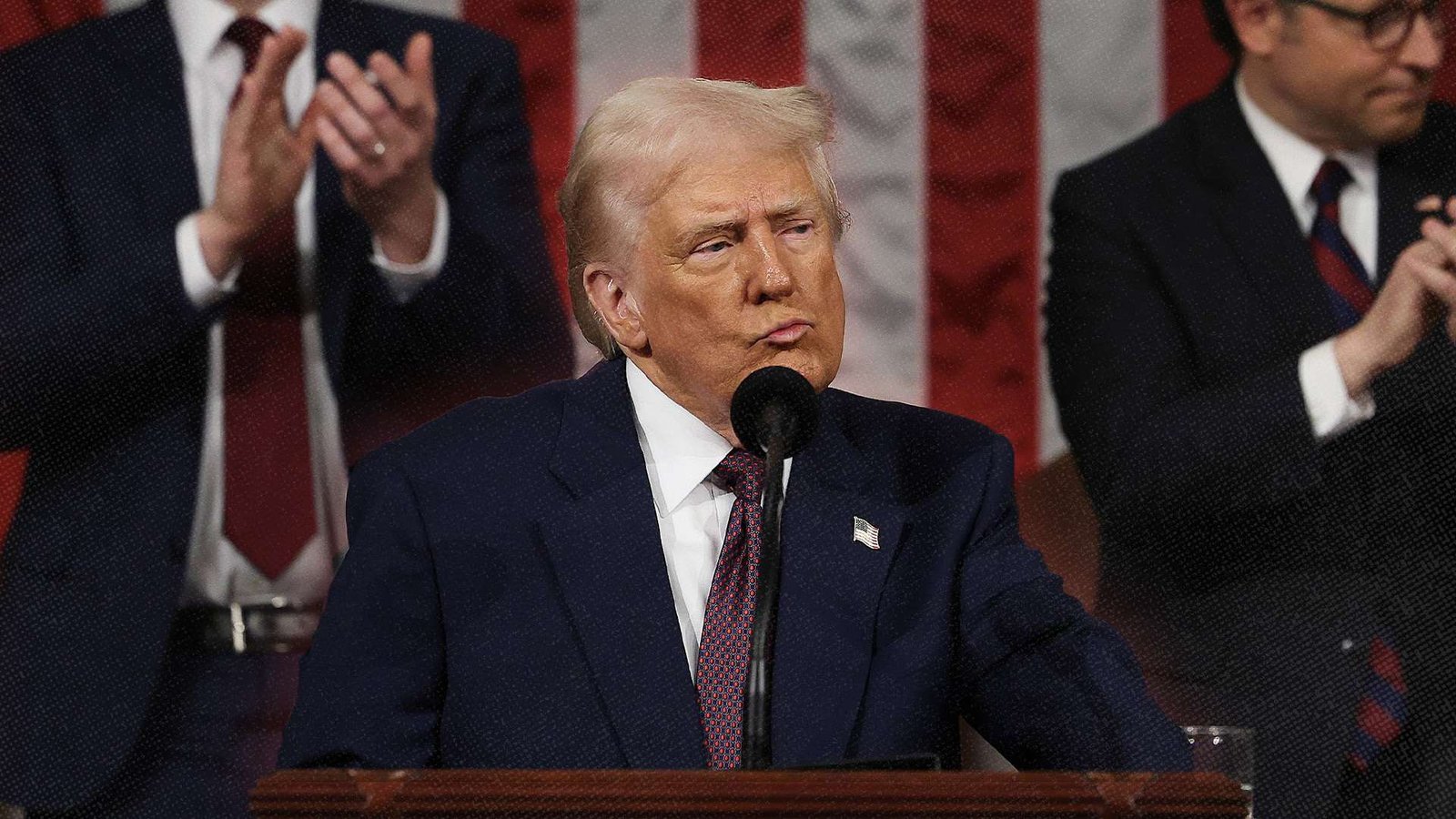
Trump, who shares some of Clinton’s gift of gab, inexhaustible self-regard, and attendant lack of discipline, no doubt hopes that he, too, can slather on enough verbal magic to burnish his record and eventually defy gravity in the November midterms. “It’s going to be a long speech,” the president told reporters yesterday, “because we have so much to talk about.” And when Trump says long, remember that his instantly forgotten stemwinder from 2025 clocked in at a record-shattering, liver-taxing 100 minutes.
Unhappily for the 47th president, he’s shouting into political headwinds considerably stiffer than those faced by the 42nd. Clinton held an approval rating of 60 percent (per Gallup) when he stepped to the Capitol podium in 1998; Trump was in the high 30s in three recent national polls (Gallup, regrettably, has exited the presidential polling game after 88 years).
Clinton also benefited in our two-party pendulum process from being the perceived victim of overreach by an opposition party that controlled both houses of Congress, whereas Trump’s victimhood narrative (at a time when his party holds slim majorities on Capitol Hill) pales in comparison to his impeachment-marred first term and lawfare-addled four years in the wilderness. The president tonight will no doubt keep whining about the Supreme Court in the wake of Friday’s Learning Resources v. Trump rebuke of his emergency tariffing, but the public is (rightly) against him on that case, and is unlikely to develop a late-breaking empathy toward the most powerful man on the planet calling his own judicial appointees “fools and lapdogs” who are “very unpatriotic and disloyal to our Constitution” and possibly “swayed by foreign interests.”
Like professional athletes in their mid-30s insisting they can make their bodies perform as if in their 20s, sixth-year presidents have a hard time internalizing that their spells are weakening, their days are growing short, and the electorate is kinda tired of hearing from them. Even popular second-term presidents like Ronald Reagan and Dwight Eisenhower saw their public support slip between SOTU day and the midterms, on the way to shellackings in the Senate.
So their speeches (Ike’s excepted; he was spooked about Sputnik) tend to be unhumble-brags, comically similar to one another, about how over the last five years we’ve cut crime, ended wars, added jobs, and gotten two steps closer to true energy independence.
“Here are the results of your efforts,” Barack Obama said in 2014, in a pure distillation of the form. “The lowest unemployment rate in over 5 years; a rebounding housing market; a manufacturing sector that’s adding jobs for the first time since the 1990s; more oil produced at home than we buy from the rest of the world, the first time that’s happened in nearly 20 years; our deficits cut by more than half.”
Trump will be doing a l-o-t of this tonight. This we know both from pre-game reporting, and also because he is constantly inserting Tourette’s-like boasts (of often dubious factual quality) about the stock market and gas prices and manufacturing growth into nonsequiturial contexts such as Supreme Court critiques and foreign policy speeches.
The Wall Street Journal reports that Trump “will use his State of the Union address to sell the public on the economy and unveil new measures meant to lower costs.” Therein lies a gaping pitfall, exemplified by Richard Nixon’s cursed sixth-year SOTU from 1974.
“Despite this record of achievement,” Tricky Dick insisted, after the usual litany of gilded brags, “as we turn to the year ahead we hear once again the familiar voice of the perennial prophets of gloom telling us now that because of the need to fight inflation, because of the energy shortage, America may be headed for a recession. Let me speak to that issue head on. There will be no recession in the United States of America.”
Reader, that oil shock-triggered recession lasted from November 1973 to March 1975.
In our debased state of national politics we have become accustomed to presidents making promises they cannot possibly hope to deliver on, particularly just months before they become a lame duck—Nixon’s in 1974 included “helping toward the achievement of a just and lasting settlement in the Middle East,” making “high-quality health care available to every American in a dignified manner,” checking “the rise in prices…and [moving] the economy into a steady period of growth at a sustainable level.”
But as the ghost of Joe Biden can attest, woe unto the POTUS who points to the cloudy economic sky and declares it blue.
Trump, haunted by his underwater economic numbers and spurred on by the unlikely electoral success of New York Mayor Zohran Mamdani, will announce a bunch of “affordability” measures tonight (at least when not angrily defending his across-the-board tax hikes on imports). But, lacking both discipline and effective handlers, he will not get out of his own way in making such incongruous statements as “I’ve won affordability.” The electorate, as we have seen, can stomach gratuitous lying, just not so much about the quality and conditions of their own lives.
So: a laundry list of exaggerated and misstated accomplishments, particularly about the economy; a dog’s breakfast of micromeasures that would use the heavy hand of the federal government to force down some prices, punctuated by potshots at the Supreme Court, some semiquincentennial pep talks, and a 12-minute standing ovation for the gold medal–winning U.S. hockey team. Trump may not get his Nobel Peace Prize, but he has at least a 50–50 chance of breaking his own all-time record for minutes spent babbling from the throne.
Odds of breaking the six-year Itch? Zero.
Read the full article here
Fact Checker
Verify the accuracy of this article using AI-powered analysis and real-time sources.