

 Freedom Index
Listen to the article
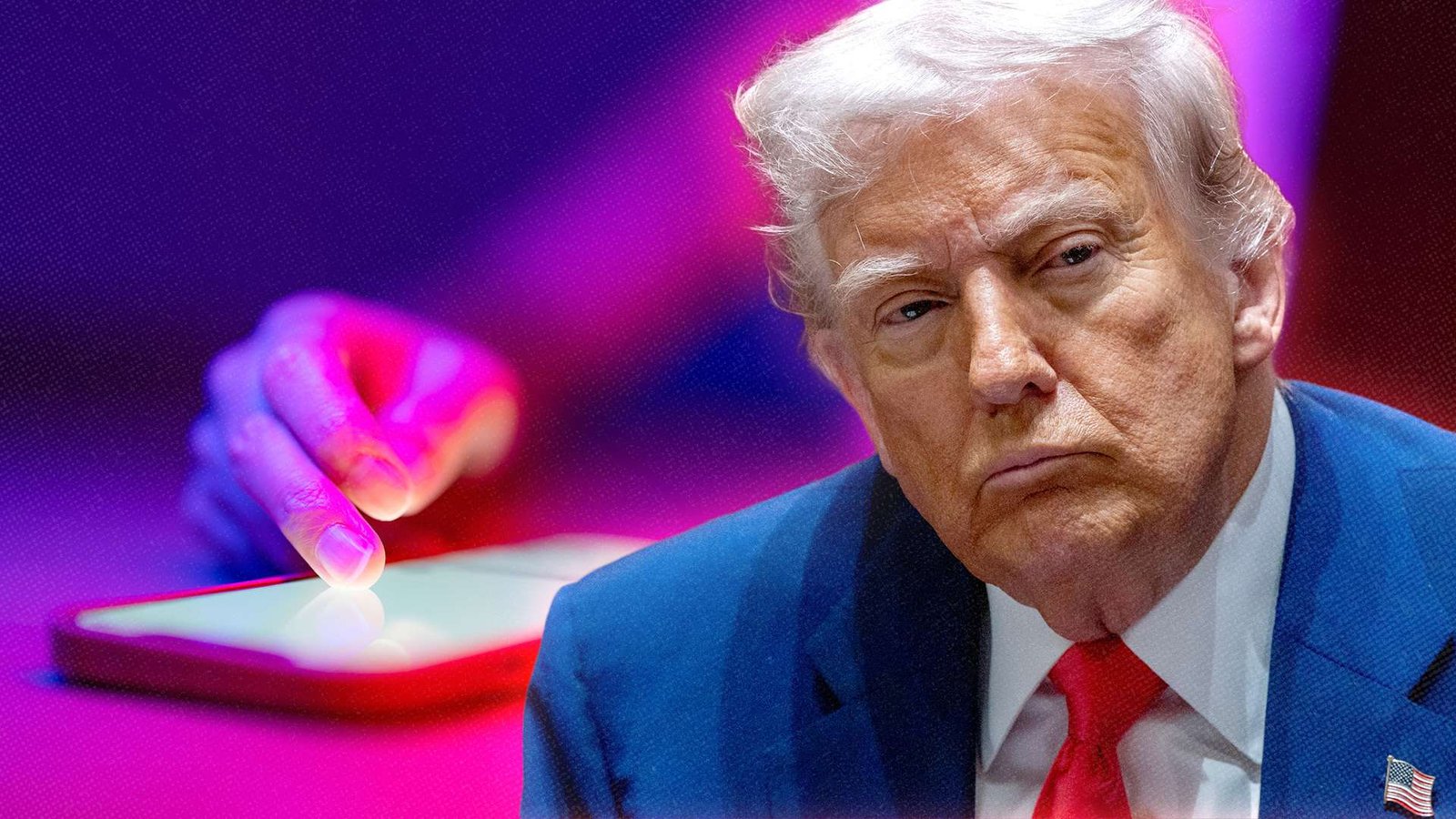
The Trump administration has approved a profoundly disturbing new immigration policy: collecting social media account information from anyone seeking to change their immigration status or obtain work or travel authorization. On February 11, the policy was approved for a one-year period.
You are reading Sex & Tech, from Elizabeth Nolan Brown. Get more of Elizabeth’s sex, tech, bodily autonomy, law, and online culture coverage.
Social media data will now be required of “the more than 3 million people applying each year for immigration status changes—such as seeking work or travel authorization, a green card, or citizenship,” notes
Under the new program, U.S. Citizenship and Immigration Services (USCIS) will ask applicants to provide all usernames or handles associated with any social media platform they have used in the past five years. The list of platforms it considers social media is long, including everything from the likes of Instagram, X, and TikTok to Discord, Telegram, Reddit, Twitch, YouTube, and all sorts of platforms popular in foreign countries.
This is a policy that seems tailor-made for rejecting people based not on any danger they pose but on their politics and beliefs. It’s antithetical to free speech values. It greatly lends itself to pretextual reasoning. If an administration decides it wants fewer immigrants of a certain ethnicity, religion, race, sexual orientation, etc., it can use social media postings as an excuse, citing even tepid criticism of the U.S. as evidence of a “hostile attitude.”
That people could be punished for protected speech is something of which the Trump administration has made no secret. More from the Brennan Center:
In reviving the proposal this year, USCIS said that gathering social media handles is necessary to comply with the administration’s new policy of screening people in the United States for “hostile attitudes” or “hateful ideology” toward Americans or U.S. culture and institutions. These are vague phrases that have been used to label and punish constitutionally protected speech.
In addition, USCIS announced in April that it would begin screening non-U.S. citizens’ social media for “antisemitic activity” and “anti-Americanism.” It provided no concrete definitions of these terms, enabling broad and indiscriminate targeting of protected speech. The agency later directed immigration officers to consider these views “an overwhelmingly negative factor” in discretionary reviews of immigration requests. The State Department has followed suit, directing consular officers to review visa applicants’ online presence for “anti-American” and “antisemitic” activities.
Requiring immigration officials to collect social media data demands that those who might want to work or study in the U.S., or those who are here temporarily and would like to get a green card or become a citizen, intensely censor themselves in public. People who know their future immigration status may depend on what they do (or don’t) post online will be effectively silenced.
That’s bad for those silenced, of course, but it’s also bad for American society more generally. We will lose people willing to speak out truthfully about what’s going on in immigrant communities. We will lose people willing to make their voices heard about U.S. policies and politics. We will lose the perspective of current and future immigrants.
The Department of Homeland Security (DHS) argues that all of this is necessary for security purposes. But we have a long history of Homeland Security using “security” to justify all manner of privacy abuses. And we’ve already seen the current administration use First Amendment-protected online speech as justification for arrests, attempted deportations, and more. It’s recently been attempting to unmask social media accounts that are critical of Immigration and Customs Enforcement (ICE).
Besides, in documents first obtained by the Knight First Amendment Institute through a Freedom of Information Act request, federal officials even say that requiring social media handles would have “very little impact on improving the screening accuracy of relevant systems.”
Meanwhile, the potential for abuse also goes beyond immigration decisions. “The long-term retention and sharing of these handles also violates federal privacy law and enables the continuous surveillance of millions of people in the United States—all with little to no oversight to protect privacy and civil liberties,” points out.
A date spot for people with AI companions is here! Except…not really. “Now you can take your AI chatbot on an actual date at NYC’s ‘world first’ companion cafe,” says a recent New York Post headline. “On Wednesday night, Same Same Wine Bar was filled with patrons sitting at tables for one-ish, with their tech devices propped up on stands to make video calls to their virtual partners and headphones to hear them,” the article explains.
I’m sure tech doomers everywhere found their take typing fingers itching upon reading that. But read down a bit and you’ll find this:
Milling around the room on opening night, it was clear that most attendees were either fellow members of the media, influencers, or curious techies. Richter was one of the few genuine patrons.
Not only were there very few people actually taking chatbots out for a romantic drink, but the locale in question has not actually become a full-time companion cafe, despite what the Post headline implies. It was simply hosting a one-night event put on by EvaAI, an app that allows people to text or video chat with AI personalities.
It seems this was a marketing stunt, not a reason to hit the “humanity is doomed” alarm.
“Don’t ask if AI data centers use a lot of water. Ask if they’re worth it,” writes Bonnie Kristian on Substack. Her piece looks at a BBC article that shirks rigorous reporting in favor of promoting an alarmist view of artificial intelligence. Then Kristian steps back to consider the broader media landscape surrounding AI and water use:
It’s true that data centers, whether they’re purpose-built for AI or not, often use water for cooling. It’s also true that what these usages vary widely by build type and physical environment. Undark has what strikes me as a nuanced article explaining some key differences here, and this (very long!) Substack post on AI and water from Andy Masley seems well-researched and sensible, deserving of the attention it has received, even if I don’t share the wider conclusions of that attention.
From reading these and other sources, my sense is it’d be prudent to use closed-loop cooling designs (instead of designs where a lot of water evaporates) and to concentrate centers in colder places with lots of water whenever those choices are available.
What seems rather less prudent is a lot of reporting on this topic. It’s sensationalist and ill-informed, tossing out lots of big numbers (millions of gallons a day!) without explaining exactly what those numbers mean for a specific center design or how they fit into extant water usage and needs in a specific geographic location.
Kristian goes on to point out that data centers don’t only power AI and data centers aren’t the only types of businesses that use a whole lot of water. The correct way to think about water use is probably not to simply look at how much water a given industry or purpose uses but to consider the value of that use.
In short: Is it worth it?
Whether you think so will depend a lot on your attitudes toward AI, of course. The actual value here is up for much debate. But we should be having the debate on those terms, not simply gasping at big numbers.
Oops. Turns out Persona, Discord’s age-verification service, was secretly screening selfies against government watchlists AND accessible by the feds. It’s backed by Peter Thiel. “The state wants to see everything. The corporations want to see everything. And they’ve learned to work together.”
— Mike Stabile (@mikestabile.bsky.social) 2026-02-21T22:57:32.620Z
More Sex & Tech News
• Anyone who wants to force you to identify yourself to the government as a precondition for querying or speaking on the internet has other goals in mind,” said…the State Department’s undersecretary for public diplomacy? Wow.
•”As a sex worker, I’m better off as an entrepreneur—not an employee,” suggests brothel worker and sex worker rights advocate Alice Little in a Nevada Independent piece opposing brothel worker unionization. Working as an independent contractor “has allowed me to set my own schedule, set my own rates, offer the services I choose and have the ability to turn away guests for any reason,” Little writes. “I am solely in control of my image, my brand and my website. I decide how I want to advertise myself, how I want to communicate with clients and how I want to manage my business.…A union cannot and should not be responsible for negotiating my personal boundaries.”
• A coincidental traffic stop or AI-powered surveillance?
• How bad tech studies become “proof” when they support the right narrative:
r = .04. p < .05. Cue the moral panic.
This post breaks down how weak effects become “proof” when they fit the right story. – When Small Effects Make Big Headlines, by @DocGrawitch Shoutout to @CJFerguson1111 for the stimulus for this. https://t.co/Xtad5WuNwv pic.twitter.com/NBLzs3gyUT— Matt Grawitch (@DocGrawitch) February 17, 2026
• The New York Times looks at why federal prosecutors increasingly bring sex trafficking charges against people accused of other sex crimes. The answer is basically that trafficking statutes are pretty broad and somewhat malleable, which means they can potentially apply to all sorts of crimes. (That might be good news for prosecutors looking to win cases, but it doesn’t always serve the interest of justice. See, for instance, the way the feds have stretched trafficking parameters in the OneTaste case.)
• Have you checked out the Reason app yet? It just got a redesign.
Read the full article here
Fact Checker
Verify the accuracy of this article using AI-powered analysis and real-time sources.