

 Freedom Index
Listen to the article
Last week, anti-Israel activist group Palestine Action won a victory in the courts as the High Court of Justice in London declared the government’s 2025 ban on the group disproportionate and unlawful.
The ruling could have major implications for free expression in the United Kingdom given how widely and aggressively the ban on Palestine Action was imposed last year. Ultimately, the ban wasn’t just about the group itself or its conduct but a much broader range of speech about the group — all enforced under anti-terror legislation.
The group was banned in July under the UK’s Terrorism Act 2000 after members broke into Brize Norton, an airbase hosting a Royal Air Force station, and vandalized military planes with red paint because the “aircraft can be used to refuel and have been used to refuel Israeli fighter jets.” Activists involved with the group were also accused of causing damage to an Israeli defense and technology company’s headquarters and spray-painting the Ministry of Defence building in 2024.
Repression deepens in Hong Kong with Jimmy Lai’s guilty verdict and censorship over deadly Wang Fuk Court fire
Hong Kong jails Jimmy Lai, UK prosecutors seek to reverse a free speech victory, and a new U.S. border policy could export self-censorship worldwide.
Read More
Vandalism is, quite obviously, not protected speech. But talking about or even expressing general support for groups that have engaged in alleged criminal activity is not the same as engaging in that criminal activity. That’s just, well, speech. UK police didn’t see it that way, though.
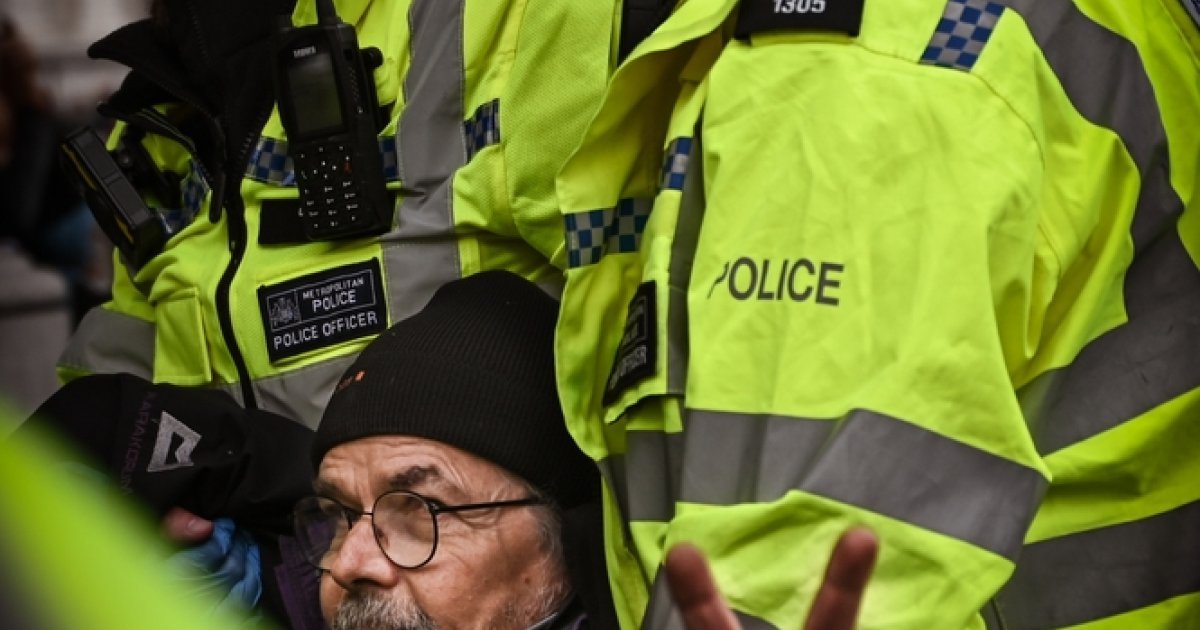
In the weeks and months after the ban was instituted, widespread protests regularly popped up in London and other cities in favor of the group and in opposition to the ban. London’s Metropolitan Police immediately acted to arrest protesters, making clear that “expressing support for” a proscribed group “is a criminal offence.” At one point the Metropolitan Police even posted to X, “We have significant resources deployed to this operation. It will take time but we will arrest anyone expressing support for Palestine Action.”
And they meant that quite literally. Since last summer, at least 2,787 people have been arrested for expressing support for the group, many for holding signs reading “I oppose genocide, I support Palestine Action.”
The arrests even reached more oblique references to the group and speech about speech about the group. A man who held up a magazine cover about the arrests of protesters holding up pro-Palestine Action signs was arrested under the Terrorism Act 2000, as was a man who held up a sign of a political cartoon — legally available for sale in a Private Eye magazine — that criticized the ban on Palestine Action. Another woman claimed she was arrested for holding a sign that didn’t express support for the group but just said, “I do not support the proscription of Palestine Action.” And late last month, London police arrested two people for holding a banner supporting Palestine Action but activist groups have said the banner was specifically obscured so it did not read “We are all Palestine Action.”
Put simply, treating this kind of basic political speech as a terror offense is incompatible with a free society — but in many ways the UK has been looking less and less like one these days. Excessive, pervasive, and widespread policing of speech online and off has, unfortunately, become the rule rather than the exception.
Spain considers banning teens from social media and holding tech executives criminally responsible for ‘hate speech’
Spain eyes jailing tech CEOs and banning teens from social media as global crackdowns on speech grow — from Hong Kong to Pakistan and the UK.
Read More
We’ll find out soon whether the ruling about Palestine Action will signal a change in the UK but for now some uncertainty remains. The court left the ban in place until the government has time to appeal, which it intends to do. “I am disappointed by the court’s decision and disagree with the notion that banning this terrorist organisation is disproportionate,” Home Secretary Shabana Mahmood said of the ruling. “The proscription of Palestine Action followed a rigorous and evidence-based decision-making process, endorsed by parliament. The proscription does not prevent peaceful protest in support of the Palestinian cause, another point on which the court agrees.”
Metropolitan Police, which conducted most of the arrests in relation to expression of support for the group, admitted it is in an “unusual” position given that the ban was ruled unlawful but will remain pending appeal. Police will “continue to identify offences where support for Palestine Action is being expressed, but they will focus on gathering evidence of those offences and the people involved to provide opportunities for enforcement at a later date, rather than making arrests at the time.”
So, for the time being, expressing support for Palestine Action is essentially Schrödinger’s speech crime.
Read the full article here
Fact Checker
Verify the accuracy of this article using AI-powered analysis and real-time sources.