Close Menu
FSNN | Free Speech News NetworkFSNN | Free Speech News Network
  • Home
  • News
    • Politics
    • Legal & Courts
    • Tech & Big Tech
    • Campus & Education
    • Media & Culture
    • Global Free Speech
  • Opinions
    • Debates
  • Video/Live
  • Community
  • Freedom Index
  • About
    • Mission
    • Contact
    • Support
Trending

New York sues Kalshi, will seek damages, alleging it offers gambling platform

20 minutes ago

Aave Proposal Targets 50 Reserves in Six-Market Wind-Down

22 minutes ago

$38M in Bitcoin Drained by Coldcard Key Flaw Its Maker Thinks AI Found

24 minutes ago
Facebook X (Twitter) Instagram
Facebook X (Twitter) Discord Telegram
FSNN | Free Speech News NetworkFSNN | Free Speech News Network
Market Data Newsletter
Friday, July 31
  • Home
  • News
    • Politics
    • Legal & Courts
    • Tech & Big Tech
    • Campus & Education
    • Media & Culture
    • Global Free Speech
  • Opinions
    • Debates
  • Video/Live
  • Community
  • Freedom Index
  • About
    • Mission
    • Contact
    • Support
FSNN | Free Speech News NetworkFSNN | Free Speech News Network
Home»Cryptocurrency & Free Speech Finance»ETH Denver 2026 Opens With Builder Energy Despite Crypto Slump
Cryptocurrency & Free Speech Finance

ETH Denver 2026 Opens With Builder Energy Despite Crypto Slump

News RoomBy News Room5 months agoNo Comments4 Mins Read1,636 Views
Share Facebook Twitter Pinterest Copy Link LinkedIn Tumblr Email VKontakte Telegram
ETH Denver 2026 Opens With Builder Energy Despite Crypto Slump
Share
Facebook Twitter Pinterest Email Copy Link

Listen to the article

0:00
0:00

Key Takeaways

Playback Speed

Select a Voice

In brief

  • ETH Denver founder says the market downturn has trimmed hype and sharpened builder focus.
  • Conference attendees describe a more intimate, return-on-investment-driven crowd.
  • Beyond tech, ETH Denver also places a focus on art and mental wellness.

Crypto prices may be down, but the mood inside ETH Denver on opening day is up.

Despite the cold, a line formed outside the new venue, the National Western Center, well before doors opened.

For ETH Denver founder John Paller, the event reflects a year’s worth of work that began immediately after last year’s event. 

“A lot of people think this is the beginning, but for our team, we actually didn’t stop from last year,” he told Decrypt, describing the first day as “the crescendo.”

While the cryptocurrency market downturn has dominated headlines, Paller said ETH Denver thrives during downturns.

“ETH Denver has always benefited from bear markets,” Paller said, noting that sponsors narrow their event budgets and concentrate spending.

Paller did, however, acknowledge that attendance is expected to fall short of peak years. 

“Instead of 25,000, there’s only going to be 10,000 or 8,000 people or something,” he said, but added that compared to earlier editions, the event has continued to expand. “From 2020 we were at 2,500, so it’s still grown, the core nucleus, and the signal has grown.”

ETH Denver 2026. Photo: Decrypt

“The noise to signal ratio is going to be much better,” he said. “Just a lot less noise, a lot higher signal. The people who are here are serious, and they care deeply about the future of web three and the user owned Internet.”

Russell Castagnaro, founder of Unicorn.eth, said the change in the vibe is noticeable.

“There are a lot more people who are seriously interested,” Castagnaro told Decrypt. “It got so big over the last two years that everyone just had to be there. Now, when they come, they really want to get ROI for themselves. They want to make sure they’re meeting people, building, and getting exposed to all the new technologies. It’s a lot more back to its roots in many ways, but in an evolved state.”

For some first-time attendees like Tyler Gentry, founder of fintech consultancy firm NEED-AID, the appeal of coming to ETH Denver lies in observing how decentralized communities operate.

ETH Denver
ETH Denver 2026. Photo: Decrypt

“I came to ETH Denver to see how a DAO cooperative community comes together in real time and to explore how NEED-AID can use that blueprint to democratize giving for nonprofits and unlock the next generation of donors,” he said.

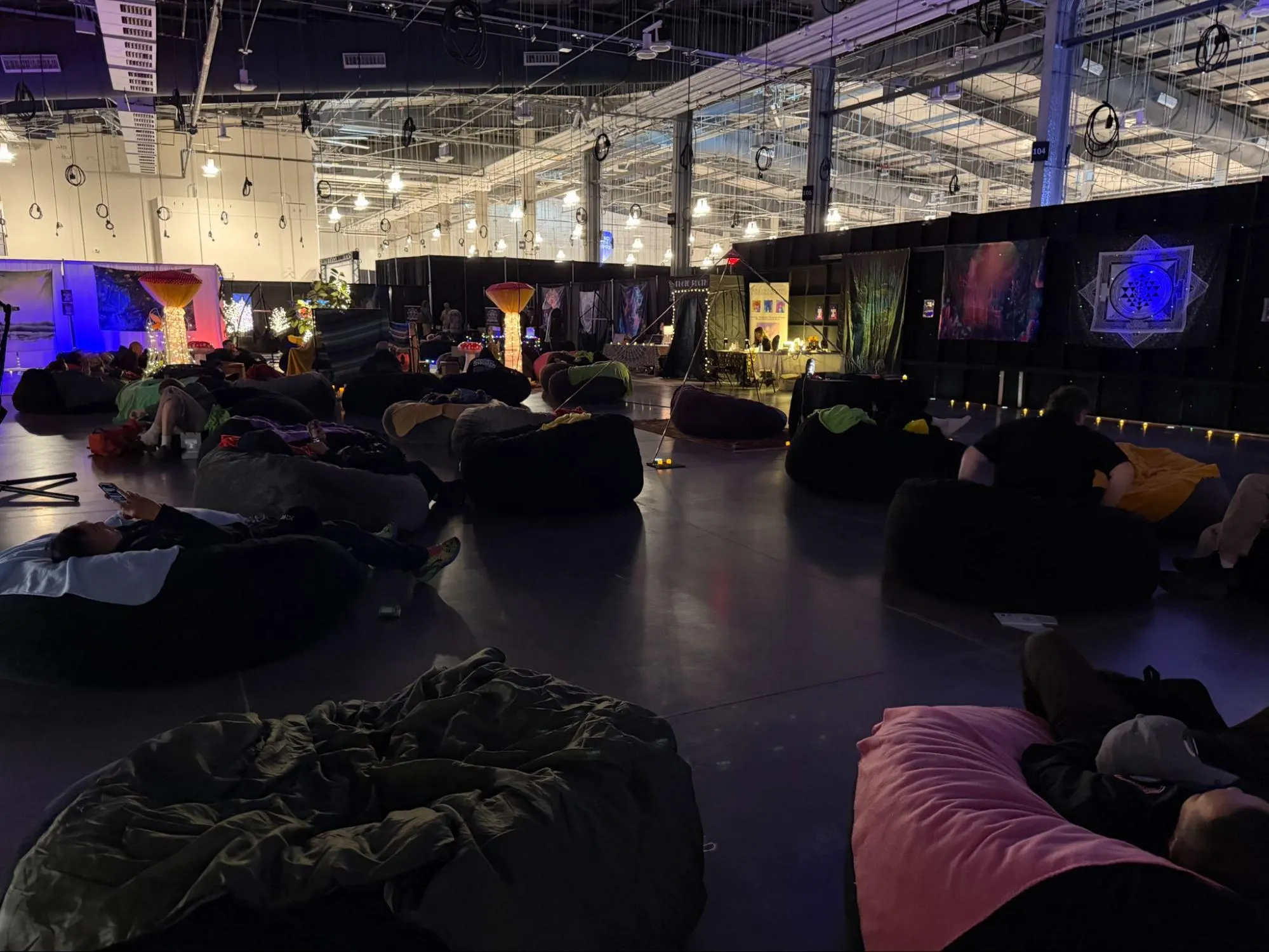
But the vibe around ETH Denver isn’t all about the latest trends in AI or crypto markets. In the Zen Zone, located near the entrance, centers on art and mental wellness before panels and networking begin.

“The vibes are what kept me coming back,” Shana Douglas, co-founder of blockchain education and outreach project NFT CLT, said. “I’ve been here since four or five years when we’re at the castle and it was super intimate. So this isn’t as intimate as that, but it’s definitely setting the tone for a strong builder community and making sure we’re all vibing nicely.”

ETH Denver 2026. Photo: Decrypt

NFT CLT co-founder Tony Bravado, said this year’s ETH Denver feels “more intimate.”

“In order for us to build community, we’ve got to have tight knit places where people can gather, where people can share other ideas, as well as people can grow wellness,” he said. “You have AI, you have wellness, all together, and it just feels good to be here.”

While prices remain well below prior highs, ETFs shed millions, and sentiment on Crypto Twitter has turned decidedly bearish, the attendees of ETH Denver, while a smaller gathering than in years past, appear focused on building not only new technologies but a stronger community going into 2026.

Daily Debrief Newsletter

Start every day with the top news stories right now, plus original features, a podcast, videos and more.

Read the full article here

Fact Checker

Verify the accuracy of this article using AI-powered analysis and real-time sources.

Get Your Fact Check Report

Enter your email to receive detailed fact-checking analysis

5 free reports remaining

Continue with Full Access

You've used your 5 free reports. Sign up for unlimited access!

Already have an account? Sign in here

Share. Facebook Twitter Pinterest LinkedIn Tumblr Email Telegram Copy Link
News Room
  • Website
  • Facebook
  • X (Twitter)
  • Instagram
  • LinkedIn

The FSNN News Room is the voice of our in-house journalists, editors, and researchers. We deliver timely, unbiased reporting at the crossroads of finance, cryptocurrency, and global politics, providing clear, fact-driven analysis free from agendas.

Related Articles

Cryptocurrency & Free Speech Finance

New York sues Kalshi, will seek damages, alleging it offers gambling platform

20 minutes ago
Cryptocurrency & Free Speech Finance

Aave Proposal Targets 50 Reserves in Six-Market Wind-Down

22 minutes ago
Cryptocurrency & Free Speech Finance

$38M in Bitcoin Drained by Coldcard Key Flaw Its Maker Thinks AI Found

24 minutes ago
Media & Culture

Some Tentative Thoughts on Substack

1 hour ago
Cryptocurrency & Free Speech Finance

Quantum Solutions, Hyperscale Data tap crypto treasuries to fund AI data centers

1 hour ago
Cryptocurrency & Free Speech Finance

RWA Perpetual Futures Near Bitcoin Volume on Hyperliquid, Binance

1 hour ago
Add A Comment

Comments are closed.

Editors Picks

Aave Proposal Targets 50 Reserves in Six-Market Wind-Down

22 minutes ago

$38M in Bitcoin Drained by Coldcard Key Flaw Its Maker Thinks AI Found

24 minutes ago

Some Tentative Thoughts on Substack

1 hour ago

Our report with the University of Essex The weaponisation of travel bans to Silence Speech and Dissent is published today. Photo: Curated Lifestyle/Unsplash+ When we think of state censorship, we often picture prison cells, violent police crackdowns or control of newsrooms. However, our report titled The weaponisation of travel bans to silence speech and dissent published today by Index on Censorship reveals a quieter, less visible tool of state repression that is devastating civil society across the world. We found that rather than protecting public safety, governments are increasingly manipulating “national security” or “public order” exemptions to trap journalists, fracture families and exile critics. Our research shows that these bans are highly adaptable tools that occur around politically sensitive events such as protests, elections and crackdowns on democratic activity. Their shared, devastating objective is to control narratives, block external scrutiny and create a chilling effect on free expression. As we researched this topic, we strongly felt that to understand the severity of this crisis, the spotlight must remain entirely on the impacted individuals. The victims of this widespread authoritarian trend pay with their lives and livelihoods being upended by arbitrary and undemocratic measures. Our analysis highlights that in authoritarian contexts, travel bans act as overt tools of absolute repression. In Saudi Arabia, they function as a form of “quasi-detention”, ensuring that prisoners of conscience remain silenced long after they are physically released from their cells. Take the example of Salma Al-Shehab, a doctoral student at Leeds University, who was imprisoned simply for tweeting in support of women’s rights. Upon her release, she was handed an eight-year travel ban, effectively destroying her academic career by barring her return to the United Kingdom. Similarly, in Algeria, our research shows how journalists like Mustapha Bendjama find themselves trapped in a bureaucratic nightmare. Extrajudicial travel bans, known as ISTNs, are routinely issued by security agencies without formal judicial oversight, leaving targets in a legal vacuum with no clear avenues for appeal. Bendjama shared with us that this forced isolation acts as a “mental imprisonment” that has dried up his sources and severely compromised his ability to conduct rigorous journalism. One of our most troubled findings was that the chilling effect of these restrictions extends well beyond authoritarian states, creeping into hybrid democracies. In India, administrative tools like “Look Out Circulars” are deployed to trap critical voices within the country’s borders. Sanna Irshad Mattoo, a Pulitzer Prize-winning photojournalist, was prevented from travelling to New York to accept her award, sending a clear message that international recognition offers no immunity from state retaliation. In Georgia, foreign journalists who report critically on the country’s democratic backsliding have been arbitrarily denied re-entry at the border using generic legislative clauses. French journalist Clément Giradot was refused entry after reporting on political demonstrations, a decision that suddenly separated him from his home, his Georgian wife and his young child without any concrete legal justification. It became clear to us that these are not isolated administrative errors. We believe they are part of a coordinated assault on international human rights. Whether it is Nicaragua arbitrarily revoking citizenship to render critics stateless, Belarus forcing exiled dissidents into jeopardy by refusing to renew passports abroad or the United States deploying visa revocations and social media screenings against lawfully present critics, the goal appears to be one: to enforce widespread self-censorship and fear. The international community can no longer treat these administrative traps as routine border control measures. We urgently recommend taking action. States must do away with these opaque directives, end the use of secondary travel bans as a form of collective punishment against families and align their domestic laws with international human rights standards. Furthermore, democratic host nations must step in to provide secure legal status and alternative travel documents for exiled dissidents while applying sustained diplomatic pressure to demand the lifting of these arbitrary restrictions globally. Respecting and protecting freedom of speech should not know any ideological boundaries or state borders. With this report, we express our solidarity with the brave ones who raised their voices and with many more who were silenced and never known. While researching and interviewing participants at the front lines of this injustice, we were reminded of the importance of academia’s role as both a sanctuary for freedom of expression and a service to society at large. window.option_df_140795 = {“outline”:[],”autoEnableOutline”:”false”,”autoEnableThumbnail”:”false”,”overwritePDFOutline”:”false”,”direction”:”1″,”pageSize”:”0″,”source”:”https:\/\/www.indexoncensorship.org\/wp-content\/uploads\/2026\/07\/travel-bans-report.pdf”,”wpOptions”:”true”}; if(window.DFLIP && window.DFLIP.parseBooks){window.DFLIP.parseBooks();}   READ MORE

1 hour ago
Latest Posts

Quantum Solutions, Hyperscale Data tap crypto treasuries to fund AI data centers

1 hour ago

RWA Perpetual Futures Near Bitcoin Volume on Hyperliquid, Binance

1 hour ago

Brickbat: Apples and Oranges

2 hours ago

Subscribe to News

Get the latest news and updates directly to your inbox.

At FSNN – Free Speech News Network, we deliver unfiltered reporting and in-depth analysis on the stories that matter most. From breaking headlines to global perspectives, our mission is to keep you informed, empowered, and connected.

FSNN.net is owned and operated by GlobalBoost Media
, an independent media organization dedicated to advancing transparency, free expression, and factual journalism across the digital landscape.

Facebook X (Twitter) Discord Telegram
Latest News

New York sues Kalshi, will seek damages, alleging it offers gambling platform

20 minutes ago

Aave Proposal Targets 50 Reserves in Six-Market Wind-Down

22 minutes ago

$38M in Bitcoin Drained by Coldcard Key Flaw Its Maker Thinks AI Found

24 minutes ago

Subscribe to Updates

Get the latest news and updates directly to your inbox.

© 2026 GlobalBoost Media. All Rights Reserved.
  • Privacy Policy
  • Terms of Service
  • Our Authors
  • Contact

Type above and press Enter to search. Press Esc to cancel.

🍪

Cookies

We and our selected partners wish to use cookies to collect information about you for functional purposes and statistical marketing. You may not give us your consent for certain purposes by selecting an option and you can withdraw your consent at any time via the cookie icon.

Cookie Preferences

Manage Cookies

Cookies are small text that can be used by websites to make the user experience more efficient. The law states that we may store cookies on your device if they are strictly necessary for the operation of this site. For all other types of cookies, we need your permission. This site uses various types of cookies. Some cookies are placed by third party services that appear on our pages.

Your permission applies to the following domains:

  • https://fsnn.net
Necessary
Necessary cookies help make a website usable by enabling basic functions like page navigation and access to secure areas of the website. The website cannot function properly without these cookies.
Statistic
Statistic cookies help website owners to understand how visitors interact with websites by collecting and reporting information anonymously.
Preferences
Preference cookies enable a website to remember information that changes the way the website behaves or looks, like your preferred language or the region that you are in.
Marketing
Marketing cookies are used to track visitors across websites. The intention is to display ads that are relevant and engaging for the individual user and thereby more valuable for publishers and third party advertisers.