Close Menu
FSNN | Free Speech News NetworkFSNN | Free Speech News Network
  • Home
  • News
    • Politics
    • Legal & Courts
    • Tech & Big Tech
    • Campus & Education
    • Media & Culture
    • Global Free Speech
  • Opinions
    • Debates
  • Video/Live
  • Community
  • Freedom Index
  • About
    • Mission
    • Contact
    • Support
Trending

UK crypto rules moving too slowly to secure global hub status, says FCA-registered stablecoin Issuer Agant

18 minutes ago

BVNK Survey Finds 39% Receive Income in Stablecoins

22 minutes ago

DeFi protocol ZeroLend shuts down after 3 years, citing inactive chains and hacks

1 hour ago
Facebook X (Twitter) Instagram
Facebook X (Twitter) Discord Telegram
FSNN | Free Speech News NetworkFSNN | Free Speech News Network
Market Data Newsletter
Tuesday, February 17
  • Home
  • News
    • Politics
    • Legal & Courts
    • Tech & Big Tech
    • Campus & Education
    • Media & Culture
    • Global Free Speech
  • Opinions
    • Debates
  • Video/Live
  • Community
  • Freedom Index
  • About
    • Mission
    • Contact
    • Support
FSNN | Free Speech News NetworkFSNN | Free Speech News Network
Home»News»Global Free Speech»Cambodian journalist Luot Sophal detained over military water shortage report
Global Free Speech

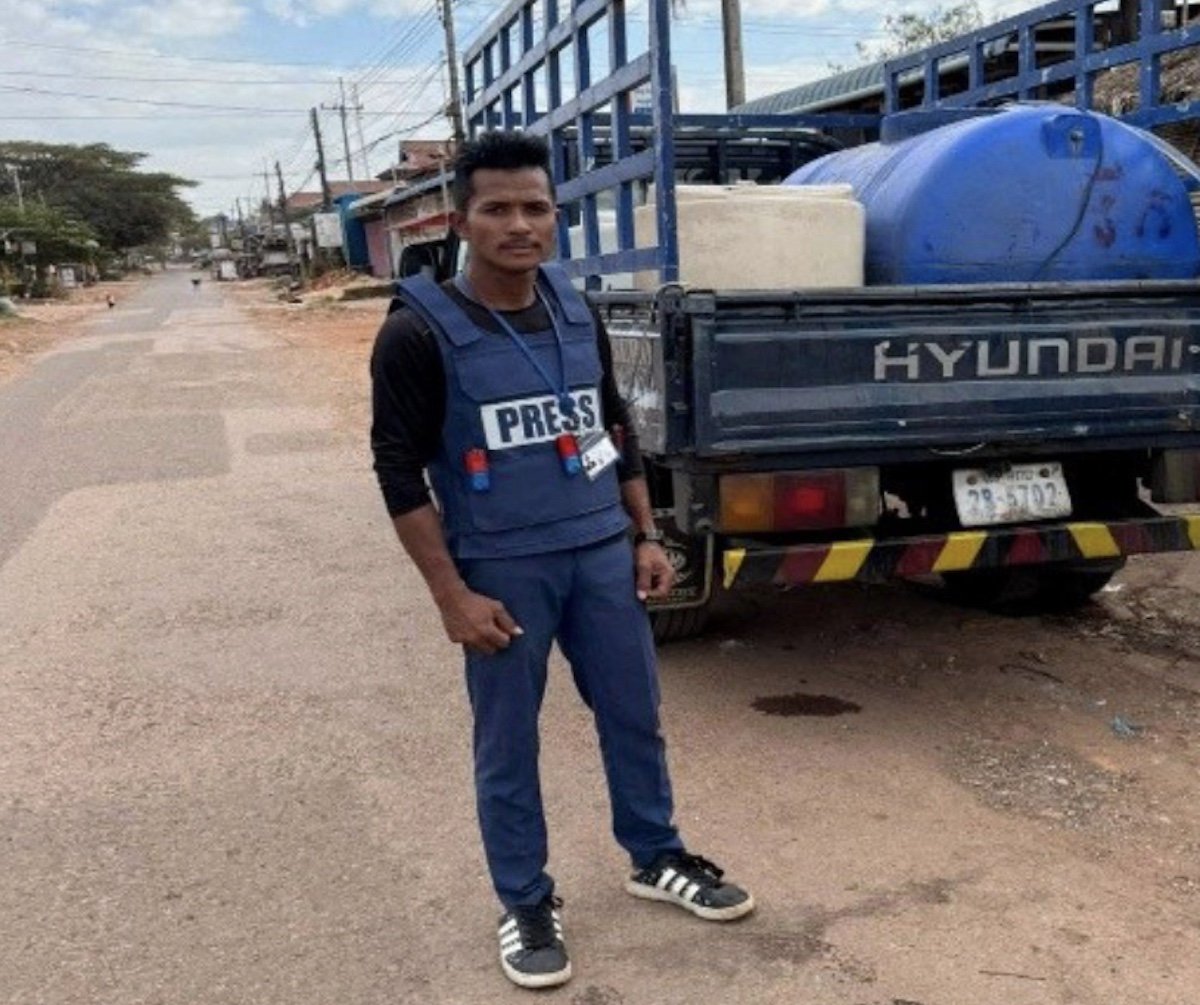
Cambodian journalist Luot Sophal detained over military water shortage report

News RoomBy News Room2 hours agoNo Comments2 Mins Read1,236 Views
Share Facebook Twitter Pinterest Copy Link LinkedIn Tumblr Email VKontakte Telegram
Cambodian journalist Luot Sophal detained over military water shortage report
Share
Facebook Twitter Pinterest Email Copy Link

Listen to the article

0:00
0:00

Key Takeaways

Playback Speed

Select a Voice

Bangkok, February 17, 2026—The Committee to Protect Journalists calls on Cambodian authorities to immediately and unconditionally release journalist Luot Sophal, who was arrested after publishing a report about an alleged water shortage faced by frontline Cambodian soldiers.

On February 13, Sophal, a journalist with the local independent Srotop Yuvakvey news, was arrested by police in Samraong, the capital of Oddar Meanchey province, and taken to the provincial headquarters for questioning, according to a Kiripost report and statements from local rights groups.

Sophal was later charged under Articles 472, 494 and 495 of the penal code for demoralizing the armed forces and incitement to commit a felony, according to an Oddar Meanchey Provincial Court statement. If convicted, he faces up to seven years in prison.

“Journalist Luot Sophal committed no crime by merely reporting the news and should be freed without charge,” said Shawn Crispin, CPJ’s senior Southeast Asia representative. “Cambodian authorities must stop treating journalists like criminals and allow them to cover issues of public interest without fear of arrest or imprisonment.”

Sophal was arrested after publishing a video on his personal Facebook page on February 7 discussing the alleged water shortage and including a photograph of government leaders, according to the sources. While in custody, authorities ordered him to delete the post and apologize in a video.

He is being held at Oddar Meanchey prison, local rights group LICADHO told CPJ via messaging app.

Sophal’s arrest and detention come amid a widening crackdown on press freedom in Cambodia. On February 3, local reporter Hem Vanna was arrested and charged for reporting on alleged abuse in a suspected Cambodian scam center and is being held in pre-trial detention.

On February 11, investigative reporter Mech Dara was detained by Koh Kong provincial police for more than an hour and forced to delete photos he had taken of a suspected scam compound raid, news reports said.

The Ministry of Information did not immediately respond to CPJ’s emailed request for comment. Cambodia is one of Asia’s worst jailers of journalists, with at least five currently behind bars, according to CPJ research.

Read the full article here

Fact Checker

Verify the accuracy of this article using AI-powered analysis and real-time sources.

Get Your Fact Check Report

Enter your email to receive detailed fact-checking analysis

5 free reports remaining

Continue with Full Access

You've used your 5 free reports. Sign up for unlimited access!

Already have an account? Sign in here

Share. Facebook Twitter Pinterest LinkedIn Tumblr Email Telegram Copy Link
News Room
  • Website
  • Facebook
  • X (Twitter)
  • Instagram
  • LinkedIn

The FSNN News Room is the voice of our in-house journalists, editors, and researchers. We deliver timely, unbiased reporting at the crossroads of finance, cryptocurrency, and global politics, providing clear, fact-driven analysis free from agendas.

Related Articles

Global Free Speech

Ethiopia revokes Reuters journalists’ accreditation following investigative report

17 hours ago
Global Free Speech

Philippine journalist Frenchie Mae Cumpio denied bail, to remain in prison after 6 years

1 day ago
Global Free Speech

Group of teenage students using smartphones. Credit: Davidovich Mikhail/Alamy Banning social media for the under-16s appears to be contagious. Australia set the trend in December and now other countries are considering doing the same. There is growing momentum in Britain in favour of a ban (with the House of Lords having voted in favour of one last month). Spain is the first European country to propose legislation and Greece is said to be following suit. The Spanish prime minister, Pedro Sánchez, has spoken candidly about the abuse he has experienced online, saying it has “crossed many red lines” and nearly caused him to resign in 2024. He’s pushing through laws not only to ban access to major platforms for under-16s, but to hold social media executives criminally responsible if they do not take down illegal or hateful content. The country might even go one step further: Sira Rego, the youth minister, has suggested X should be prohibited altogether, because of the “flagrant violations of fundamental rights” taking place on the platform. She listed various issues, including the sexual deepfake images generated by Grok, and called the broader social media landscape “undemocratic” and controlled by “a few digital strongmen”. Elon Musk, of course, hit back, first posting on X: “Dirty Sánchez is a tyrant and a traitor to the people of Spain”, and an hour and a half later posting “Sánchez is the true fascist totalitarian.” I am not going cheerlead for Musk here. On X specifically, I find the culture now often unpleasant, somewhere I visit out of habit and seldom linger. And while X seems to be a microcosm of the worst trends of social media today, the other major platforms have flaws too. Do read this excellent piece we recently published from Brazilian writer Nina Auras on Meta banning left-wing political accounts in her country. But for those of us who work in defence of freedom of expression, the question is not whether platforms are flawed. The question is whether restricting access to them will strengthen our speech rights or weaken them. At Index, we’re not neuroscientists studying the cognitive effects of scrolling and the impact of social media on the young (as a sidenote a landmark trial has just started in Los Angeles on the mental health effects of Instagram and YouTube, the outcome of which will be very insightful). Rather we’re advocates for people whose speech is curtailed, be it journalists, activists or others. From that vantage point, social media remains incredibly important. For the isolated and the marginalised, it can be a lifeline: a source of learning, solidarity and visibility. The platforms continue to help expose state violence, mobilise protest movements and even unseat autocrats. Our recent magazine issue on Generation Z explored exactly that, and for those of us paying close attention to events in Iran, social media provided some of the best access to on-the-ground information. It is for these reasons that, until recently, the governments most eager to ban social media have typically been the least tolerant of dissent. Yes, the calls from Australia, Spain, Greece, the UK and other countries are rooted in different, more admirable reasons. It’s just bans will still have the same impact. None of the above excuses the abuse, the disinformation, the addictive design of algorithms and democratic interference. Those harms demand attention. But when solutions jump straight to prohibition without reckoning with what might be lost, they begin to resemble moral panics of the past – video games, rock ’n’ roll, the printing press, each once cast as existential threats to society that should be controlled no matter what the cost. READ MORE

3 days ago
Global Free Speech

CPJ nominates Philippine journalist Frenchie Mae Cumpio for UNESCO’s Guillermo Cano Prize

4 days ago
Global Free Speech

The Gen Z revolution will be polarised

4 days ago
Global Free Speech

CPJ welcomes Guatemalan journalist Jose Rubén Zamora’s release to house arrest, calls for all charges to be dropped

4 days ago
Add A Comment
Leave A Reply Cancel Reply

Editors Picks

BVNK Survey Finds 39% Receive Income in Stablecoins

22 minutes ago

DeFi protocol ZeroLend shuts down after 3 years, citing inactive chains and hacks

1 hour ago

SBI Holdings Targets Majority Stake in Singapore Exchange Coinhako

1 hour ago

Cambodian journalist Luot Sophal detained over military water shortage report

2 hours ago
Latest Posts

Polygon Tops Ethereum In Daily Transaction Fees Over The Weekend

2 hours ago

Steak ‘n Shake Says Bitcoin Has Lifted Sales ‘Dramatically’ in 9 Months

2 hours ago

The American Constitution Society Still Does Not Have A Competing Theory Other Than “Antitrumpism”

3 hours ago

Subscribe to News

Get the latest news and updates directly to your inbox.

At FSNN – Free Speech News Network, we deliver unfiltered reporting and in-depth analysis on the stories that matter most. From breaking headlines to global perspectives, our mission is to keep you informed, empowered, and connected.

FSNN.net is owned and operated by GlobalBoost Media
, an independent media organization dedicated to advancing transparency, free expression, and factual journalism across the digital landscape.

Facebook X (Twitter) Discord Telegram
Latest News

UK crypto rules moving too slowly to secure global hub status, says FCA-registered stablecoin Issuer Agant

18 minutes ago

BVNK Survey Finds 39% Receive Income in Stablecoins

22 minutes ago

DeFi protocol ZeroLend shuts down after 3 years, citing inactive chains and hacks

1 hour ago

Subscribe to Updates

Get the latest news and updates directly to your inbox.

© 2026 GlobalBoost Media. All Rights Reserved.
  • Privacy Policy
  • Terms of Service
  • Our Authors
  • Contact

Type above and press Enter to search. Press Esc to cancel.

🍪

Cookies

We and our selected partners wish to use cookies to collect information about you for functional purposes and statistical marketing. You may not give us your consent for certain purposes by selecting an option and you can withdraw your consent at any time via the cookie icon.

Cookie Preferences

Manage Cookies

Cookies are small text that can be used by websites to make the user experience more efficient. The law states that we may store cookies on your device if they are strictly necessary for the operation of this site. For all other types of cookies, we need your permission. This site uses various types of cookies. Some cookies are placed by third party services that appear on our pages.

Your permission applies to the following domains:

  • https://fsnn.net
Necessary
Necessary cookies help make a website usable by enabling basic functions like page navigation and access to secure areas of the website. The website cannot function properly without these cookies.
Statistic
Statistic cookies help website owners to understand how visitors interact with websites by collecting and reporting information anonymously.
Preferences
Preference cookies enable a website to remember information that changes the way the website behaves or looks, like your preferred language or the region that you are in.
Marketing
Marketing cookies are used to track visitors across websites. The intention is to display ads that are relevant and engaging for the individual user and thereby more valuable for publishers and third party advertisers.