

 Freedom Index
Listen to the article
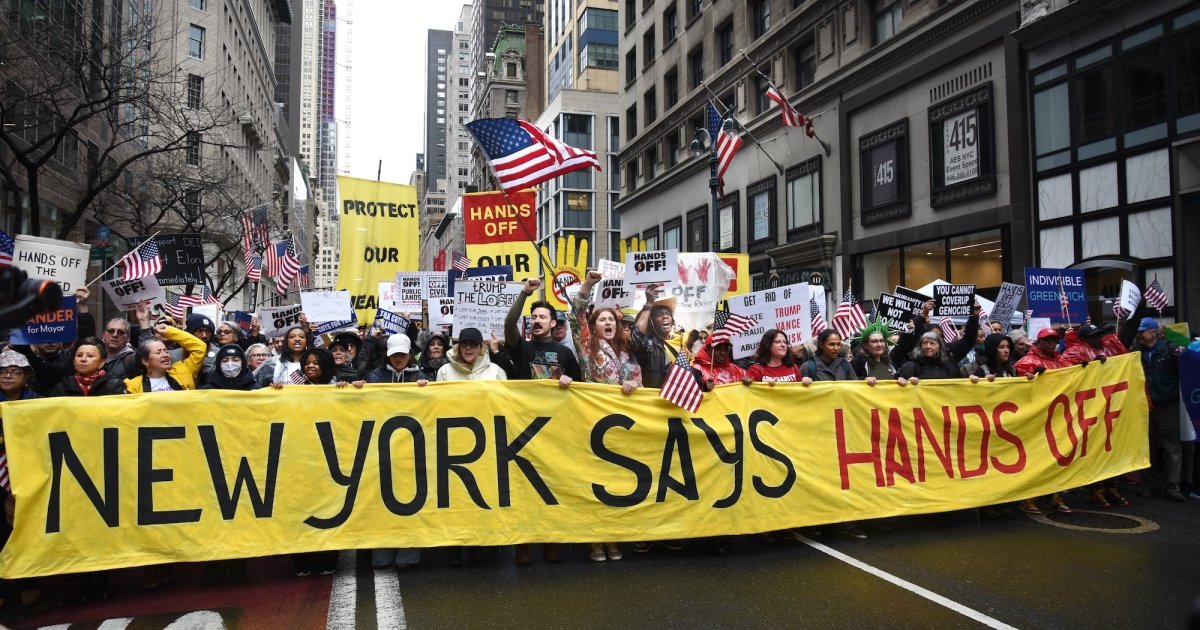
Core among the rights protected by the First Amendment is the right to demonstrate. No matter what our message is, whether other people are delighted or outraged by it, we get to march down the street and say our piece.
This right is currently under attack in Albany. A pair of proposals, one by members of the legislature and one by Gov. Kathy Hochul, would criminalize demonstrating at many locations across the state.
Here’s a deep dive into the details of these bills: what they cover, how they muzzle protesters, and why they’re unconstitutional.
Lasher/Sutton Bill: S.8599 / A.9335
The first proposal is Senate Bill 8599 / Assembly Bill 9335 from Sen. Sam Sutton and Rep. Micah Lasher. It bans demonstrations near religious sites and most health clinics. A first offense can get you up to 364 days in jail; a second offense, up to four years.
What speech is covered
The bill bans all demonstrations of just two or more people at all covered sites, at all hours of the day. It does not matter if the demonstration has anything to do with the religious site or health clinic, or if the facility is even open at the time of the protest. The demonstrators don’t need to be making threats or inciting violence. And the content or viewpoint of the demonstration is irrelevant: a pro-choice demonstration outside a Planned Parenthood is banned, and a pro-life demonstration outside a church is banned. (More on that later.)
LAWSUIT: Illinois law blocks Democratic dissenters from operating without party elites’ permission
With the help of FIRE, one group of dissident Democrats is suing to strike down Illinois’ unconstitutional law — permanently.
Read More
What sites are covered
- Places of religious worship — like churches, mosques, synagogues, and temples — defined as any building, structure, or space, public or private, “used primarily for religious services, observance, prayer, assembly, or devotional practice.”
- Health clinics — more specifically, “reproductive health care facilities,” a term already defined in the law. The definition covers any site which provides “medical, surgical, counseling or referral services relating to the human reproductive system.” In addition to abortion clinics and fertility clinics, this appears to cover any specialist that provides care “relating to” reproductive organs — not just urologists and OB-GYNs, but oncologists, dermatologists, radiologists, surgeons, and so forth, plus all primary care doctors and pediatricians (who, at a minimum, provide referrals for reproductive care).
How big is the buffer zone?
The buffer zone extends 25 feet from the sidewalks and streets touching the covered site, not just 25 feet from the property itself. And the definition of “reproductive health care facilities” includes the entire building in which the clinic is located.
In practice, this means the buffer zones are substantially larger than 25 feet from the protected building — they’re 25 feet plus width of the adjoining streets and sidewalks, no matter how wide they are.
Imagine an office building in Manhattan with a covered health clinic on the 20th floor. Because the bill says the entire building is included, the buffer zone includes all of the sidewalks and streets touching any side of the building, plus the extra 25 feet from the edge of those streets and sidewalks.
How does this affect speech?
It’s hard to overstate the effect of this proposal. There are thousands of locations across New York that are covered by the bill. Fully banning demonstrations around every single one will create a series of First Amendment dead zones where police can throw protesters in jail merely for shouting a slogan, holding a sign, or marching down the street. In densely populated areas, these zones will be close together or even overlap.
Some examples of what this looks like in practice:
- The New York City Pride Parade route goes directly past a hospital and multiple churches and health clinics. The area cordoned off for forming the parade covers several other churches, a mosque, two fertility clinics and a women’s health clinic. Even in Albany, which has a fraction of the density of New York City, the route for a No Kings march went directly past a church, an urgent care clinic, and primary care practice.
- Unionized nurses and other healthcare workers often organize rallies outside of hospitals that employ them, like this one in Buffalo.
- Monthly pro-life processions in New York City go from a church — a site of religious worship — to an abortion clinic — a reproductive health care facility.
- The governor’s regional office in Manhattan — naturally a site of frequent demonstrations — is in an office building that also has a women’s health clinic and an office of a Baptist church at which, according to their website, they host a weekly prayer gathering. Directly across the street from the building is a urology practice, so protesters would be barred by overlapping buffer zones.
- The governor and other elected officials regularly give speeches at churches, synagogues, and other houses of worship.
- St. Patrick’s Cathedral in Manhattan takes up an entire city block. It touches the street on all four sides, and none of the sidewalks are more than 25 feet wide (according to the city’s sidewalk data). That would ban demonstrating anywhere in sight of the cathedral. This would cover things like this pro-choice picket outside the cathedral, or this protest of child sexual abuse by a clergymember. It would also cover the St. Patrick’s Day parade, which marches down Fifth Avenue past the cathedral.
Under this bill, all of these demonstrators could be jailed for almost a year.
The response to this may be: Well, obviously the city isn’t going to arrest people at labor rallies or in the St. Patrick’s Day parade. But under the First Amendment, the government doesn’t get to enforce speech restrictions selectively. The state can’t allow the demonstrations it likes and then enforce the ban on others. The law has to be enforced equally regardless of what a demonstrator is saying and to whom.
Is it constitutional?
Even if the state promises to enforce this proposal equally, it’s unconstitutional. Public streets and sidewalks are traditional public forums for speech. That means that even content neutral “time, place, and manner” restrictions are unconstitutional if they’re “substantially broader than necessary to achieve the government’s interest.”
In 2014, the Supreme Court in McCullen v. Coakley applied this rule to a Massachusetts buffer zone law that banned standing on the sidewalk within 35 feet of the entrance to an abortion clinic. The law was challenged by pro-life activists who wanted to stand on the sidewalk to talk and hand literature to women entering the clinics. The buffer zone was smaller than the one proposed here (including in the Hochul bill, below) — it extended 35 feet, but only from a clinic entrance, not the sidewalks and streets that touched any part of a clinic — and it applied only to clinics that provided abortions.
The Court found the restriction was a content neutral, time, place, and manner restriction on speech — but that was not enough to save it. The Court held that the state’s interest in “ensuring public safety outside abortion clinics, preventing harassment and intimidation of patients and clinic staff, and combating deliberate obstruction of clinic entrances” was insufficient to justify such a significant burden on the plaintiffs’ speech. The court noted that the state had plenty of other options that would be less burdensome, including enforcing existing laws against assault, trespass, and obstructing access to abortion clinics.
To survive strict scrutiny, the government must prove there’s no other possible way to serve the state’s goal that would put less of a burden on protected speech than to chill speech around every house of worship and covered health clinic across the state. That seems extremely unlikely.
The state’s interest here has been described by the bill’s sponsors in different ways. The bill was prompted by a protest outside of a synagogue while it was hosting an event on Jewish emigration to Israel. Rep. Lasher explicitly cited that protest as the reason for the bill, and described its justification as “ensur[ing] that New Yorkers are able to enter houses of worship without having to run a gauntlet of hate speech.”
But “hate speech” is not excluded from First Amendment protection. And McCullen is crystal clear that if the state’s goal is protecting people from offensive speech, the statute is no longer content neutral (and, therefore, is extremely constitutionally suspect):
To be clear, the Act would not be content neutral if it were concerned with undesirable effects that arise from “the direct impact of speech on its audience” or “[l]isteners’ reactions to speech.” If, for example, the speech outside Massachusetts abortion clinics caused offense or made listeners uncomfortable, such offense or discomfort would not give the Commonwealth a content-neutral justification to restrict the speech.
The more constitutionally defensible formulation of the state’s interest here might be preventing people from facing true threats of violence or incitement as they enter houses of worship. But even they are inadequate bases upon which to ban so much protected speech in so many areas across the entire state. The state can already address illegal threats of violence by enforcing its existing ban on using threats (or actual violence) to “intimidate or interfere with” a person engaging in religious activities at a “place of religious worship” (or obtaining “reproductive health services.”)
Even if we look past the aggregate effect of the bill and zoom in to a single location, the burden on speech is severe. The proposal would force demonstrators back 25 feet away from the streets and sidewalks touching the covered site. In many places, that will put them so far away from the people they’re trying to reach that they’ll be unable to get their message across to them. That alone could prove fatal in court.
Hochul Bill
This proposal from Gov. Hochul is similar to the Lasher/Sutton bill, and it carries the same criminal penalties: 364 days in jail for the first offense and up to four years for the second.
What speech is covered
Hochul’s bill bans demonstrating inside the buffer zone “with intent to alarm and annoy anyone who seeks to enter, exit, work inside of, or use the services of” the religious site or covered health clinic.
Because the law defines “reproductive health care facilities” to include the entire building in which a covered health clinic is located, the bill appears to apply to people with “intent to alarm and annoy” anyone going into the entire building, not just those visiting the actual clinic.
Subscribe to FIRE Updates
Follow the fights that define free speech. Stay up to date with FIRE’s biggest cases and battles for free expression.
Read More
What sites are covered
- Reproductive health care facilities — defined in the same way as the Lasher/Sutton bill.
- Places of religious worship — defined as “any building or structure that a reasonable person would know that religious adherents collectively recognize as a place to regularly gather for or to hold religious worship activities or provide religious education or instruction.”
This would largely overlap with the sites covered by the Lasher/Sutton bill, with a few exceptions: (1) it only covers buildings and structures, but not mere “spaces”; (2) it excludes buildings that a reasonable person would not know are used for religious worship or education, which would carve out places that don’t look like religious sites from the outside; and (3) it more clearly covers all religious schools. According to enrollment data from the state, New York has about 1250 religious schools in K-12 alone.
How big is the buffer zone?
Same as the Lasher/Sutton bill: 25 feet from the streets and sidewalks touching the covered site.
How does this affect freedom of expression?
The overwhelming chilling effect of this proposal is similar to the Lasher/Sutton bill. It covers almost all of the same locations, and although it’s not a total ban on all demonstrations within the buffer zones, it still criminalizes a broad swath of expressive activity.
The bill bans demonstrating within a buffer zone if you intend “to alarm and annoy” people coming and going from the site. This intent requirement excludes demonstrations whose message has nothing to do with the covered site, and it limits the ban to hours when people would in fact be coming and going. But during those hours, the bill empowers police to arrest demonstrators if they decide a protest within the buffer zone has gotten too “alarming and annoying” for the people coming to the site.
This vague standard could arguably apply to any protest whose aim is to get a message to the people at the protest location. The point of protesting someone’s actions is not to comfort or console them.
Looking at some of the examples above: Is it not alarming and annoying when your employees picket you, or your constituents protest you? Is it alarming and annoying if a pro-life demonstrator outside a clinic tells you abortion is murder? Or if pro-choice protestors stand outside your cathedral and chant: “Pro-life? That’s a lie — You don’t care if people die”? Or if abuse victims say your clergy have committed heinous crimes?
The upshot is demonstrators will have to stay outside the buffer zones or risk jail time – even when their speech is protected by the First Amendment.
Is it constitutional?
As with the Lasher/Sutton bill, the sheer amount of speech chilled and outright criminalized by this proposal makes it very unlikely to survive in court. But Hochul’s bill faces an additional problem: It is not content neutral. That means it has to clear an even higher constitutional bar.
Under the First Amendment, laws that are neutral on their face will still be considered content-based regulations of speech if they “cannot be ‘justified without reference to the content of the regulated speech.’”
Let’s apply this to the demonstration which prompted the bill. In addition to the people protesting the event, there were also pro-Israel counterprotestors. Video footage shows them at the same location, the same distance from the building. How would the police tell which protesters might intend to “alarm and annoy” people entering the synagogue and which weren’t, without looking at the content of their message? They couldn’t.
Extrapolate this to the other demonstrations discussed above. Labor rallies may “alarm and annoy” hospital administrators because the content of the protest is about those administrators’ decisions over salaries and working conditions. But if they held the same rally — in the same location, at the same volume — in support of those administrators, it could not be construed as intending to alarm and annoy.
Protests of elected officials leaving a house of worship after a speech may “alarm and annoy” them if the content of the protest includes harsh criticism of their policies and threats of electoral consequences. But the same demonstration done in support of the elected official would not.
You get the idea. The bill cannot be enforced without looking at the content of the constitutionally protected speech at issue. Arguably, it cannot even be applied without looking to the viewpoint of the speech, which would make it categorically unconstitutional. But even if it’s merely content-based, not viewpoint-based, that means the law will be subject to strict scrutiny, the most exacting form of constitutional review. To survive strict scrutiny, the government must prove there’s no other possible way to serve the state’s goal that would put less of a burden on protected speech than to chill speech around every house of worship and covered health clinic across the state. That seems extremely unlikely.
One final note: Proponents of the Hochul bill may argue that intent to “alarm” and “annoy” is already found in existing New York laws against harassment and stalking. But those laws proscribe conduct or threats (with the requisite intent), not protected speech. When New York had a statute that banned protected speech (specifically, “communicat[ing]”) with intent to “harass, annoy, threaten or alarm” another person, it was struck down by New York’s highest court for being unconstitutionally vague and overbroad. That decision relied on an earlier case in which the court struck down a ban on using “abusive” language with intent to “harass” or “annoy” someone, on the grounds that it proscribed too much protected expression.
Read the full article here
Fact Checker
Verify the accuracy of this article using AI-powered analysis and real-time sources.