Close Menu
FSNN | Free Speech News NetworkFSNN | Free Speech News Network
  • Home
  • News
    • Politics
    • Legal & Courts
    • Tech & Big Tech
    • Campus & Education
    • Media & Culture
    • Global Free Speech
  • Opinions
    • Debates
  • Video/Live
  • Community
  • Freedom Index
  • About
    • Mission
    • Contact
    • Support
Trending

Hong Kong (HKSAR) to continue support of local digital asset community, chief executive says

6 minutes ago

SafeMoon CEO Given 8-Year Jail Time Over Crypto Scam

8 minutes ago

Citadel Securities Teams Up With LayerZero on New Blockchain Push

11 minutes ago
Facebook X (Twitter) Instagram
Facebook X (Twitter) Discord Telegram
FSNN | Free Speech News NetworkFSNN | Free Speech News Network
Market Data Newsletter
Wednesday, February 11
  • Home
  • News
    • Politics
    • Legal & Courts
    • Tech & Big Tech
    • Campus & Education
    • Media & Culture
    • Global Free Speech
  • Opinions
    • Debates
  • Video/Live
  • Community
  • Freedom Index
  • About
    • Mission
    • Contact
    • Support
FSNN | Free Speech News NetworkFSNN | Free Speech News Network
Home»Cryptocurrency & Free Speech Finance»What It Actually Takes to Prove Someone Is Satoshi Nakamoto
Cryptocurrency & Free Speech Finance

What It Actually Takes to Prove Someone Is Satoshi Nakamoto

News RoomBy News Room10 hours agoNo Comments5 Mins Read1,648 Views
Share Facebook Twitter Pinterest Copy Link LinkedIn Tumblr Email VKontakte Telegram
What It Actually Takes to Prove Someone Is Satoshi Nakamoto
Share
Facebook Twitter Pinterest Email Copy Link

Listen to the article

0:00
0:00

Key Takeaways

Playback Speed

Select a Voice

Verifying Satoshi Nakamoto: A matter of math, not media

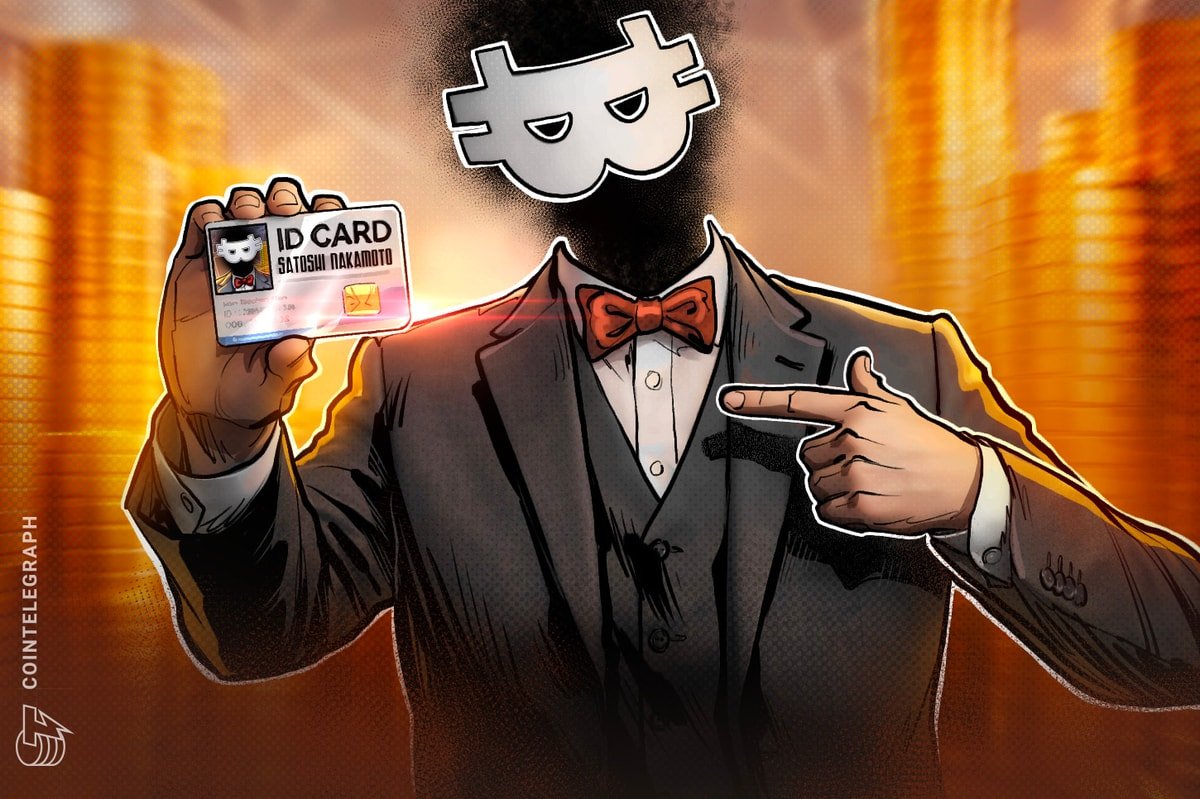
From time to time, individuals claim to be Satoshi Nakamoto, Bitcoin’s pseudonymous creator. Such announcements generate headlines, spark heated debates and trigger instant skepticism. Yet after years of assertions, lawsuits, leaked files and media interviews, no claim has been backed by definitive proof.

The reason is simple. Proving someone is Satoshi is not a matter of storytelling, credentials or courtroom victories. It is a cryptographic problem governed by unforgiving rules.

Nakamoto built Bitcoin (BTC) to function as a peer-to-peer (P2P) cryptocurrency without requiring trust in people. It is widely assumed that Satoshi Nakamoto is an adopted name rather than a real one. As a result, anyone who claims to be Satoshi, or is presented as such, must prove that identity. That proof would likely involve identity documents, historical communication records and, most critically, control of a private key associated with one of Bitcoin’s earliest addresses.

Over the years, several individuals have been speculated to be Satoshi Nakamoto, but only a few have publicly claimed to be the creator of Bitcoin.

The most prominent claimant is Craig Steven Wright, who repeatedly asserted that he was Satoshi. That claim collapsed after a UK High Court ruling explicitly determined he was not Satoshi Nakamoto and sharply criticized the credibility of his evidence.

Dorian S. Nakamoto was identified by Newsweek in 2014 as Satoshi Nakamoto, but he immediately denied any connection to Bitcoin’s creator. Early Bitcoin pioneer Hal Finney also rejected speculation that he was Satoshi Nakamoto before his passing. Nick Szabo has likewise been speculated to be Satoshi over the years and has consistently denied the claim.

What constitutes genuine proof of ownership in Bitcoin

In cryptographic systems like Bitcoin, identity is bound to private key ownership. Demonstrating control requires signing a message with that key, a process that anyone can verify publicly.

This distinction is clear:

  • Evidence can be debated, interpreted or challenged.

  • Cryptographic verification is binary; it either checks out or it does not.

Bitcoin’s verification model does not rely on authority, credentials or expert consensus. It depends on mathematics, not people, institutions or opinion.

Did you know? Early Bitcoin forum posts and the white paper used British spellings like “colour” and “favour.” This sparked theories about Satoshi’s geographic background, though linguists caution that spelling alone can be easily imitated or deliberately altered.

The gold standard: Signing with early keys

The most conclusive proof of being Satoshi would be a public message signed using a private key from one of Bitcoin’s earliest blocks, particularly those associated with Satoshi’s known mining activity in 2009.

Such a signature would be:

  • Verifiable by anyone using standard tools

  • Impossible to forge without the actual private key

  • Free from dependence on courts, media or trusted third parties.

The tools required for such proof are simple, accessible and decisive, yet no one has ever provided it.

Did you know? Satoshi gradually stepped away from public communication in 2010, just as Bitcoin started attracting developers and media attention. Their final known message suggested they had “moved on to other things,” fueling speculation about motive and timing.

Moving early coins: Even more powerful, but improbable

An even stronger demonstration would be transferring Bitcoin from an untouched Satoshi-era wallet. That single onchain action would dispel nearly all doubt.

Yet it carries massive downsides:

  • Instant worldwide scrutiny

  • Severe personal security threats

  • Potential tax, legal and regulatory fallout

  • Market disruption from anticipated dumps.

The most ironclad proof is also the most disruptive. It makes inaction a rational choice, even for the true creator.

Did you know? Blockchain researchers estimate that early mining patterns linked to Satoshi may represent roughly 1 million BTC, making those dormant wallets some of the most closely watched in crypto history.

Why documents, emails and code don’t settle the ownership

While emails, draft papers, forum posts and code contributions can support a claim, they do not constitute definitive evidence. Such materials can be forged, edited, selectively leaked or misinterpreted.

Code authorship does not prove key control. In Bitcoin, keys define identity, and everything else is secondary. Analysis of emails, draft papers and forum posts may offer intriguing correlations between an individual and Bitcoin, but it lacks certainty. The samples are limited, and styles can overlap or be mimicked.

In social settings or conventional legal disputes, identity can be supported by personal testimony or documentation. However, such evidence is irrelevant within Bitcoin’s decentralized model.

Human memory is fallible, and incentives can be misaligned. Bitcoin was designed specifically to avoid reliance on such factors. Cryptographic proof removes any human role from the verification process.

Why partial proof is not proof

Some claimants offer evidence behind closed doors. However, material shown only to select individuals, or signatures produced using later Bitcoin keys, does not meet the required standard.

To convince the world, proof must be:

  • Public: Visible to anyone

  • Reproducible: Independently verifiable

  • Direct: Tied to Satoshi-era keys.

Anything less leaves room for doubt, which is unacceptable to the Bitcoin community.

For Bitcoin to function, its creator does not need to be known or visible. On the contrary, its decentralization narrative is strengthened by the creator’s absence. There is no founder to defer to, no authority to appeal to and no identity to attack or defend.

While most organizations or projects rely on founders or management teams, Bitcoin functions precisely because identity is irrelevant.

Read the full article here

Fact Checker

Verify the accuracy of this article using AI-powered analysis and real-time sources.

Get Your Fact Check Report

Enter your email to receive detailed fact-checking analysis

5 free reports remaining

Continue with Full Access

You've used your 5 free reports. Sign up for unlimited access!

Already have an account? Sign in here

Share. Facebook Twitter Pinterest LinkedIn Tumblr Email Telegram Copy Link
News Room
  • Website
  • Facebook
  • X (Twitter)
  • Instagram
  • LinkedIn

The FSNN News Room is the voice of our in-house journalists, editors, and researchers. We deliver timely, unbiased reporting at the crossroads of finance, cryptocurrency, and global politics, providing clear, fact-driven analysis free from agendas.

Related Articles

Cryptocurrency & Free Speech Finance

Hong Kong (HKSAR) to continue support of local digital asset community, chief executive says

6 minutes ago
Cryptocurrency & Free Speech Finance

SafeMoon CEO Given 8-Year Jail Time Over Crypto Scam

8 minutes ago
Cryptocurrency & Free Speech Finance

Citadel Securities Teams Up With LayerZero on New Blockchain Push

11 minutes ago
Cryptocurrency & Free Speech Finance

Crypto’s banker adversaries didn’t want to deal in latest White House meeting on bill

1 hour ago
Cryptocurrency & Free Speech Finance

Sam Bankman-Fried Seeks New Trial in FTX Fraud Case

1 hour ago
Cryptocurrency & Free Speech Finance

Discord Downplays Timing, Impact of Its New Age-Verification Policy

1 hour ago
Add A Comment
Leave A Reply Cancel Reply

Editors Picks

SafeMoon CEO Given 8-Year Jail Time Over Crypto Scam

8 minutes ago

Citadel Securities Teams Up With LayerZero on New Blockchain Push

11 minutes ago

Can Congress Get ‘YIMBY Grants’ Right?

44 minutes ago

CPJ: Cuba’s detention of content producers stifles access to information 

58 minutes ago
Latest Posts

Crypto’s banker adversaries didn’t want to deal in latest White House meeting on bill

1 hour ago

Sam Bankman-Fried Seeks New Trial in FTX Fraud Case

1 hour ago

Discord Downplays Timing, Impact of Its New Age-Verification Policy

1 hour ago

Subscribe to News

Get the latest news and updates directly to your inbox.

At FSNN – Free Speech News Network, we deliver unfiltered reporting and in-depth analysis on the stories that matter most. From breaking headlines to global perspectives, our mission is to keep you informed, empowered, and connected.

FSNN.net is owned and operated by GlobalBoost Media
, an independent media organization dedicated to advancing transparency, free expression, and factual journalism across the digital landscape.

Facebook X (Twitter) Discord Telegram
Latest News

Hong Kong (HKSAR) to continue support of local digital asset community, chief executive says

6 minutes ago

SafeMoon CEO Given 8-Year Jail Time Over Crypto Scam

8 minutes ago

Citadel Securities Teams Up With LayerZero on New Blockchain Push

11 minutes ago

Subscribe to Updates

Get the latest news and updates directly to your inbox.

© 2026 GlobalBoost Media. All Rights Reserved.
  • Privacy Policy
  • Terms of Service
  • Our Authors
  • Contact

Type above and press Enter to search. Press Esc to cancel.

🍪

Cookies

We and our selected partners wish to use cookies to collect information about you for functional purposes and statistical marketing. You may not give us your consent for certain purposes by selecting an option and you can withdraw your consent at any time via the cookie icon.

Cookie Preferences

Manage Cookies

Cookies are small text that can be used by websites to make the user experience more efficient. The law states that we may store cookies on your device if they are strictly necessary for the operation of this site. For all other types of cookies, we need your permission. This site uses various types of cookies. Some cookies are placed by third party services that appear on our pages.

Your permission applies to the following domains:

  • https://fsnn.net
Necessary
Necessary cookies help make a website usable by enabling basic functions like page navigation and access to secure areas of the website. The website cannot function properly without these cookies.
Statistic
Statistic cookies help website owners to understand how visitors interact with websites by collecting and reporting information anonymously.
Preferences
Preference cookies enable a website to remember information that changes the way the website behaves or looks, like your preferred language or the region that you are in.
Marketing
Marketing cookies are used to track visitors across websites. The intention is to display ads that are relevant and engaging for the individual user and thereby more valuable for publishers and third party advertisers.