Close Menu
FSNN | Free Speech News NetworkFSNN | Free Speech News Network
  • Home
  • News
    • Politics
    • Legal & Courts
    • Tech & Big Tech
    • Campus & Education
    • Media & Culture
    • Global Free Speech
  • Opinions
    • Debates
  • Video/Live
  • Community
  • Freedom Index
  • About
    • Mission
    • Contact
    • Support
Trending

Our Coblogger Stewart Baker Has Died

31 minutes ago

You Installed Hermes. Now Make It Look Better Than ChatGPT or Claude

60 minutes ago

Policy Summit and other things at Consensus 2026: State of Crypto

2 hours ago
Facebook X (Twitter) Instagram
Facebook X (Twitter) Discord Telegram
FSNN | Free Speech News NetworkFSNN | Free Speech News Network
Market Data Newsletter
Sunday, May 3
  • Home
  • News
    • Politics
    • Legal & Courts
    • Tech & Big Tech
    • Campus & Education
    • Media & Culture
    • Global Free Speech
  • Opinions
    • Debates
  • Video/Live
  • Community
  • Freedom Index
  • About
    • Mission
    • Contact
    • Support
FSNN | Free Speech News NetworkFSNN | Free Speech News Network
Home»News»Media & Culture»The Supreme Court Is Poised To Remind States That the Constitution Doesn’t Stop at the Liquor Store
Media & Culture

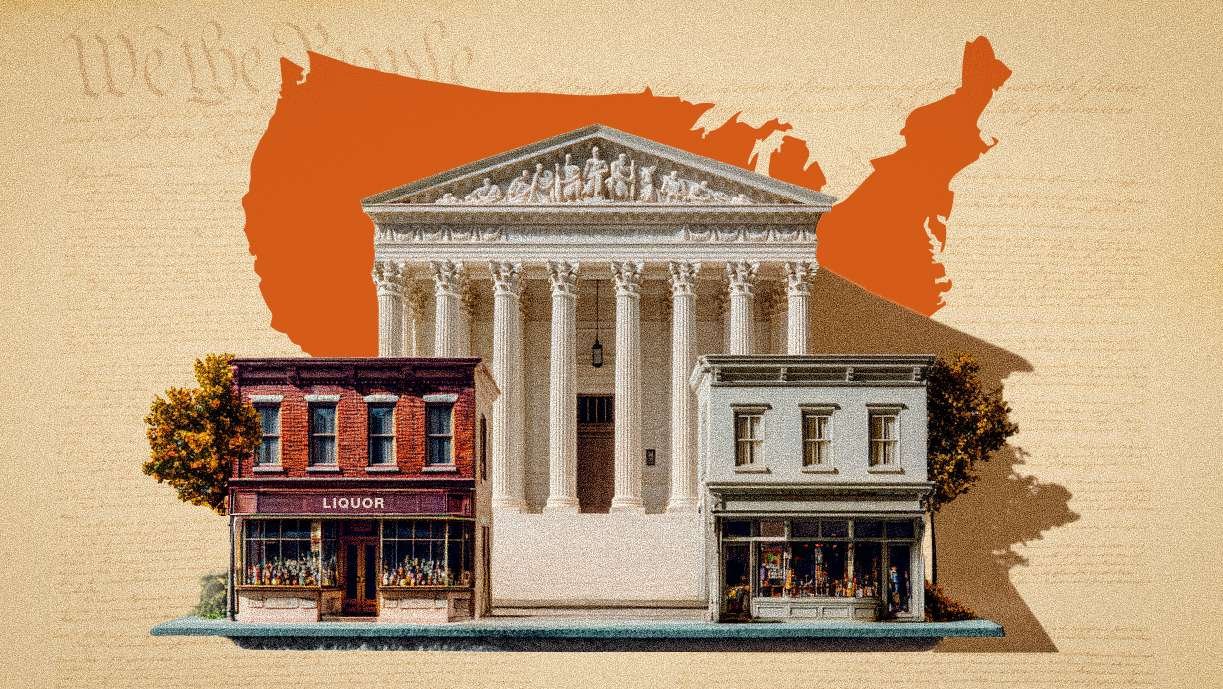
The Supreme Court Is Poised To Remind States That the Constitution Doesn’t Stop at the Liquor Store

News RoomBy News Room3 months agoNo Comments4 Mins Read386 Views
Share Facebook Twitter Pinterest Copy Link LinkedIn Tumblr Email VKontakte Telegram
The Supreme Court Is Poised To Remind States That the Constitution Doesn’t Stop at the Liquor Store
Share
Facebook Twitter Pinterest Email Copy Link

Listen to the article

0:00
0:00

Key Takeaways

Playback Speed

Select a Voice

Twice in the past two decades, the U.S. Supreme Court has heard landmark cases involving protectionist alcohol laws, and twice the Court has made it clear that when states discriminate against out-of-state alcohol businesses, they are running afoul of the U.S. Constitution. But so far, many lower courts have refused to listen. Now, the Supreme Court may be poised to step in and clarify once and for all that, when it comes to alcohol, regulators cannot simply ignore the Constitution.  

The latest case arises out of Arizona, where several wine enthusiasts have brought a legal challenge to the state’s requirement that all wine retailers must have an in-state physical storefront in order to ship wine directly to Arizona consumers. The challengers argue that this physical presence requirement violates the so-called Dormant Commerce Clause, which forbids states from unduly interfering with interstate commerce by discriminating against out-of-state economic interests.  

Requiring in-state storefronts puts a damper on what’s known as direct-to-consumer alcohol shipping, whereby out-of-state wine retailers could ship their products right to the doorsteps of Arizona customers. Since it is financially impossible for most out-of-state wine shops to open up brick-and-mortar storefronts in Arizona, the rule effectively locks out-of-state competitors out of the wine shipping market in the state.

The Supreme Court has grappled with similar questions before. In the 2005 case Granholm v. Heald, the Supreme Court struck down in-state physical presence requirements for wineries (but not wine retailers), thereby freeing up out-of-state wineries to ship across state lines directly to consumers. In 2019, the Court stepped into the fray again, striking down a Tennessee law that required liquor store owners to be residents of the state for multiple years before they were eligible to receive a retailing license.

The import of these landmark cases is clear: States cannot enact protectionist alcohol laws that discriminate against out-of-state economic interests unless they can show that such rules promote legitimate, nonprotectionist interests such as public health and safety. Instead of following these straightforward holdings, numerous lower courts have continued to narrowly interpret them or create manufactured loopholes to evade them.

Leading the charge is the infamous 9th Circuit, which has adopted what’s known as the “essential feature” test for evaluating alcohol laws like Arizona’s. Under this test, the 9th Circuit held that because Arizona’s in-state physical presence mandate was an “essential feature” of the state’s three-tier system of alcohol regulation, the law was immunized from a Dormant Commerce Clause challenge.

In the 9th Circuit’s view, the three-tier system—which requires that alcohol producers, wholesalers, and retailers all be legally distinct entities—is vital to the regulation of alcohol in America today. Therefore, if out-of-state wine retailers were allowed to ship directly to Arizona residents without an in-state physical storefront, they’d be bypassing the wholesaling and retailing tiers in Arizona.

Under the framing of the “essential feature” test, courts are simply able to deem discrete alcohol laws to be “essential” to the three-tier system, which in turn creates a get-out-of-jail-free card that inoculates these protectionist laws from constitutional scrutiny. Not only is the 9th Circuit’s test an obvious and willful evasion of past Supreme Court holdings, but it doesn’t even make sense on its own merits.

Alcohol delivery has exploded since COVID-19, as the vast majority of states have implemented some form of pro-delivery reform for booze. Regulating this delivery wave has proven relatively straightforward, with states using simple licensing and permitting rules.

Just like a brewery, winery, bar, or liquor store needs to obtain a license in order to operate, alcohol delivery likewise requires a license. If a retail shop proceeds to deliver or ship alcohol in a shady or dangerous way, the license can simply be revoked—just like a bar that is caught in a sting for serving underage patrons.

Requiring in-state storefronts is as non-essential a feature of the alcohol regulatory system as one can imagine. Moreover, 13 states plus Washington, D.C., already allow out-of-state wine retail shops to ship their products directly to in-state residents. All of these states have a three-tier system just like Arizona, further underscoring that in-state physical storefronts are entirely non-essential.

Given this backdrop, it’s clear that the 9th Circuit’s “essential feature” test is detached from the on-the-ground reality of how alcohol regulation actually works. Simply allowing states to deem parts of their alcohol regulatory code as “essential,” and thus magically escape a constitutional challenge, is an obvious sidestepping of the Supreme Court’s past decisions.

The Manhattan Institute and Reason Foundation have filed an amicus brief in support of petitioners in the Arizona case. Perhaps the third time this goes to the Supreme Court will be the charm.

Read the full article here

Fact Checker

Verify the accuracy of this article using AI-powered analysis and real-time sources.

Get Your Fact Check Report

Enter your email to receive detailed fact-checking analysis

5 free reports remaining

Continue with Full Access

You've used your 5 free reports. Sign up for unlimited access!

Already have an account? Sign in here

#CivicEngagement #Journalism #MediaAccountability #NarrativeControl #NewsAnalysis
Share. Facebook Twitter Pinterest LinkedIn Tumblr Email Telegram Copy Link
News Room
  • Website
  • Facebook
  • X (Twitter)
  • Instagram
  • LinkedIn

The FSNN News Room is the voice of our in-house journalists, editors, and researchers. We deliver timely, unbiased reporting at the crossroads of finance, cryptocurrency, and global politics, providing clear, fact-driven analysis free from agendas.

Related Articles

Media & Culture

Our Coblogger Stewart Baker Has Died

31 minutes ago
Cryptocurrency & Free Speech Finance

You Installed Hermes. Now Make It Look Better Than ChatGPT or Claude

60 minutes ago
Media & Culture

Reversing the Global Decline of Democracy’s Most Essential Freedom”

3 hours ago
Media & Culture

"Martial Home"

4 hours ago
Cryptocurrency & Free Speech Finance

North Korea’s Crypto Hack Playbook Won’t Work on Canton Network, Says Digital Asset CEO

5 hours ago
Media & Culture

Punctuation Matters. At the Heart of This Case Is the Placement of a Comma

8 hours ago
Add A Comment

Comments are closed.

Editors Picks

You Installed Hermes. Now Make It Look Better Than ChatGPT or Claude

60 minutes ago

Policy Summit and other things at Consensus 2026: State of Crypto

2 hours ago

Reversing the Global Decline of Democracy’s Most Essential Freedom”

3 hours ago

OFAC Said Seized Wallets Were Iranian; Analysis Finds Other State Actors More Likely

3 hours ago
Latest Posts

"Martial Home"

4 hours ago

Can Bitcoin Seal its Best Weekly Close in Over Three Months?

4 hours ago

Crypto is at the bottom of U.S. voters’ priorities heading into the midterm, CoinDesk survey shows

5 hours ago

Subscribe to News

Get the latest news and updates directly to your inbox.

At FSNN – Free Speech News Network, we deliver unfiltered reporting and in-depth analysis on the stories that matter most. From breaking headlines to global perspectives, our mission is to keep you informed, empowered, and connected.

FSNN.net is owned and operated by GlobalBoost Media
, an independent media organization dedicated to advancing transparency, free expression, and factual journalism across the digital landscape.

Facebook X (Twitter) Discord Telegram
Latest News

Our Coblogger Stewart Baker Has Died

31 minutes ago

You Installed Hermes. Now Make It Look Better Than ChatGPT or Claude

60 minutes ago

Policy Summit and other things at Consensus 2026: State of Crypto

2 hours ago

Subscribe to Updates

Get the latest news and updates directly to your inbox.

© 2026 GlobalBoost Media. All Rights Reserved.
  • Privacy Policy
  • Terms of Service
  • Our Authors
  • Contact

Type above and press Enter to search. Press Esc to cancel.

🍪

Cookies

We and our selected partners wish to use cookies to collect information about you for functional purposes and statistical marketing. You may not give us your consent for certain purposes by selecting an option and you can withdraw your consent at any time via the cookie icon.

Cookie Preferences

Manage Cookies

Cookies are small text that can be used by websites to make the user experience more efficient. The law states that we may store cookies on your device if they are strictly necessary for the operation of this site. For all other types of cookies, we need your permission. This site uses various types of cookies. Some cookies are placed by third party services that appear on our pages.

Your permission applies to the following domains:

  • https://fsnn.net
Necessary
Necessary cookies help make a website usable by enabling basic functions like page navigation and access to secure areas of the website. The website cannot function properly without these cookies.
Statistic
Statistic cookies help website owners to understand how visitors interact with websites by collecting and reporting information anonymously.
Preferences
Preference cookies enable a website to remember information that changes the way the website behaves or looks, like your preferred language or the region that you are in.
Marketing
Marketing cookies are used to track visitors across websites. The intention is to display ads that are relevant and engaging for the individual user and thereby more valuable for publishers and third party advertisers.