

 Freedom Index
Listen to the article
From Chief Judge James Boasberg’s decision Tuesday in U.S. v. Carey (D.D.C.):
You cannot falsely shout fire in a crowded theater. What about lighting a fire in a crowded park? After President Donald Trump issued an executive order directing the Department of Justice to prosecute anyone who engages in the protected speech of burning the American flag, Defendant Jan Carey marched to Lafayette Park and burned a flag in protest.
He stands charged with violating park regulations that prohibit setting a fire outside a designated area or receptacle and lighting a fire that damages property or threatens public safety…. The Court holds that the regulations do indeed apply to Carey’s flag burning, but it finds that he is entitled to proceed with a further inquiry into whether he is being prosecuted to punish him for his allegedly illegal actions or for his constitutionally protected speech….
The First Amendment protects burning the American flag. Texas v. Johnson (1989). Yet last August, President Trump issued an executive order decrying flag burning and announcing, “My Administration will … prosecute those who … otherwise violate our laws while desecrating this symbol of our country, to the fullest extent permissible under any available authority.” The order noted that flag burning might violate several “content-neutral laws” that fight “harm unrelated to expression, … such as open burning restrictions … or destruction of property laws.”
Outraged, Carey grabbed an American flag and headed to Lafayette Park, which sits right across from the White House. He laid the flag down on a brick path and, clutching a lighter in one hand and a megaphone in the other, declared that he had served in the Army for twenty years and “fought for every single one of your rights to express yourself …. There’s a First Amendment right to burn the American flag. The [President] signed an executive order today saying that it was illegal to burn the American flag.” Gesturing at the White House, Carey announced, “I’m burning this flag as a protest to that illegal fascist President that sits in that house.” He then bent down and lit the flag on fire. Officers on the scene eventually extinguished the burning flag, leaving its charred remains and some scorched bricks underneath….
[Carey] was charged with the misdemeanors of (1) “[l]ighting or maintaining a fire” that was not “in designated areas or receptacles and under conditions that may be established by the superintendent,” and (2) “[l]ighting, tending, or using a fire … in a manner that threatens, causes damage to, or results in the burning of property … or park resources, or creates a public safety hazard.” …
The court concluded that Carey’s conduct was indeed forbidden by National Park Service regulations. But it also concluded that he might be entitled to have the case against him dismissed on the grounds that this was a “vindictive prosecution” motivated not by a desire to neutrally enforce the burning rules but (to oversimplify a longish discussion) a desire to target the message of the flagburning:
The Court finds plausible the position that Carey’s prosecution is actually vindictive, but it cannot yet definitively decide the question. Consider both sides of the scale.
On one, the President directed the Department of Justice to target anyone who engaged in a particular form of protected speech and to bring any charges it could against him. When deciding what to do with Carey, officers discussed this order and implied that it was relevant to their choice. Wong, the supervising officer, mused that “the President just today signed an executive order [that] says we’re arresting him.” Other officers on the scene commented that “[t]he only thing is that executive order went out today for flag burning,” and surmised that prosecutors might base their charging decision on the order: “Trump signed an executive order for the flag stuff, so I don’t know if they’re gonna try to charge that federally or not.”
While the current record contains little direct evidence of prosecutors’ thinking, the executive order directed the Department of Justice to “prosecute those who … otherwise violate our laws while desecrating this symbol of our country, to the fullest extent permissible under any available authority.” Once police had brought prosecutors the case, it is hard to believe that they would feel free to defy the President by declining to charge Carey. The Court therefore questions whether prosecutors could make an independent judgment of the merits of charging an arrested flag burner, raising a strong possibility that Carey would not have been prosecuted but for his speech.
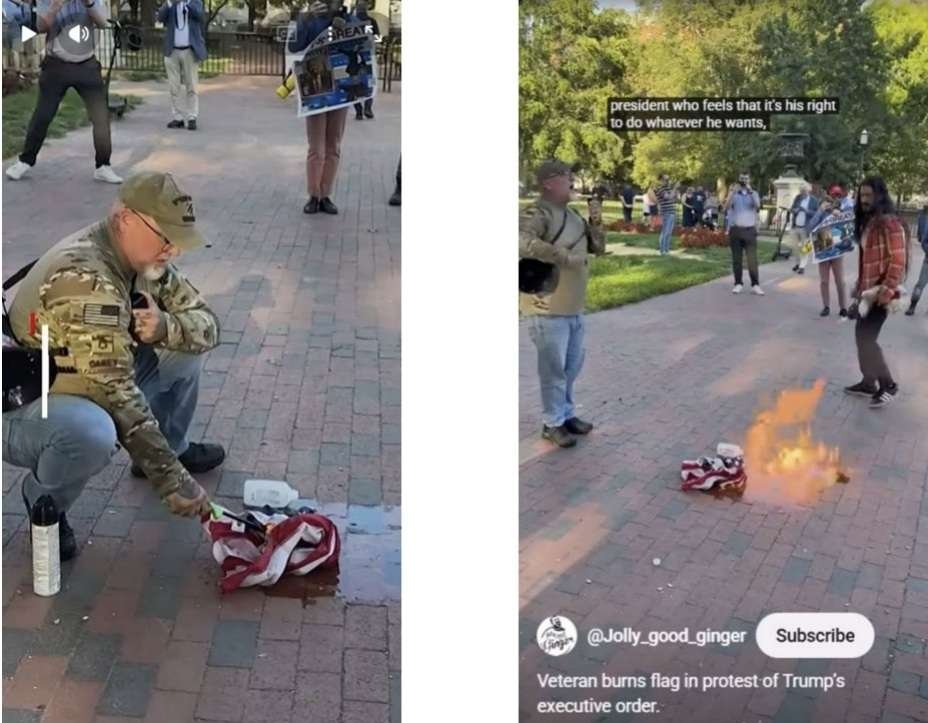
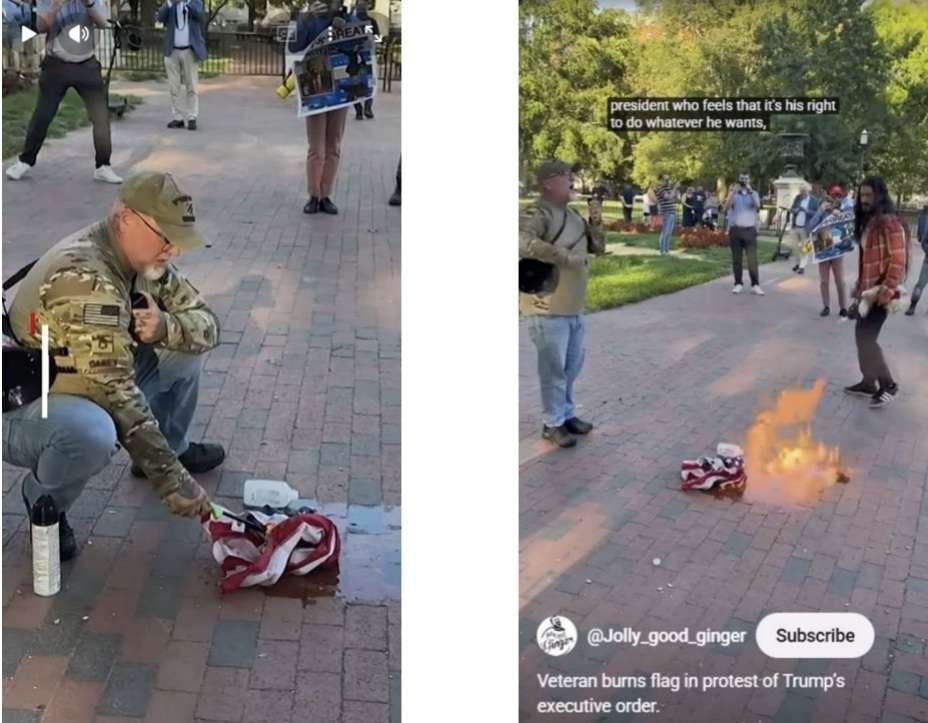
On the other side of the scale, it also seems plausible that Carey was charged because of the fire he lit, not the flag he burned. Judge for yourself:
The fire is not contained. As seen in the photo on the left, Carey seems to have dumped isopropyl alcohol on the flag and left a trail of the fuel leading from the burning flag to the plastic alcohol bottle lying nearby. The same photo shows what appears to be a pressurized canister of bug spray [allegedly used as an accelerant] sitting a few feet from the flame. Bystanders are nearby, and Carey did not put up any barriers to keep them away from the fire. Nor does Carey seem to have had anything with which he could put the fire out if something had gone wrong. And the fire damaged the bricks underneath it.
There is therefore strong but not decisive evidence suggesting that officials had both a vindictive motive and an independent justification to bring these charges. The Court thus cannot confidently find on the current record whether this prosecution is actually vindictive.
It can, however, seek more information. To obtain discovery in a vindictive-prosecution claim, defendants must clear a hurdle. See U.S. v. Armstrong (1996) (“Discovery” into allegedly improper prosecution “will divert prosecutors’ resources and may disclose the Government’s prosecutorial strategy[,] … thus requir[ing] a … rigorous standard for discovery in aid of such a claim.”)…. “[A] defendant must provide some evidence tending to show the existence of the essential elements of the defense.” That showing does not mean proof, but it requires “a colorable claim,” which is itself a “demanding” standard. Applying it to the elements of vindictive prosecution, Carey must offer some evidence tending to show that he would not have been prosecuted but for his protected speech.
Carey easily clears that bar. The executive order directing prosecutors to find charges to pin on flag burners, not to mention officers’ statements suggesting that the order might have played a role in Carey’s prosecution, each creates a colorable claim that the Government is punishing Carey for exercising his First Amendment rights. He has therefore shown enough evidence of actual vindictiveness to merit further inquiry.
If Carey instead travels the path of circumstantial evidence triggering a presumption, he arrives at the same place. He has certainly established a presumption. Any time a policy directs the Department of Justice to find charges to bring against people who exercise their rights in disfavored ways, the odds of vindictiveness are high indeed. Imagine if the President signed an executive order instructing prosecutors to add all charges they possibly could against any defendant who demands a jury trial. If a defendant exercised that right and prosecutors then acted consistently with the order, courts would have no problem smelling a risk of retaliation. Carey’s case thus fits a general fact pattern in which there is a realistic likelihood of vindictiveness.
The burden thus shifts to the Government to rebut the presumption with record evidence that justifies its action. As discussed above, the record shows that Defendant lit a risky fire that seemed to damage federal property. That gave the Government a good-faith basis to believe that Carey had violated federal law, which would justify prosecuting him.
The burden then shifts back to Carey to show that the justification is pretextual. He has produced an executive order that singles out people who engage in disfavored speech and tells prosecutors to find crimes to charge them with, as well as statements by officers that suggest this order may have influenced the Government’s choices here. The Court does not find that evidence decisive. But it does find that it creates a colorable claim of pretext—which, once again, entitles Carey to proceed further….
Mara E. Verheyden-Hilliard and Nick Place (Partnership for Civil Justice Fund) and Tezira Abe (D.C. Federal Public Defender’s office) represent Carey.
Read the full article here
Fact Checker
Verify the accuracy of this article using AI-powered analysis and real-time sources.