

 Freedom Index
Listen to the article
This video is based on an essay by Francisco Ceballos and narrated by Zoe Booth.
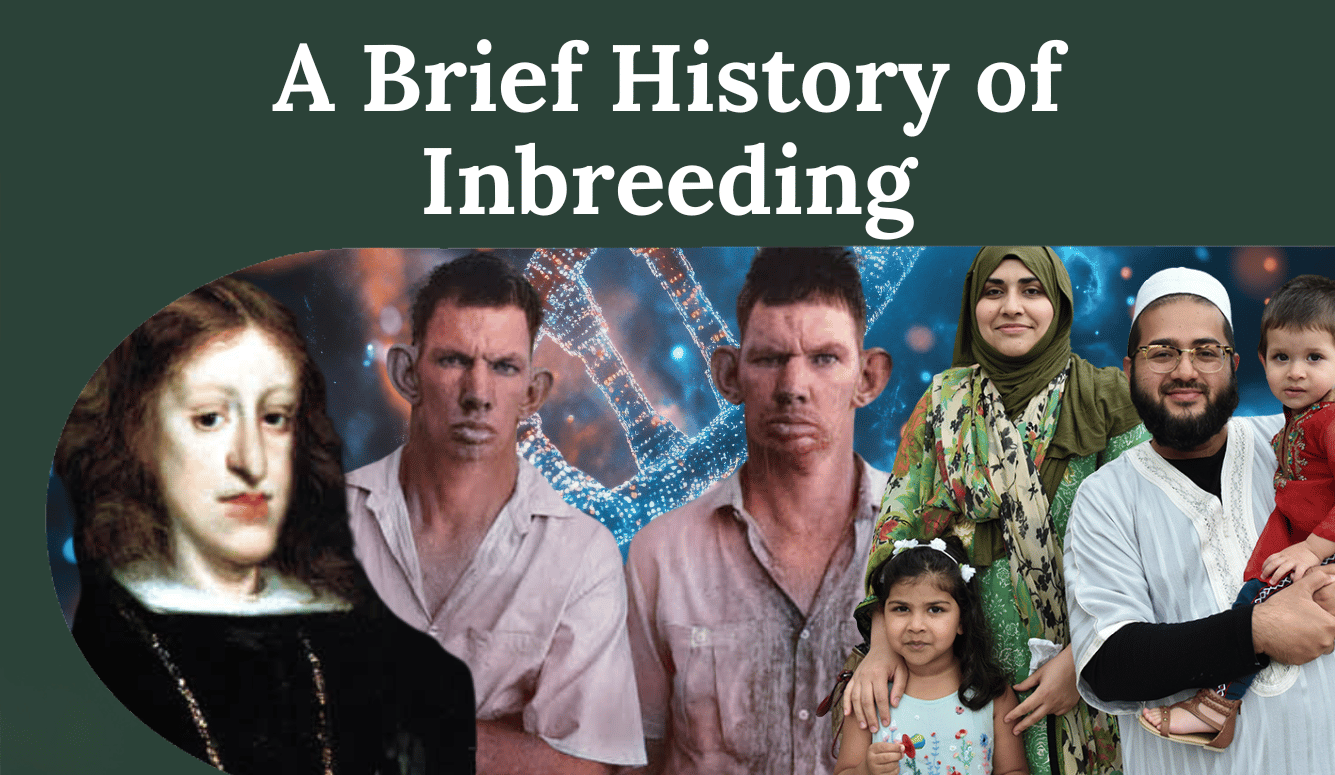
Claims that Ilhan Omar married her brother have circulated online since 2016, resurfacing periodically as a piece of political misinformation. The allegation is false and repeatedly debunked. But as this video essay argues, the persistence of the rumour reveals something deeper than partisan gossip. It touches an ancient and pervasive human anxiety about inbreeding—an anxiety that long predates modern politics, religion, or even settled agriculture.
Drawing on genetics, history, and anthropology, the video examines how human societies have regulated kinship and reproduction, often bending moral rules when power, inheritance, or social cohesion were at stake. From royal dynasties in Europe to widespread cousin marriage in parts of the modern world, practices of consanguinity have left measurable biological traces.
Advances in genomics now allow researchers to identify these traces directly, through runs of homozygosity that reveal patterns of relatedness and genetic risk. As the evidence accumulates, the video argues, liberal societies face an uncomfortable tension between cultural sensitivity and public-health realism. Ignoring the biology of kinship may feel tolerant, but it carries real costs.
The essay is based on the work of biologist Francisco Ceballos, whose research explores how inbreeding has shaped human history and health.
The Hidden Health Cost of Cousin Marriage and Inbreeding
How kinship, culture, and genetics shaped one of humanity’s oldest taboos.
Transcript
View full transcript
Did Ilhan Omar marry her brother? This claim went viral on Twitter, but is it true? Well no, it’s not.
This claim has been circulating since 2016 and has been dismissed repeatedly, but it keeps coming up from the political graveyard every election, every election cycle. Trump revived it again in 2025, calling it proof of immigration fraud, but there’s no DNA evidence and no confirmed records.
But this rumor, absurd or not, taps into something far older than partisan gossip. It scratches at a deep cultural anxiety—one that predates America, predates Islam, predates even agriculture: the fear of inbreeding.
From ancient myths to modern medicine, humans have drawn a moral line at incest. Yet that same moral boundary has often been bent—or quietly erased—when the stakes were high enough. Marriages between cousins, uncles and nieces, even siblings, have been practiced by emperors and prophets, peasants and popes. And today, with the tools of genetic science, we’re beginning to see—in unambiguous detail—what these choices have done to our bodies, our genomes, and our societies.
So let’s strip away the rumor, the scandal, and the political posturing. Let’s ask a harder question: what happens when humans mate with their relatives—not metaphorically, but genetically?
First, we need to distinguish between accidental inbreeding and intentional consanguinity.
The first kind happens when a population is small, isolated, and intermarrying not by design, but by necessity. This is called endogamy—marrying within a closed group. You might find it in mountain villages, desert oases, or isolated religious sects. Over generations, everyone becomes related, whether they know it or not. The gene pool shrinks, and genetic diversity begins to fade like a worn-out photocopy.
The second kind is deliberate. This is consanguinity: choosing to marry within your family—often first cousins—for reasons of culture, class, inheritance, or religion. In some societies, cousin marriage is seen as a way to keep wealth in the family, or to strengthen clan ties. In others, it’s simply tradition. This kind of inbreeding isn’t random—it’s symbolic. It’s not about geography. It’s about meaning.
And for centuries, that meaning shaped human history. The royal houses of Europe practically turned inbreeding into a political strategy. Genealogies were their laboratory, and power the prize. The Catholic Church, at times, banned cousin marriage—until it needed a dispensation. In Islam, first-cousin marriage is lawful and historically common, partly because the Qur’an forbids closer relations, but not cousins. The Prophet’s cousin married his daughter, setting a precedent that echoes across the Muslim world.
What we see, again and again, is a tension between biology and culture—between what keeps lineages pure and what keeps populations healthy.
And now, thanks to modern genomics, we can measure that tension with precision.
Here’s the science: every person carries two copies of each gene—one from each parent. Normally, those copies are slightly different. That difference is what makes us robust. It protects us from recessive diseases and gives us genetic resilience.
But when both copies come from the same ancestor—when a child inherits identical versions of a gene from both sides—that region of DNA becomes homozygous, meaning it’s the same by descent. These stretches of identical DNA are called runs of homozygosity, or ROH.
And ROH don’t lie. They reveal how closely your parents were related. Long stretches mean close kinship—siblings, first cousins. Shorter ones suggest more distant overlap. And the sobering truth? We all have them. Even the most outbred populations carry the fingerprints of ancient inbreeding. Humanity, after all, came from small, scattered groups. Our family trees, mathematically speaking, fold back on themselves.
But here’s the rub: the more homozygosity in your genome, the higher your risk of recessive genetic disorders. The arithmetic is brutal. In the general population, a rare disease might affect one in 10,000 children. Among the offspring of first cousins? That risk can be five, even seven times higher.
But that’s just the start.
Inbreeding also leads to what geneticists call inbreeding depression—a subtle but consistent decline in fitness. Fertility drops. Infant mortality rises. Cognitive and physical development slow down. Charles Darwin noticed it in plants. He bred them, self-fertilized them, and watched as their vitality withered over generations. The same principle applies to humans.
Let’s make this concrete.
In the city of Bradford, in northern England, roughly a quarter of marriages are between first cousins. It’s a city with universal healthcare and high-quality public services. And yet, researchers found that children from consanguineous unions had 181 percent higher mortality than their peers. They made more GP visits, had more prescriptions, more emergency admissions. Their rates of learning difficulties were 89 percent higher. Speech and language problems—63 percent higher. By age ten, they were 38 percent less likely to meet developmental benchmarks.
This is not about poverty. This is not about access. It’s about genetics.
And Bradford is not unique. In Pakistan, cousin marriages lead to a 2.9-fold increase in autosomal recessive disease. In Saudi Arabia and Qatar, metabolic disorders are several times more common than global averages—directly traceable to consanguinity.
What’s remarkable is how consistent these findings are across geographies and cultures. A meta-analysis of nearly 48,000 consanguineous unions found a 4.4 percent increase in pre-reproductive mortality. These numbers are not trivial. They echo through families, through healthcare systems, through entire societies.
And yet… try talking about it.
In 2024, when a British MP raised the issue of cousin marriage as a public-health concern, he was accused of bigotry. When the NHS published guidance on the risks, it quietly removed the document under pressure.
Why? Because in modern liberal societies, the biology of kinship has become taboo. We speak frankly about smoking, about obesity, about alcohol. We calculate their costs in years of life lost, in hospital visits, in tax burdens. But when the same logic applies to culturally sensitive practices—like cousin marriage—we get nervous.
Science becomes politicised. Clarity is traded for caution.
But the genome doesn’t care about your politics. It doesn’t care about your feelings. It operates with cold, mathematical consistency. When genetic diversity narrows, risk expands.
To talk about cousin marriage isn’t to shame. It isn’t to judge. It’s to acknowledge a risk factor—one that, like all others, deserves to be understood, not ignored.
Ten percent of the global population today descends from cousin unions. This isn’t a fringe issue. It’s a contemporary human reality. And pretending otherwise doesn’t help anyone—least of all the families most affected.
Inbreeding is not just a moral idea. It is a biological process with measurable consequences. And if we believe in intellectual honesty, in public health, and in human dignity, then we should be willing to look it in the face.
This video is based entirely on the work of biologist Francisco Ceballos, whose essay for Quillette explores the genetic, cultural, and historical dimensions of inbreeding with remarkable clarity. Ceballos holds a PhD from the University of Santiago de Compostela and combines expertise in genetics, bioinformatics, and statistical modelling to study how patterns of homozygosity and consanguinity have shaped human history and health. His original essay, titled “Inbreeding: A Natural Experiment in Human Genetics”, provides the scientific and philosophical foundation for everything discussed here. You can read it in full at http://Quillette.com .
Chapters
00:00 The Ilhan Omar “brother marriage” claim
00:29 Why fear of inbreeding predates modern politics
00:42 How historical elites used close-kin marriage to consolidate power
01:09 Two paths to inbreeding: endogamy vs consanguinity
01:51 Why cousin marriage persists across cultures
02:18 Religious approaches to cousin marriage
02:59 Homozygosity and what genomes reveal about kinship
03:54 Why increased homozygosity raises disease risk
04:22 Inbreeding depression and elevated genetic risk
04:52 The Bradford case study
05:35 Global data from Pakistan, Saudi Arabia, and Qatar
06:04 Meta-analysis of consanguineous unions
06:19 Why genetic risk became politically taboo
07:13 Global prevalence and contemporary relevance
07:41 Based on Francisco Ceballos’ Quillette essay
Further Reading
If you found this video essay useful, subscribe to the Quillette YouTube channel and browse our video archive.
Subscribe on YouTube
Read the full article here
Fact Checker
Verify the accuracy of this article using AI-powered analysis and real-time sources.