

 Freedom Index

Listen to the article
Financial authorities in India have reiterated concerns over cryptocurrency transactions, warning they may complicate tax enforcement.
India’s Income Tax Department (ITD), under the Central Board of Direct Taxes (CBDT), flagged major risks linked to crypto activity during a parliamentary standing committee on finance, The Times of India reported on Thursday.
The warning came during a Wednesday parliamentary committee meeting involving multiple agencies, including the Financial Intelligence Unit (FIU), the Department of Revenue, and the CBDT, which discussed the report “A Study on Virtual Digital Assets (VDAs) and Way Forward.”
The ITD highlighted challenges posed by offshore exchanges, private wallets and decentralized finance (DeFi) tools, which make detecting taxable income more difficult.
Involvement of multiple jurisdictions complicates tax enforcement
At the committee meeting, ITD officials reportedly flagged how “anonymous, borderless and near-instant” value transfers with crypto could allow one to move funds without regulated financial intermediaries.
The authority also pointed to jurisdictional challenges posed by offshore VDA activity. With multiple jurisdictions involved, tracking transactions and identifying holders for tax purposes is “virtually impossible,” the ITD reportedly said.
“Although there have been efforts in recent months on information sharing, it remains difficult, inhibiting the ability of tax officials to undertake proper assessment and reconstruction of transaction chains,” the report noted.
India levies a flat 30% tax on crypto gains
India levies a flat 30% tax on all profits from crypto asset activity, along with a 1% tax deducted at source (TDS) applied to all transfers, whether profitable or not.
While India formally allows cryptocurrency trading under this heavy tax regime and approved the return of major US exchange Coinbase in 2025, the government’s overall stance toward crypto remains cautious and mixed.
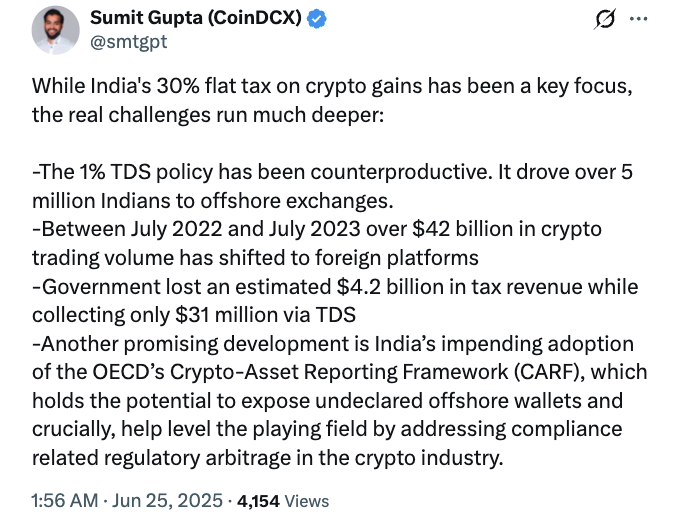
Local executives have previously noted that India’s crypto ecosystem is at a pivotal stage, with adoption rising and the FIU approving 49 crypto exchanges in fiscal year 2024–2025.
Related: India’s central bank urges countries to prioritize CBDCs over stablecoins
However, the current tax framework creates challenges, as losses on crypto transactions are not recognized, generating “friction rather than fairness,” CoinSwitch co-founder Ashish Singhal reportedly said.
Magazine: How crypto laws changed in 2025 — and how they’ll change in 2026
Read the full article here
Fact Checker
Verify the accuracy of this article using AI-powered analysis and real-time sources.