

 Freedom Index
Listen to the article
In an essay from her classic collection Against Interpretation (1966), the writer and critic Susan Sontag identifies two contrasting forms of artistic expression: one aims at arousing the viewer’s emotions, while the other provokes more detached engagement that invites reflection. The idea is strikingly similar to Marshall McLuhan’s distinction between “hot” and “cool” forms of media that provoke different styles of audience engagement. For Sontag, however, the difference is more idiosyncratic than rigorously formal. Cinema, the focus of many of Sontag’s essays, can like any medium be made to serve both hot or cool artistic temperaments and either carnal or spiritual ambitions. As she points out, most directors gravitate to one end of the spectrum or the other. Either they are consistently antic, like the Spanish filmmaker Luis Buñuel, or elliptical and reserved like the French director Robert Bresson.
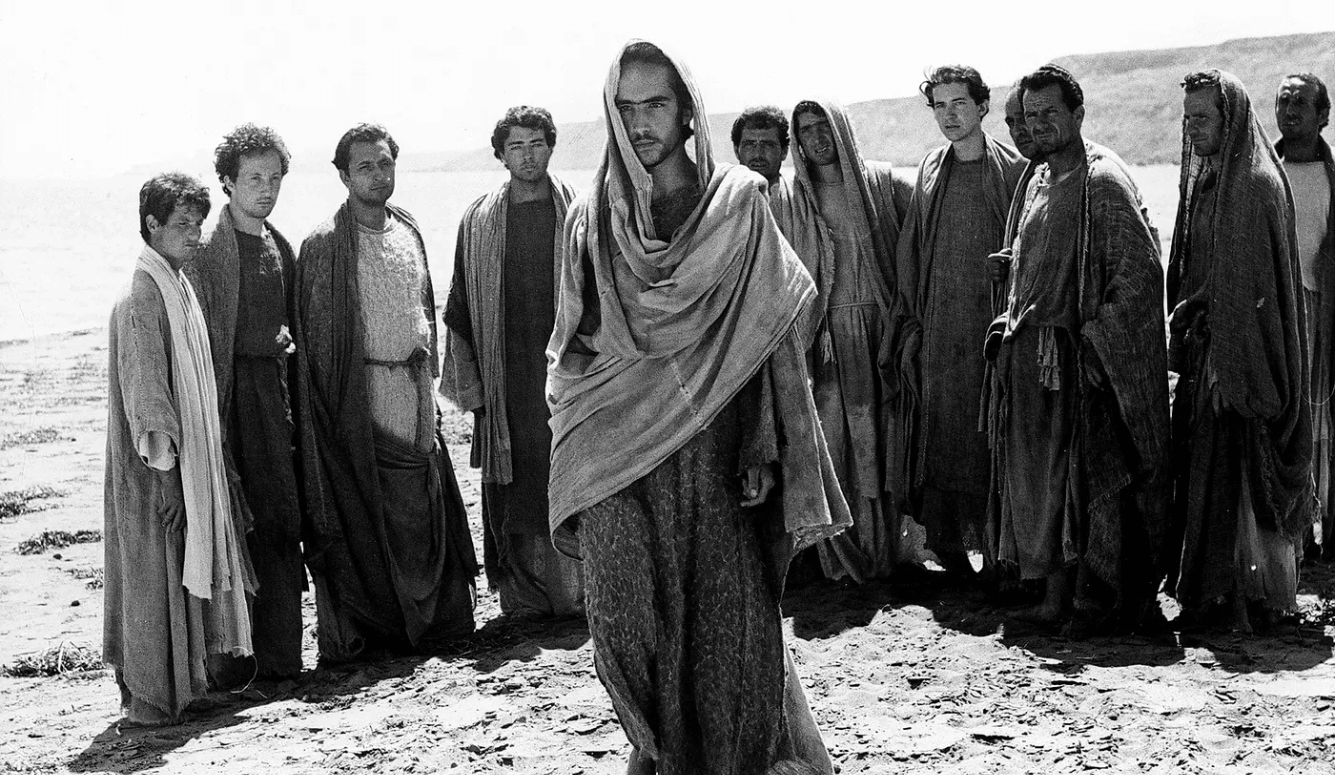
The polymathic Italian writer, actor, and director Pier Paolo Pasolini, however, made masterpieces in both idioms. In striking contrast to earlier and later films that were declared obscene and blasphemous, Pasolini’s The Gospel According to Matthew (1964) is paradigmatic of the detached yet reverent mood that Sontag terms “spiritual style,” which also characterises Bresson’s films. In Pasolini’s take on the gospel, narrative devices that heighten emotion, such as suspense, are unavailable. The outcome is foretold. The plot and dialogue are furnished entirely by the most complete and detailed of the synoptic gospels, the Book of Matthew, which tells a story known to almost every schoolchild.
The Gospel According to Matthew presents an unembellished, literal rendering of the life of Jesus of Nazareth as narrated by the gospel, with a few subtle twists. For instance, the director filmed not in the Levant but in rural Apulia, a remote province in southeastern Italy, with non-professional actors who were mainly local villagers. His unsuccessful attempt to find suitable locations in Israel and Palestine is itself the subject of a fascinating documentary. Pasolini found “Israel much too modern and the Palestinians much too wretched” to serve as convincing stand-ins for Judea in the first century CE.
The British critic Alexander Walker observed that The Gospel According to Matthew “grips the historical and psychological imagination like no other religious film…. For all its apparent simplicity, it is visually rich and contains strange, disturbing hints and undertones about Christ and his mission.” As the great Russian director Andrei Tarkovsky remarked, there is more than a hint of fanatical militancy in Pasolini’s Jesus.
When it comes to the Jewish authorities, the disturbing elements Walker alludes to are more explicit. Herod and the temple priests are depicted as unambiguously corrupt and malevolent. The charismatic dissident, Jesus, the subject of messianic prophecy, represents an intolerable threat to their authority. This view comes directly from the gospel itself, which contains the seeds of what would grow into a centuries-long legacy of Christian antisemitism and persecution of Jews. Likewise Herod’s massacre of the innocents, shown early in the film, contains the roots of the blood libel against Jews. These tropes map directly onto commonplace forms of antisemitism familiar today—up to and including the vogue for so-called legitimate criticism of Israel as exceptionally perfidious.
Yet the film also questions the historical and theological legitimacy of seeing the gospels as the basis for antisemitism. For example, Pasolini cast Jewish actors in the film as both opponents and followers of Jesus, including the writer Natalia Ginzburg, who appears as Mary of Bethany. Similarly, the scene of the last supper depicts the apostles’ final gathering as a peasants’ seder, differing in its rustic informality from traditional portrayals in Christian iconography such as Leonardo da Vinci’s The Last Supper. These details point to a deliberate choice by Pasolini to present a more historically grounded—and more Jewish—view of the gospels, which anticipates more recent scholarly accounts of early Christianity. According to historians such as L. Michael White and Paula Fredriksen, the texts that would become the canonical gospels told a different story to their initial audiences than to later ones. Like Jesus, the apostles—including Peter, James, John, Paul, and Barnabas—were Jews. As Fredriksen argues in When Christians Were Jews (2018), the apostles believed that the death and resurrection of Jesus was an imminent sign that “God was about to fulfil his ancient promises to Israel.” The apostles understood the events of what became the Christian story primarily as a revelation to their own people, the Israelites of Judea and the broader diaspora.
Their evangelising efforts toward non-Jewish communities, documented in the Epistles and Acts, remain somewhat mysterious to historians and theologians. In her subsequent book Ancient Christianities (2024), Fredriksen explains the appearance of Christian congregations outside Judea as the result of proselytising to Jewish communities throughout the Mediterranean and the Near East in cities such as Alexandria, Damascus, and Rome. According to scholars, the appearance of gentile Christian communities coincided with the establishment of synagogues—such as the one discovered in 1961 in Ostia outside Rome—after the suppression of the Jewish revolt and the destruction of the temple in the late first century.
Paul, the apostle who most deliberately sought an audience among non-Jews, was the first to interpret Jesus’s message as having a distinct meaning for gentiles. Fredriksen claims that his audience would have included many “God-fearers,” converts and gentile sympathisers who intermingled with diasporic Jewish communities. The advent of Christianity as a religion distinct from Judaism clearly starts with Paul, who did not witness the crucifixion. By adhering strictly to the text of the gospel, Pasolini’s film adopts a different perspective rooted in the historical dynamics of late Second Temple Period Judaism. In other words, Pasolini envisioned the gospels not just as stories intended for people who now call themselves Christians but also as stories written by Jews whose protagonists were Jewish.
Exploring Early Christian Diversity with Paula Fredriksen
Jonathan Kay speaks with scholar Paula Fredriksen, whose new book describes the theological diversity that existed among Christian communities before Nicene Christianity was adopted as Rome’s state religion in the fourth century.
The film therefore focuses on the participants in the events and their actions rather than on how both Christians and non-Christians came to see them centuries later. As Tarkovsky observes, Pasolini left the story “in the form in which it was born.” It is this almost naïve directness, unmediated by interpretation, that still surprises and unsettles modern audiences, Christian and Jewish alike, despite its historical plausibility. Additionally, there is a canonical basis for it: As the book of John declares: “You worship what you do not know. We worship what we know, because salvation is from the Jews.” This is the same insight that would guide the efforts of Pope John XXIII to uproot antisemitism in the church and destroy its theological foundations. But whether the gospel contains a sacred revelation beyond its universal human meaning is where Pasolini’s agnosticism intervenes. He lets the viewer decide whether to cross that threshold.
This radical reframing frees the narrative from much of its doctrinal baggage and foregrounds the historical context. Drawing on the ancient historian Josephus, Fredriksen observes that “Judea in the late Second Temple Period,” a time of widespread civil unrest, “saw many popular movements formed around charismatic leaders who were predicting God’s coming kingdom.” She leaves no doubt as to the identity of their persecutors: “Many of these leaders… together with their followers… were cut down by Rome. Jesus, who was himself hailed as messiah, met a similar fate.” The crucial difference is that Jesus’s followers became convinced of his resurrection, a miracle they understood not as the exaltation of the son of God but as a sign of the apocalypse. As Fredriksen notes, “the resurrection of the dead was a signature miracle expected at the end-time.” In a recent essay on miracles, the poet Christian Wiman observes: “What happens in a culture is partly dependent on what the collective consciousness of the culture allows.” To those who claimed to witness Jesus’s resurrection, the event was understood in terms of earlier Jewish prophetic teachings. When the anticipated end-time failed to arrive, the story was gradually reinterpreted as a testament to Jesus’s divinity. The resurrection as a portent of the imminent coming of God’s kingdom receded from view.
In the wake of the Jewish revolt against Rome and the destruction of the temple in Jerusalem, the story slipped out of the hands of its authors and into those of the mainly gentile communities that embraced it. Christian clergy and congregations appropriated the gospels and produced interpretations that were unconnected to the context in which they first appeared. Yet the Jewish theologian David Novak notes that “both Christianity and Rabbinic Judaism come out of, and thereby supersede” Second Temple Judaism. In that sense, both are “new” religions relative to the Judaism of the temple, and fraternal in origin. Along similar lines, the German Jewish theologian Franz Rosenzweig claimed in The Star of Redemption (1921) that the gospels represented the universality of the Jewish message, extending beyond the covenant with Israel. Ultimately, they told a story of redemption to gentiles that Jews already knew. It is in this light that Pasolini sees them.
Pasolini’s film intentionally calls to mind the greatest Christian achievement of the twentieth century, perhaps of any century—the abrogation of supersessionism: the doctrine that Christianity replaces Judaism (and other faiths) by making the church the singular vessel for divine salvation. During the Second Vatican Council, convened by Pope John XXIII and continued by his successor Paul VI, various remarkable changes to longstanding traditions were adopted. None proved more radical or consequential than Nostra Aetate, or the “declaration on the relation of the Church to Non-Christian Religions.” In November 1964, as a contemporary report describes, the leadership of the Catholic church voted overwhelmingly to approve a document “condemning ‘hatred and persecutions of Jews, whether they arose in former or in our own days,’ affirming the validity of Judaism as a religious way of life with which Catholics must establish relations of ‘mutual knowledge and respect,’ and repudiating the idea of ‘the Jewish people as one rejected, cursed, or guilty of deicide.’” In doing so, they passed judgment on centuries “of Popes, Kings, Church Fathers, Saints, writers, theologians, and ordinary Christians” in terms of their attitude toward Jews and Judaism.
Nostra Aetate took its cue from an even bolder declaration of atonement that John allegedly wrote before his death and intended to have read aloud in churches worldwide:
We are conscious today that many, many centuries of blindness have cloaked our eyes so that we can no longer either see the beauty of Thy Chosen People nor recognise in their faces the features of our privileged brethren. We realise that the mark of Cain stands upon our foreheads. Across the centuries our brother Abel has lain in the blood which we drew or shed the tears we caused by forgetting Thy Love. Forgive us for the curse we falsely attached to their name as Jews. Forgive us for crucifying Thee a second time in their flesh. For we knew not what we did.
The authenticity of John’s declaration has been challenged. But whether genuine or fabricated, the statement was too much for many traditionalists within the Vatican. The topic led to a long bureaucratic and ideological wrangle during the Second Vatican Council. But eventually, to great astonishment, a statement whose guiding principles were close to John’s undelivered message was adopted under his successor.
This remarkable event coincided almost exactly with the release of The Gospel According to Matthew in Italy in October 1964. The film’s opening credits announce that it is dedicated “alla cara, lieta, familiare memoria di Giovanni XXIII” (“to the dear, joyous, and loving memory of John XXIII”) who died the year before. It remains Pasolini’s testament to the monumental reckoning and reformation undertaken by the pope in response to the Holocaust and to centuries of anti-Jewish dogma and persecution under Christianity.
Read the full article here
Fact Checker
Verify the accuracy of this article using AI-powered analysis and real-time sources.