

 Freedom Index
Listen to the article
A simple story has taken hold in American politics: Big Tech is consuming vast amounts of electricity to power artificial intelligence, and ordinary households are paying the price.
It’s a tidy narrative with a villain, a victim, and a moral. It also happens to be wrong.
In Washington, in statehouses, and increasingly in town halls, data-center projects are being stalled or blocked by communities convinced they’re about to be priced out of their own electricity. Fear is outrunning evidence. Demand is cast as the problem and technology as the threat. Energy abundance is presented as something to fear rather than build.
That belief now has institutional backing.
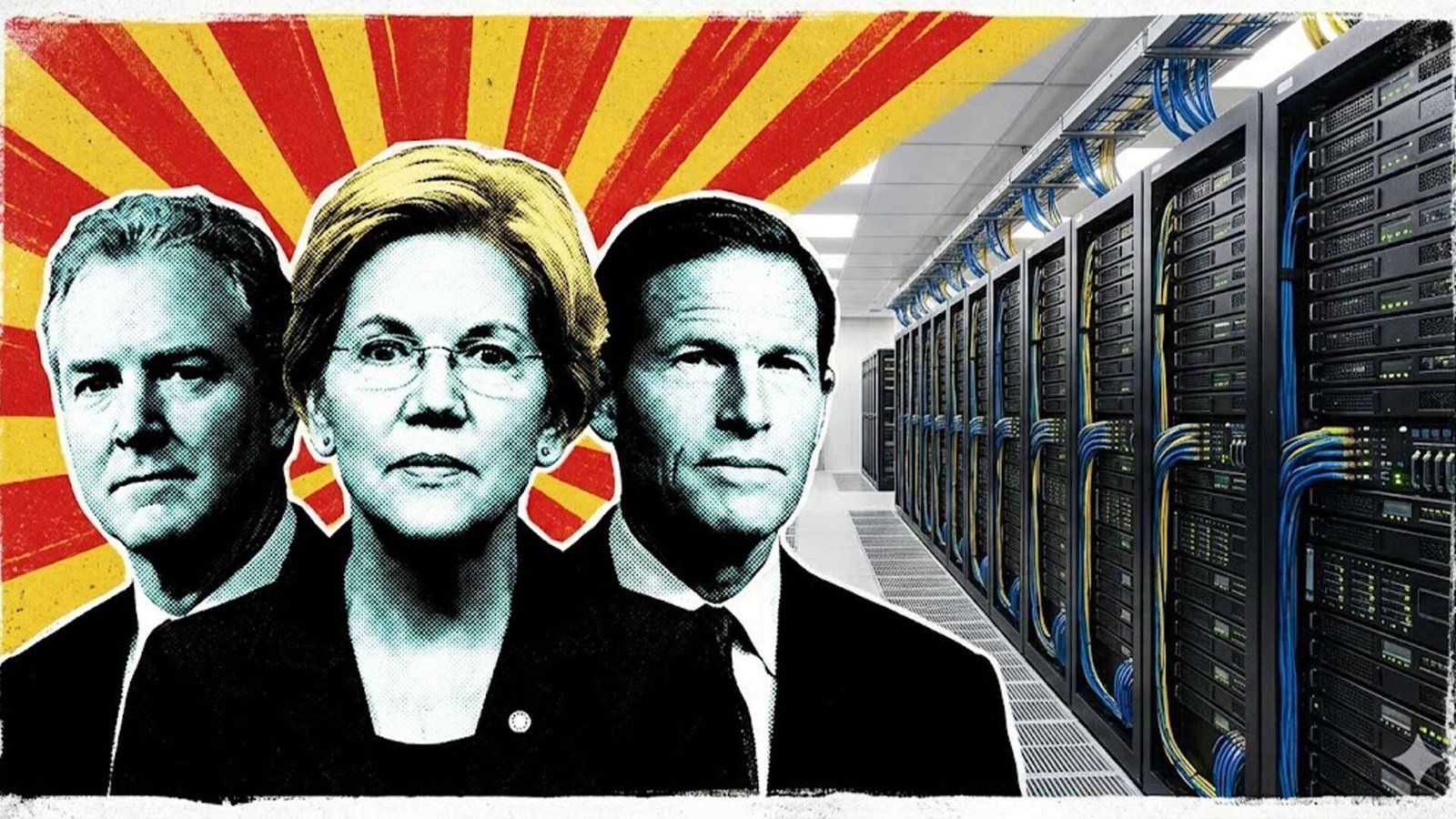
Sen. Elizabeth Warren (D–Mass.) has opened a Senate investigation into whether AI data centers are driving up Americans’ electricity bills—but the verdict is already baked in. In letters sent to utilities and hyperscalers, Warren and other Senate Democrats allege that rapid growth in data-center demand is forcing costly grid upgrades and shifting those costs onto households. One utility, Indiana Michigan Power, estimates it will spend $17 billion to meet projected data-center demand—costs Warren suggests will land on ratepayers.
“Data centers’ energy usage has caused residential electricity bills to skyrocket,” the Senate Democrats said, adding that utilities are “passing the extra costs onto their customers.” Demand, they argue, is pushing prices out of control.
Across the country, local governments are absorbing the same message and translating it into vetoes. Projects are delayed. Permits denied. A national policy failure is reframed as a local act of self-defense.
AI and energy have become the twin boogeymen of modern politics. AI is blamed for coming after jobs and truth. Energy is blamed for coming after the planet and household budgets. Combine the two in a single facility and you get the perfect villain, one that requires no examination of regulatory choices or supply-side constraints. Someone else can always be blamed.
But when you understand how electricity pricing actually works, the story collapses almost immediately.
Blaming data centers for rising electricity prices is like blaming FedEx for the cost of gasoline. Demand didn’t fail. Supply was boxed in.
Electricity is a capital-heavy business. Most of what consumers pay for isn’t the power itself, but the infrastructure that produces and delivers it: generation, transmission, substations, and distribution. Once that infrastructure exists, the marginal cost of serving additional load is relatively low. What makes electricity expensive isn’t use. It’s underuse.
For this reason, steady demand has historically driven prices down, not up. When more electricity flows across the same wires, fixed costs are spread over more kilowatt-hours. Utilities recover investments more efficiently, and per-unit costs fall.
Recent research from Lawrence Berkeley National Laboratory examined state-level data from 2019 to 2024. The lab found that states with higher electricity demand growth generally experienced smaller increases in retail prices. In some cases, prices declined outright.
A separate 2025 analysis by Energy and Environmental Economics reached a similar conclusion. Large-load customers often pay more than the minimum cost required to serve them, generating surplus revenue that utilities can use for grid upgrades without raising residential rates. In California, PG&E has projected that incremental data-center growth could reduce average household bills by up to 2 percent.
Data centers fit this model unusually well. They draw power continuously, not in short, spiky bursts like air conditioning on a hot summer afternoon. A 100-megawatt facility runs like a small industrial city, but one with predictable demand and long planning horizons. Utilities can build around it.
And they do. In many regions, hyperscalers pay industrial rates and cover the full cost of the infrastructure built to serve them, including new substations, upgraded transformers, and transmission expansions that remain part of the grid long after a project is complete. In northern Virginia, large data center customers cover roughly 9 percent of transmission costs, helping keep residential transmission rates below the national average. In Mississippi, revenue from large data-center loads has funded grid modernization without raising household rates.
This is not theoretical. It’s how grids stay solvent.
The investigation’s central assumption—that more electricity use must mean higher bills—confuses consumption with scarcity. Prices rise only when supply can’t respond.
If rising demand isn’t the culprit, then why are electricity prices climbing? The answer isn’t technological. It’s political.
For decades, policymakers have systematically constrained the supply side of American energy. New power plants take years, sometimes decades, to permit. Transmission lines spend longer in court than they do under construction. Baseload generation, nuclear most of all, has been treated as a moral failure rather than an engineering necessity. Capacity is retired faster than it can be replaced.
Layer on an aging grid, wildfire liability, storm hardening, fuel volatility, and renewable mandates imposed without sufficient transmission, and the real drivers of higher bills come into focus. These are policy costs, not market ones.
Policymakers are scapegoating demand to avoid reckoning with the consequences of their own decisions. Not long ago, states competed to offer data centers sweetheart deals: tax breaks, land, discounted power. Now those same projects are treated as parasites, accused of inflating household bills and draining public resources.
Local governments mistake obstruction for protection. Town councils believe they’re defending residents from price spikes rather than blocking the very investments that would stabilize and modernize their grids. A national failure of energy policy becomes a culture of local veto.
When a data center comes to town and panic erupts, the answer isn’t subsidies or scapegoats. The answer is to build.
Build power. Build transmission. Build enough capacity that demand stops being mistaken for a threat.
Electricity isn’t a luxury good. It’s the lifeblood of a modern economy. When you ration electrons, you don’t just slow growth. You ration cancer care. You ration MRI time. You ration the computing power that lets doctors see earlier, diagnose faster, and treat more precisely.
When you throttle back power, you don’t just protect scenery. You turn off the steam that lets a quadriplegic speak through a computer. You limit the systems that translate thought into movement, movement into independence.
More intelligence, more medicine, and more industry all require more energy. You don’t get progress by pretending otherwise. You just decide who goes without it first.
Energy abundance isn’t something to tolerate. It’s the fuel for every serious ambition we have.
If we don’t build it here, someone else will. China already has.
Read the full article here
Fact Checker
Verify the accuracy of this article using AI-powered analysis and real-time sources.