

 Freedom Index
Listen to the article
Video essay written and read by Claire Lehmann. The text was originally published in The Australian.
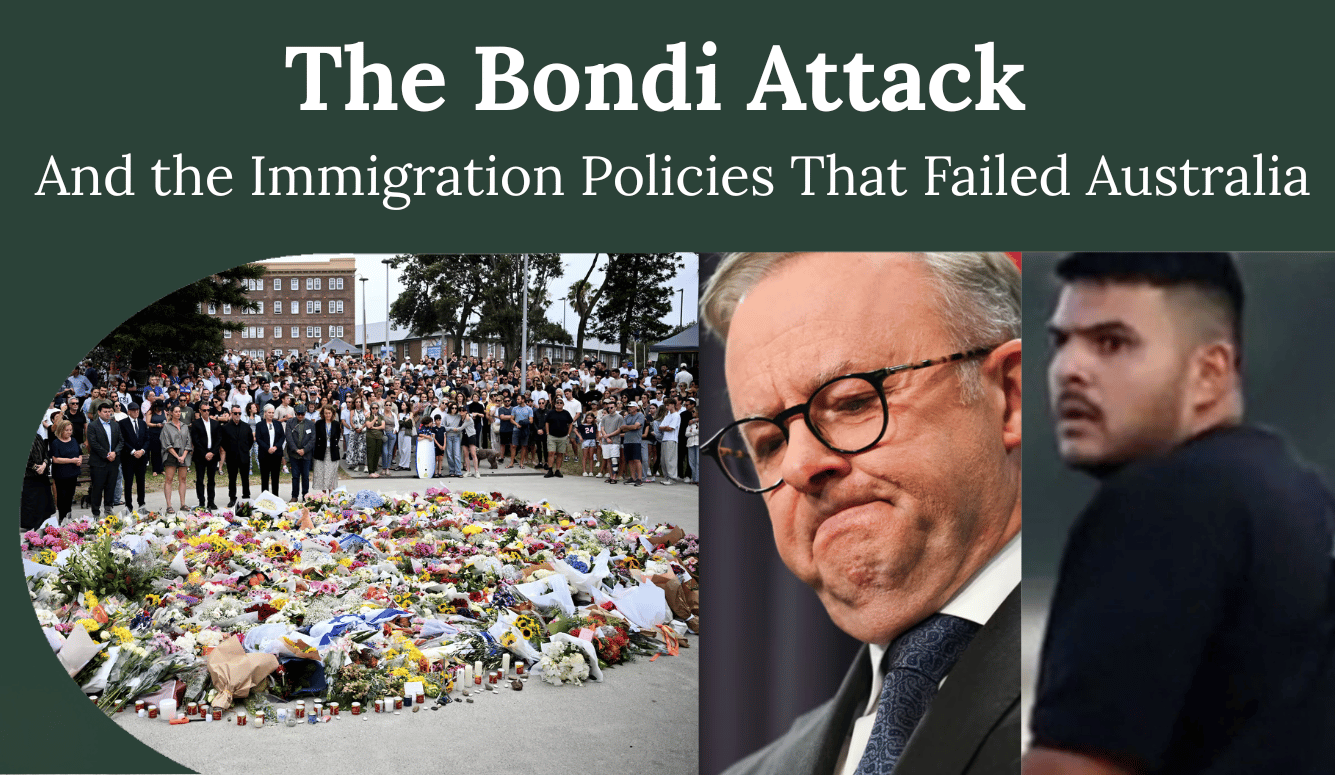
The Bondi attack was widely treated as an unforeseeable act of individual violence. Claire Lehmann argues otherwise. She contends that the conditions that made the attack possible were not accidental, but the predictable result of long-standing failures within Australia’s immigration and integration framework.
Drawing on reporting and analysis first published in The Australian, Lehmann traces how Australia’s post-1990s immigration system gradually shifted away from assimilation and enforcement toward speed, scale, and population growth. Temporary visa programs, particularly student visas, evolved into permanent settlement pathways, while warning signs related to extremism and security were repeatedly discounted.
Rather than focusing on a single intelligence lapse, Lehmann situates the Bondi attack within a broader policy environment—one shaped by institutional assumptions that time would neutralise ideology and that procedural compliance could substitute for social cohesion. In a more dangerous and interconnected world, she argues, those assumptions carry serious consequences.
View full transcript
When Sajid Akram arrived in Australia in 1998, he did so through one of the most common entry points into the country: a student visa. A student visa is not an application to join the Australian nation. It is permission to study, granted on the assumption the holder will return home.
When the terrorist arrived in Australia, Abul Rizvi was the Deputy Secretary of the Department of Immigration. Speaking on The Joe Walker Podcast earlier this year, Rizvi explained that changes made to immigration policy in 2001 were driven overwhelmingly by demographic concerns rather than cultural or social cohesion. “Probably 80% was demography,” he said. “It would have been 80% demography and probably 10% pressure from universities.”
In the two decades since, Rizvi has acknowledged that more than two million international students and working holidaymakers have come to Australia, many of them settling permanently. “It’s probably not too much of an exaggeration to say that in Australia today, immigration policy boils down to decisions about international students,” he said. When asked whether the policy he helped design would be supported by the public today if put to a vote, he answered bluntly: “No.” But in 2001, he added, “luckily no-one noticed.”
Twenty-four years later, people are noticing.
If Sajid Akram had not been granted a student visa, fifteen Australians might still be alive. After the Bondi massacre, Rizvi noted on X that Akram had been a permanent resident for 25 years and that his son was Australian-born, seemingly to minimise the role immigration played in the chain of events that led to Sunday’s terror attack. But these facts only strengthen the case for caution. If someone can live here for decades, raise children here, and still commit an act of terrorism, then the question is not whether immigration mattered—but whether we are being careful enough about who we let in.
Despite being born and raised in Australia, Akram’s son was reportedly radicalised locally. According to court records and media reporting, he came under the influence of extremist preacher Wisam Haddad and the Al Madina Dawah Centre—a place described as a “factory of hate.” This radicalisation did not occur in a failed state or a war zone. It occurred in southwest Sydney.
At some point, the warning signs were serious enough that Australia’s security services took notice. The son was placed on an ASIO watch list.
During this period, Sajid Akram reportedly continued to travel overseas, retained his Indian passport, and maintained a gun licence. According to reports, both father and son travelled to the Philippines for what authorities later described as military-style training. Yet despite extremist associations and overseas travel for training, there was no visa cancellation for Sajid Akram.
This is not a story about a missed warning. It is a story about an immigration system designed to process people efficiently but poorly equipped to respond when its core assumptions fail. Once residency is granted—and especially once a child is born here—the state largely steps back. Monitoring exists, but enforcement is timid. Risk is noted, but rarely acted upon.
Of course, most people who arrive in Australia as migrants pose no threat, and the story of modern Australia is one of diverse migrant groups enriching the nation. The heroic actions of Ahmed Al Ahmed, a migrant from Syria, are proof of that. But immigration, like any policy, involves trade-offs. In recent years we have been too willing to trade safety and cohesion for economic metrics and humanitarian virtue-signalling, with Australia’s Jewish community left to absorb the consequences.
The Akram case exposes with brutal clarity that time does not ensure assimilation. Being born in Australia does not guarantee allegiance. And paperwork does not dissolve pre-existing beliefs or loyalties. Yet our immigration policy has been built on the premise that it does.
What Rizvi designed was a system that assumed integration would take care of itself. Tony Burke now administers that same system—in a far more volatile world with far less margin for error. The Albanese government has overseen the repatriation of family members of Islamic State fighters from Syrian camps, despite ISIS’s record of genocide, sexual slavery, the recruitment of children as fighters, and mass murder.
These decisions expand the security burden at a time when ASIO has warned it is already under-resourced. Rapid population growth does not just strain hospitals and roads—it overwhelms intelligence agencies tasked with identifying threats.
When confronted on national television this week by the daughter of a Bondi victim, Burke appeared rattled and defensive. And for good reason. After Australians have been murdered, defending policies that increase the risk of similar attacks becomes morally untenable.
Immigration policy should no longer be treated as an abstract debate. It cannot be reduced to paperwork, spreadsheets, or economic theory. In the real world, individuals do not behave like economic units. They act according to beliefs, loyalties, and ideologies—some of which are incompatible with a peaceful, plural society.
The decisions of bureaucrats determine who we bring into our country, the risks we accept, and whether our social fabric holds. The Akram case shows what happens when those decisions are made recklessly.
Reflecting on the changes he helped engineer, Rizvi once remarked that immigration officials value control—but that “sometimes you have to take some risks to get some rewards.”
On Sunday at Bondi, Australians saw the price of those risks.
Further Reading
If you found this video essay useful, subscribe to the Quillette YouTube channel and browse our video archive.
Subscribe on YouTube
Read the full article here
Fact Checker
Verify the accuracy of this article using AI-powered analysis and real-time sources.