Shadow library Anna’s Archive has “backed up Spotify,” scraping 86 million audio files amounting to 300TB of data.
The group claims to be building a “music archive primarily aimed at preservation.”
Data reveal that Electronic/Dance is the largest genre category by artist count, followed by Rock and World/Traditional.
Anna’s Archive, the shadow library best known for making pirated ebooks and academic papers searchable, announced this weekend what might be the largest music piracy operation in history: “We backed up Spotify.”
The group claims it scraped 86 million audio files from Spotify, representing 99.6% of everything people actually listen to on the platform. Total size: just under 300 terabytes, distributed through bulk torrents.
Spotify isn’t happy. A spokesperson told Billboard that “a third party scraped public metadata and used illicit tactics to circumvent DRM to access some of the platform’s audio files.” Note the careful wording there: “some” audio files. Anna’s Archive says 86 million. Spotify isn’t confirming the scale. The company also called the group “anti-copyright extremists” who had previously pirated content from YouTube.
So, aside from ripping off Spotify—and the recording artists, whose income is predominantly derived from royalty payments—what exactly did they get?
The folks at Anna’s Archive scraped and archived Spotify. It will be distributed in bulk torrents over the coming month.
“With your help, humanity’s musical heritage will be forever protected from destruction by natural disasters, wars, budget cuts, and other catastrophes” pic.twitter.com/Ez2pf8GoJS
Anna’s Archive claims metadata for 99% of Spotify’s library of 256 million tracks, including audio files for the 86 million songs that actually matter—the ones people play. The metadata database alone contains 186 million unique ISRCs (International Standard Recording Codes). For comparison, MusicBrainz, the largest legal open music database, has about 5 million. Anna’s Archive just built something 37 times bigger.
Popular tracks were preserved in their original OGG Vorbis format at 160 kilobits per second—no re-encoding, no quality loss. Less popular stuff got compressed to OGG Opus at 75 kbps to save space. The group used Spotify’s own popularity metric to prioritize what to grab first, focusing on tracks with popularity scores above zero.
Over 70% of Spotify’s 256 million tracks have a popularity score of exactly zero. Nobody listens to them. The top 10,000 songs span popularity scores of 70-100. Only about 210,000 songs—roughly 0.1% of the catalog—have a popularity score of 50 or higher. Those 0.1% account for the vast majority of all listening activity.
The top three songs on Spotify right now? Lady Gaga and Bruno Mars’s “Die With A Smile” (3.07 billion streams), Billie Eilish’s “BIRDS OF A FEATHER” (3.13 billion), and Bad Bunny’s “DtMF” (1.12 billion). Those three tracks alone have more total plays than the bottom 20 to 100 million songs combined.
In other words, Spotify is mostly a graveyard of songs nobody will ever hear. The group decided not to archive that graveyard (the full catalog)—it would have required an additional 700 terabytes of storage for content representing just 0.04% of listening activity. Much of it is AI-generated slop anyway.
The weird stuff in the data
Anna’s Archive published extensive analysis of what they found. Some of it is predictable. Some of it is strange.
Track durations cluster sharply at exactly 2:00, 3:00, and 4:00 minutes. The group says they don’t know why. Album releases have exploded exponentially since 2015, with over 10 million albums dated 2023 alone—likely driven by AI generation and automated uploads.
Source: Anna’s Archive
Electronic/Dance is the largest genre category by artist count (520,075), followed by Rock (370,179) and World/Traditional (202,529).
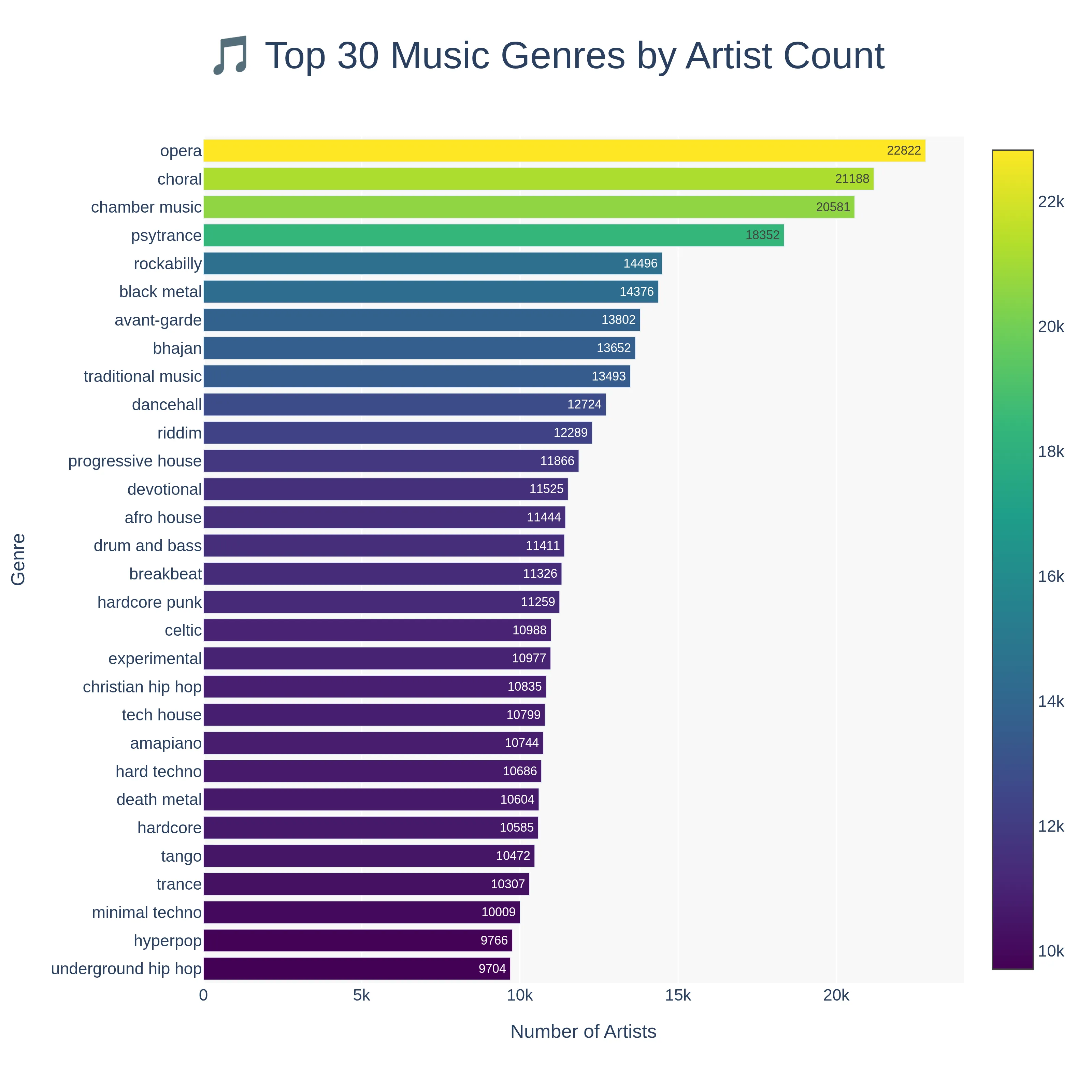
Also, believe it or not, Opera, choral, and chamber music have the most artists per specific sub-genre.
Source: Anna’s Archive
The audio features data reveals that loudness correlates strongly with energy (no surprise), BPM clusters around 120 with a normal distribution, and most tracks have low “speechiness” and “instrumentalness” scores—meaning vocals dominate. C major and G major are the most common keys. About 13.5% of all tracks on Spotify are tagged as explicit content.
Why do this?
Anna’s Archive frames it as preservation, not piracy. “We saw a role for us here to build a music archive primarily aimed at preservation,” the blog post reads. The group argues that existing music archiving efforts focus too heavily on popular artists and audiophile-quality formats (lossless FLAC), leaving obscure music vulnerable to vanishing if platforms change policies or shut down.
There’s some truth to that. Spotify controls 256 million tracks and can remove content, change licensing terms, or disappear entirely. Decentralized torrent distribution creates redundancy that can’t be shut down by any single entity. The data is already spread across thousands of torrent nodes worldwide.
But let’s be real. This is also just piracy. Spotify pays artists somewhere between $0.003 and $0.005 per stream. According to Dittomusic’s Spotify revenue calculator, 1 million reproductions would yield an artist $4,370 in royalties. Free distribution via torrents eliminates even that minimal compensation.
Both things are true at once.
The legal meteor is coming
Anna’s Archive already faces mounting legal pressure. Belgium issued blocking orders with fines up to €500,000 in July 2025. The UK secured High Court blocks in December 2024. Germany’s major ISPs blocked the site’s main domains in October 2025. According to its own transparency report, Google has removed 749 million Anna’s Archive URLs from search results—that’s 5% of all DMCA takedown requests the search engine has received since 2012.
The Internet Archive—a legitimate nonprofit—settled a lawsuit over its Great 78 Project for digitizing obsolete 78rpm records after publishers sought $621 million in damages. Anna’s Archive just archived 31,000 times more tracks, all current, all in-demand. The music industry’s legal response will make the Internet Archive case look quaint.
On Hacker News, commenters debated whether the archive would actually be useful for consumers given Spotify’s convenience. One pointed out that Anna’s Archive already offers “enterprise-level” access to its book archives for tens of thousands of dollars—essentially selling bulk data access to AI companies for training.
For now, only metadata has been fully released. The audio files are rolling out gradually through bulk torrents, starting with the most popular tracks. Anna’s Archive asked users to help seed the torrents and mentioned they might add individual file downloads if there’s enough interest.
The lawsuits are probably coming. The only question is whether the archive survives them—and at this point, it probably doesn’t matter. The data is already out there, distributed across thousands of nodes that can’t be centrally shut down. That’s the whole point of torrents.
Daily Debrief Newsletter
Start every day with the top news stories right now, plus original features, a podcast, videos and more.
The FSNN News Room is the voice of our in-house journalists, editors, and researchers. We deliver timely, unbiased reporting at the crossroads of finance, cryptocurrency, and global politics, providing clear, fact-driven analysis free from agendas.
We and our selected partners wish to use cookies to collect information about you for functional purposes and statistical marketing. You may not give us your consent for certain purposes by selecting an option and you can withdraw your consent at any time via the cookie icon.
Cookies are small text that can be used by websites to make the user experience more efficient. The law states that we may store cookies on your device if they are strictly necessary for the operation of this site. For all other types of cookies, we need your permission. This site uses various types of cookies. Some cookies are placed by third party services that appear on our pages.
Your permission applies to the following domains:
https://fsnn.net
Necessary
Necessary cookies help make a website usable by enabling basic functions like page navigation and access to secure areas of the website. The website cannot function properly without these cookies.
Statistic
Statistic cookies help website owners to understand how visitors interact with websites by collecting and reporting information anonymously.
Preferences
Preference cookies enable a website to remember information that changes the way the website behaves or looks, like your preferred language or the region that you are in.
Marketing
Marketing cookies are used to track visitors across websites. The intention is to display ads that are relevant and engaging for the individual user and thereby more valuable for publishers and third party advertisers.


 Freedom Index