

 Freedom Index
Listen to the article
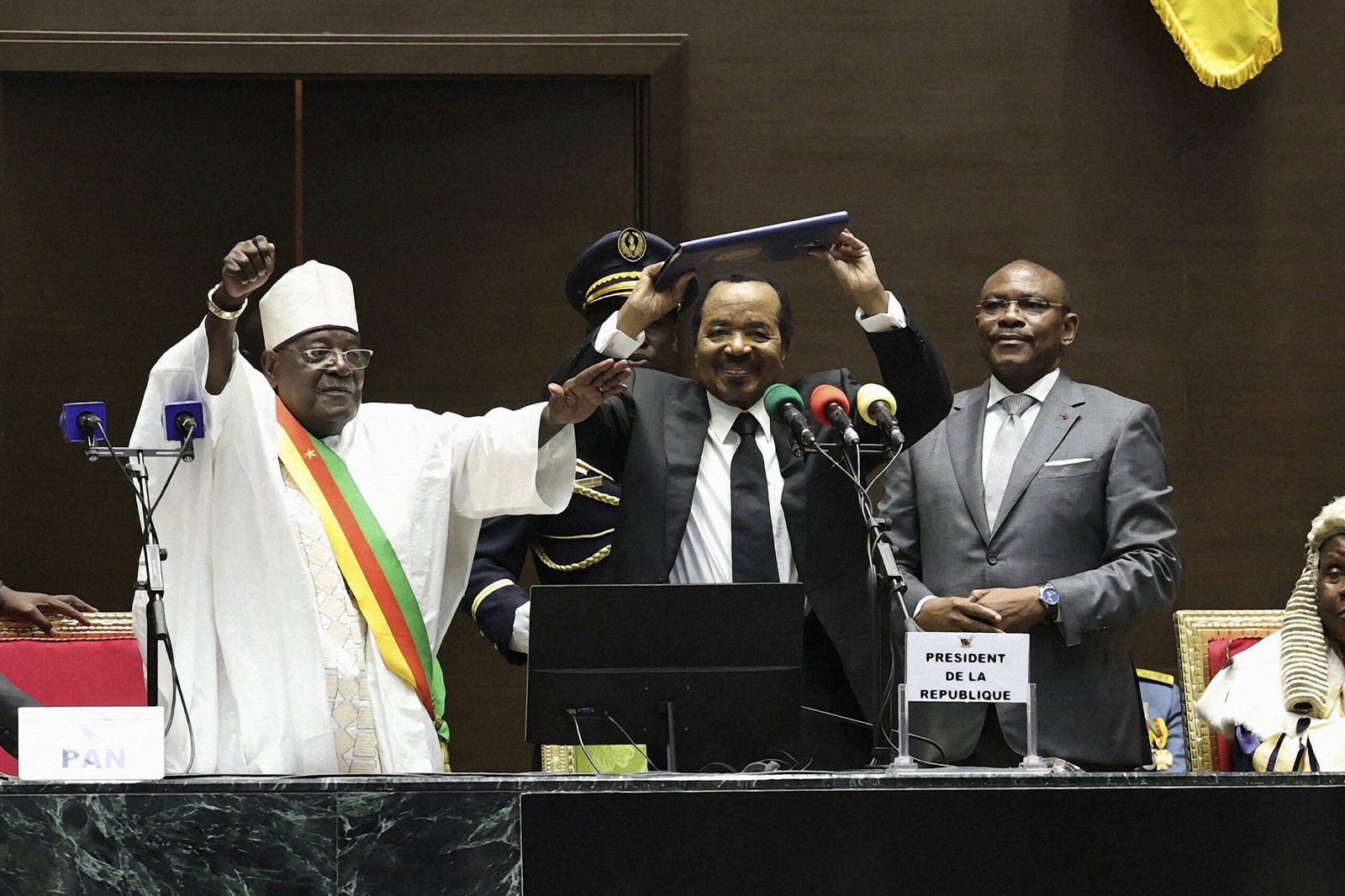
In his campaign to win an eighth term, Cameroonian President Paul Biya pledged to “strengthen measures to protect freedom of expression and journalists” in one of Africa’s most dangerous countries for the press.
But six journalists who spoke to CPJ after October’s contested election — which opposition leader Issa Tchiroma Bakary claimed to have won, before fleeing to The Gambia — said they were not convinced by 92-year-old Biya’s promise of reform after four decades of repression.
“The regime constantly gives proof that it does not want a free press,” said one journalist, who, like four other interviewees, spoke to CPJ on condition of anonymity for fear of reprisals, pointing to recent cases of intimidation, arrest, and murder.
Despite deadly protests against his re-election, Biya was sworn in on November 6, becoming the world’s oldest leader. Journalists told CPJ that they were unable to investigate what happened during and after the vote.
“Even if we try to cover it as much as we can, the post-election crisis is a taboo subject. Journalists are afraid, like their interviewees,” said one media owner.
“It is impossible to speak honestly, clearly and without fear,” they told CPJ, explaining why they turned down an invitation to participate in an international television debate about the election.
Government warns press not to ‘glorify popular insurrection’
One of the most strident voices is the powerful Minister of Territorial Administration, Paul Atanga Nji.
On October 26, Nji warned “those in the media who glorify popular insurrection and spread hatred and fake news will face the full force of the law.” On November 26, he widened the net to declare that media, social media influencers, political figures, and nonprofits, at home and abroad, who had “participated in this vast insurrectionary plot against the Republic” would be “held accountable before the competent judicial bodies.”
Officials have described protests by Bakary’s supporters as a plot to destabilize the country and overthrow the government, drawing on language in Cameroon’s sweeping anti-terrorism law, which criminalizes those who create insurrection.
Cameroonian journalists are used to such threats. Ahead of the vote, Nji banned media discussions about the ageing president’s health, warned that any outlet engaging “actions that threaten the country’s stability” would be shut down, and those who spread “fake news” would “be dealt with to the full extent of the law.”
Following the October 12 election, CPJ recorded four press freedom violations:
- On October 27, Jean Blaise Tonye, a correspondent for the Gabonese, privately owned channel TV Plus Afrique, told CPJ that protesters, armed with knives and clubs, attacked him after mistaking him for a journalist from Cameroon’s public broadcaster, CRTV.
“I was stabbed in the thigh and chest,” Tonye said, adding that the attackers stole his motorcycle and smashed his camera.
- In October, a journalist was detained for his election-related reporting before being released without charge, according to two people familiar with the case.
- In November, another journalist went into hiding after receiving a police summons over his commentary on the election, according to his publisher and a copy of the police summons, reviewed by CPJ.
CPJ is not providing further details about these two cases to safeguard those involved.
- On November 27, the regulatory National Communication Council summoned the privately owned Le Jour newspaper for alleging on November 19 that Biya’s victory had been “fabricated.” It has yet to make a decision.
‘Act of courage’ to report in secessionist regions
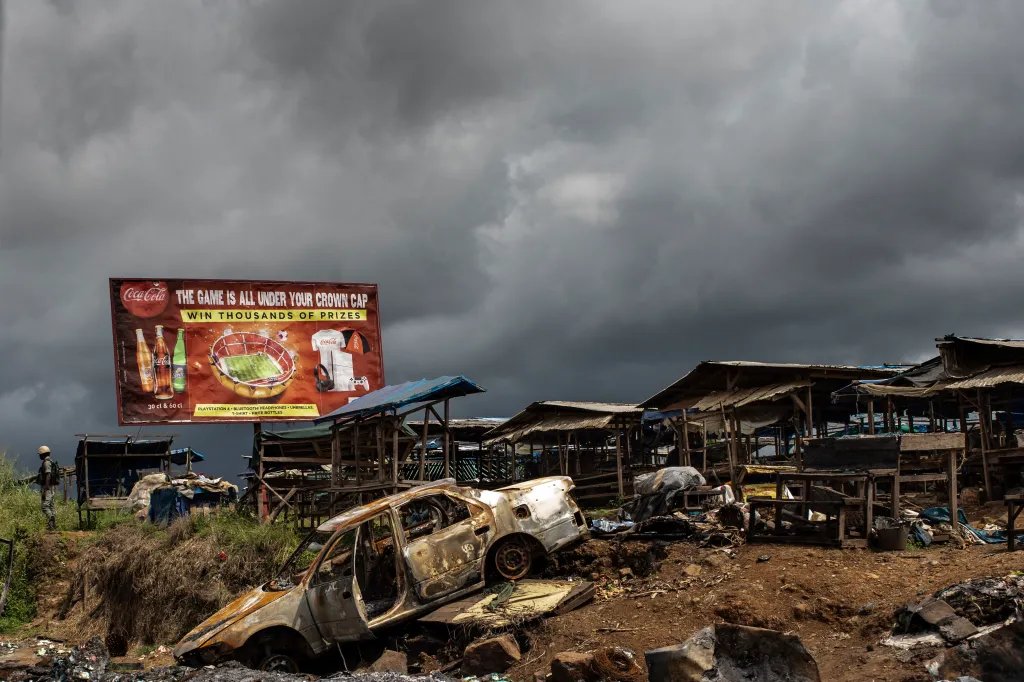
“In Cameroon today, journalism has gone beyond being just a profession; it is an act of courage,” said Mimi Mefo Newuh, a prominent exiled journalist who runs the Mimi Mefo Info news site, which has extensively covered the conflict in Cameroon’s two minority English-speaking regions.
The Anglophone crisis began in 2016 with protests over the appointment of French-speaking civil servants in the North-West and South-West regions, triggering a crackdown by the majority French-speaking government and a secessionist rebellion.
“Journalists operate in a permanent grey zone where the lines between what is ‘allowed,’ ‘sensitive,’ or ‘criminalized’ shift constantly and arbitrarily,” she said. “Access to conflict zones is restricted, communication infrastructure is often cut, and the security forces treat reporters not as observers but as threats.”
October’s election results showed a large victory for Biya in the two Anglophone regions, which are difficult to access safely given widespread kidnappings for ransom.
“Without military escorts, no journalist was ready to follow the campaign teams anywhere for coverage,” said one journalist in the northwest city of Bamenda. “They [the separatists] threatened to attack anyone involved in the process, thereby making room for fraud, given that those to report on the exercise and those to monitor were absent.”
‘Draconian’ anti-terrorism law
“What journalists face here is mostly pressure from the government,” the journalist continued, citing Cameroon’s 2014 anti-terrorism law, which has been widely used to arbitrarily detain numerous journalists.
The “draconian” law is implemented exclusively by military courts, does not clearly define terrorism, and allows pretrial detention to be renewed indefinitely. It prescribes the death penalty for those who cause death, injury or damage “with the intention of intimidating the population,” compelling the state to act, disrupt national services, or create insurrection.
Three Anglophone journalists, Tsi Conrad, Thomas Awah Junior, Mancho Bibixy, have been imprisoned for almost a decade using this law, on charges of secession, insurrection, and false news. In November, a fourth English-speaking journalist, Kingsley Fomunyuy Njoka, who was threatened for his “unpatriotic reports,” was freed after five years in jail.
Imprisonment, killing of journalists
Cameroon has long been one of Africa’s worst jailers of journalists, with suspects often held incommunicado and in lengthy pre-trial detention. In addition to the terrorism law, a 1990 law allows detention orders to “fight against organized crime” to be renewed indefinitely and a 2010 cybercrime law provides for up to four years imprisonment for publishing false information.
Half a dozen journalists have been detained in the last few years for defamation following complaints from officials, including Stéphane Nguema Zambo, Thierry Patrick Ondoua, Dimitri Wassouom Tchatchoua, Jean François Channon, Stanislas Désiré Tchoua, and Chantal Roger Tuile.
Samuel Bondjock, publishing director of the privately owned newspaper Direct Info, has attended 47 hearings in three years for a defamation case. At his most recent court appearance, on November 11, the plaintiff’s lawyer was absent and the case was postponed to January. Bondjock told CPJ that he was stressed and fearful about reporting on the state-run real estate company, whose managing director filed the lawsuit against him.
One media advocate told CPJ that the government had no interest in repealing laws that jail journalists.
“The regime considers the press to be its last enemy,” he said, adding that the executive has established control over “balancing powers,” such as parliament and the judiciary.
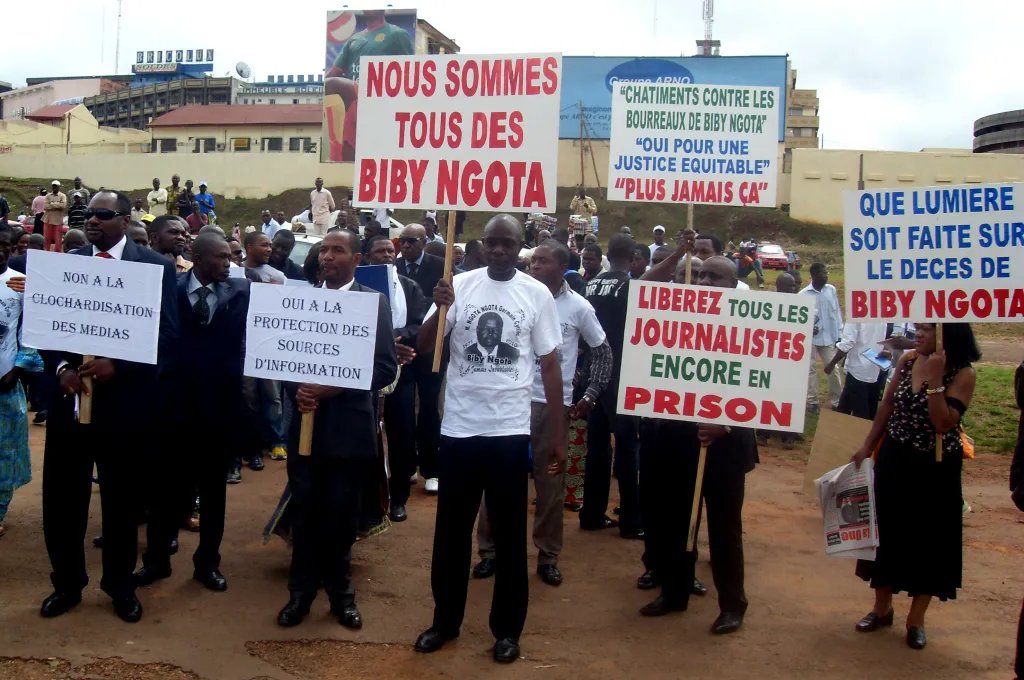
Ongoing impunity for journalists’ murders provides further evidence of the government’s lack of support for the press. There has been no independent investigation into the 2019 death in custody of Samuel Wazizi, known for his critical reporting on the Anglophone crisis. Credible allegations of torture undermine the government’s claim that he died of “severe sepsis.”
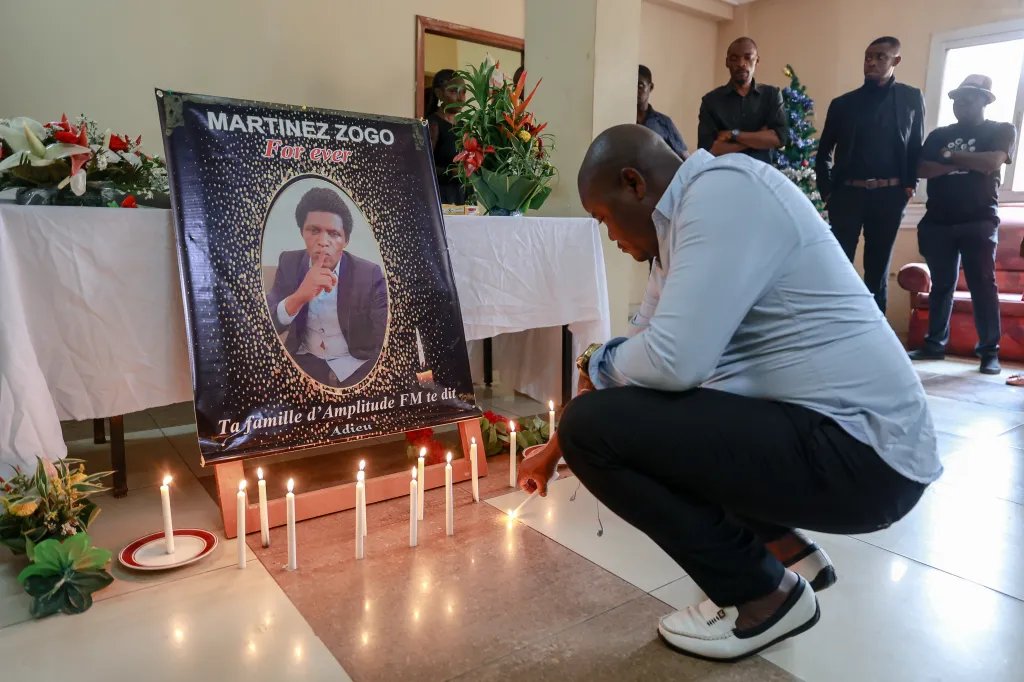
The ongoing trial for the 2023 murder of another prominent journalist, Martinez Zogo, has revealed that he was under state surveillance for years, with more than a dozen intelligence agents charged with complicity in his kidnapping, torture, and murder. Before his death, Zogo threatened to make public documents which he said proved senior officials had embezzled millions of dollars.
‘Returning would be unsafe and irresponsible’
One exile told CPJ that he saw no prospect of returning home because there was no space for independent reporting. Although Cameroon has about 760 registered media outlets, he said that most were paid to “wage divisive media battles for the benefit of rival factions” within the government.
“The current regime has impoverished, swallowed up, and subjugated the press in order to make it a tool serving its interests,” he said. “Any journalist or media outlet that does not follow this logic is systematically considered an enemy of all and hunted down.”
Mefo agreed.
“I desperately want to go home,” she said. “But under the current climate, where journalists are targeted simply for doing their jobs, returning would be unsafe and irresponsible … Exile is both a shield for my life and a platform to ensure Cameroon’s story continues to be told.”
René Emmanuel Sadi, minister of communication and government spokesman, said he would assignment a staff member to respond but they had not done so by the time of publication.
CPJ’s calls to request comment from Nji went unanswered.
Read the full article here
Fact Checker
Verify the accuracy of this article using AI-powered analysis and real-time sources.