Close Menu
FSNN | Free Speech News NetworkFSNN | Free Speech News Network
  • Home
  • News
    • Politics
    • Legal & Courts
    • Tech & Big Tech
    • Campus & Education
    • Media & Culture
    • Global Free Speech
  • Opinions
    • Debates
  • Video/Live
  • Community
  • Freedom Index
  • About
    • Mission
    • Contact
    • Support
Trending

🔊 Mass Surveillance for… Loud Music? | EFFector 38.11

21 minutes ago

Daily Deal: The 2026 Data Engineering Bundle featuring Databricks

25 minutes ago

Why Are Republicans and Democrats Abandoning Economic Freedom?

27 minutes ago
Facebook X (Twitter) Instagram
Facebook X (Twitter) Discord Telegram
FSNN | Free Speech News NetworkFSNN | Free Speech News Network
Market Data Newsletter
Wednesday, June 10
  • Home
  • News
    • Politics
    • Legal & Courts
    • Tech & Big Tech
    • Campus & Education
    • Media & Culture
    • Global Free Speech
  • Opinions
    • Debates
  • Video/Live
  • Community
  • Freedom Index
  • About
    • Mission
    • Contact
    • Support
FSNN | Free Speech News NetworkFSNN | Free Speech News Network
Home»News»Global Free Speech»CPJ’s lifeline for Palestinian journalists in Gaza
Global Free Speech

CPJ’s lifeline for Palestinian journalists in Gaza

News RoomBy News Room6 months agoNo Comments6 Mins Read197 Views
Share Facebook Twitter Pinterest Copy Link LinkedIn Tumblr Email VKontakte Telegram
CPJ’s lifeline for Palestinian journalists in Gaza
Share
Facebook Twitter Pinterest Email Copy Link

Listen to the article

0:00
0:00

Key Takeaways

Playback Speed

Select a Voice

New York, December 2, 2025 — Since what human rights groups and UN experts agree is a genocide in Gaza began in October 2023, the Committee to Protect Journalists has worked relentlessly to sustain the journalists documenting the deadliest war for the press ever recorded.  CPJ has spent more than $500,000 to provide both humanitarian and professional assistance to Gaza’s press corps — reaching 2,195 Palestinian journalists despite the extreme constraints of siege, famine, and mass displacement.

Balancing humanitarian survival and journalistic duty

Members of the press work at the Gaza Journalists Hub. (Photo: Courtesy of Arab Reporters for Investigative Journalism (ARIJ))

Gaza’s media landscape has been devastated over the course of two years of war. Journalists have lost colleagues, homes, and equipment, yet continue to report under bombardment and blackout. CPJ’s support—split between large-scale projects (costing more than $400,000) and individual grants (over $100,000)—has aimed to meet both urgent survival needs and the core requirements of journalism itself.

“Given the fluidity of the situation on the ground,” said CPJ Chief Emergencies Officer Lucy Westcott, “we’ve had to strike a balance between humanitarian needs—food, cash, clothing, hygiene kits—and journalistic ones such as equipment, safe workspaces, and psychosocial support.” While CPJ typically focuses on safety, advocacy, and emergency assistance, the organization’s response to crises is “adaptable to evolving circumstances and guided by the specific needs of journalists in crisis situations,” Westcott explained.

2024: Emergency response amid escalation

In 2024, CPJ disbursed nearly $400,000 through grants to local partners to reach journalists throughout Gaza. The Palestinian Journalists Syndicate (PJS) received $120,000 to deliver humanitarian relief—food, blankets, hygiene kits, winter clothing, and power banks—to reporters and their families. The Arab Reporters for Investigative Journalism (ARIJ) was granted $105,000 to replace essential journalistic equipment destroyed in airstrikes, while Filastiniyat, a women-led media group, received $102,350 to distribute direct cash support to journalists.

Through these projects, at least 1,844 Palestinian journalists and their families received assistance.

In addition, CPJ issued more than $40,000 in individual emergency grants to 12 journalists in Gaza and the West Bank, primarily for medical care and legal assistance. 

Despite the destruction of infrastructure in Gaza and the persistent airstrikes that made direct assistance increasingly difficult, CPJ reached journalists who suffered serious injuries in Israeli attacks, had to defend themselves in court after being arrested for their reporting, or needed help rebuilding their lives after prolonged detention. 

“Medical support was the most covered need,” said CPJ Chief Emergencies Officer Lucy Westcott, “followed by legal aid for those detained or targeted for their reporting both in Gaza and the West Bank.” 

2025: Supporting recovery and resilience

As the ceasefire took hold in 2025, CPJ shifted its focus toward recovery, rebuilding, and mental health. The organization distributed more than $100,000, before the October ceasefire, in grants to partners that prioritized safe workspaces and psychosocial support.
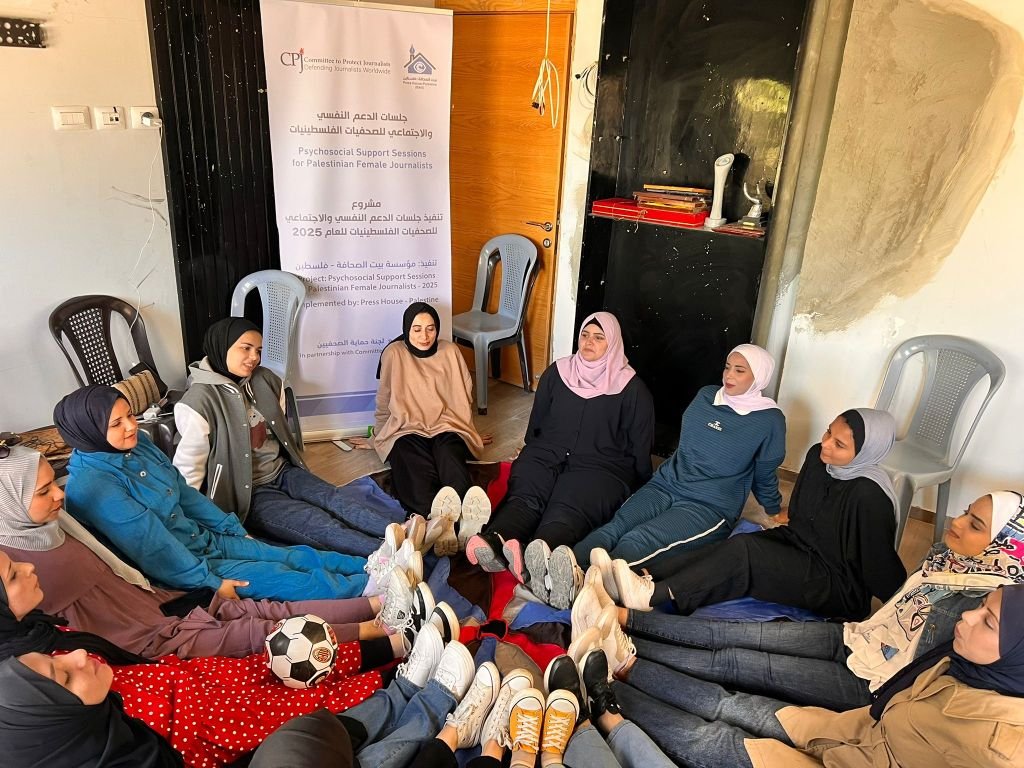
Journalists take part in an exercise during a psychosocial support session implemented by Press House - Palestine.
Journalists take part in an exercise during a psychosocial support session implemented by Press House – Palestine. (Photo: Courtesy of Press House -Palestine)

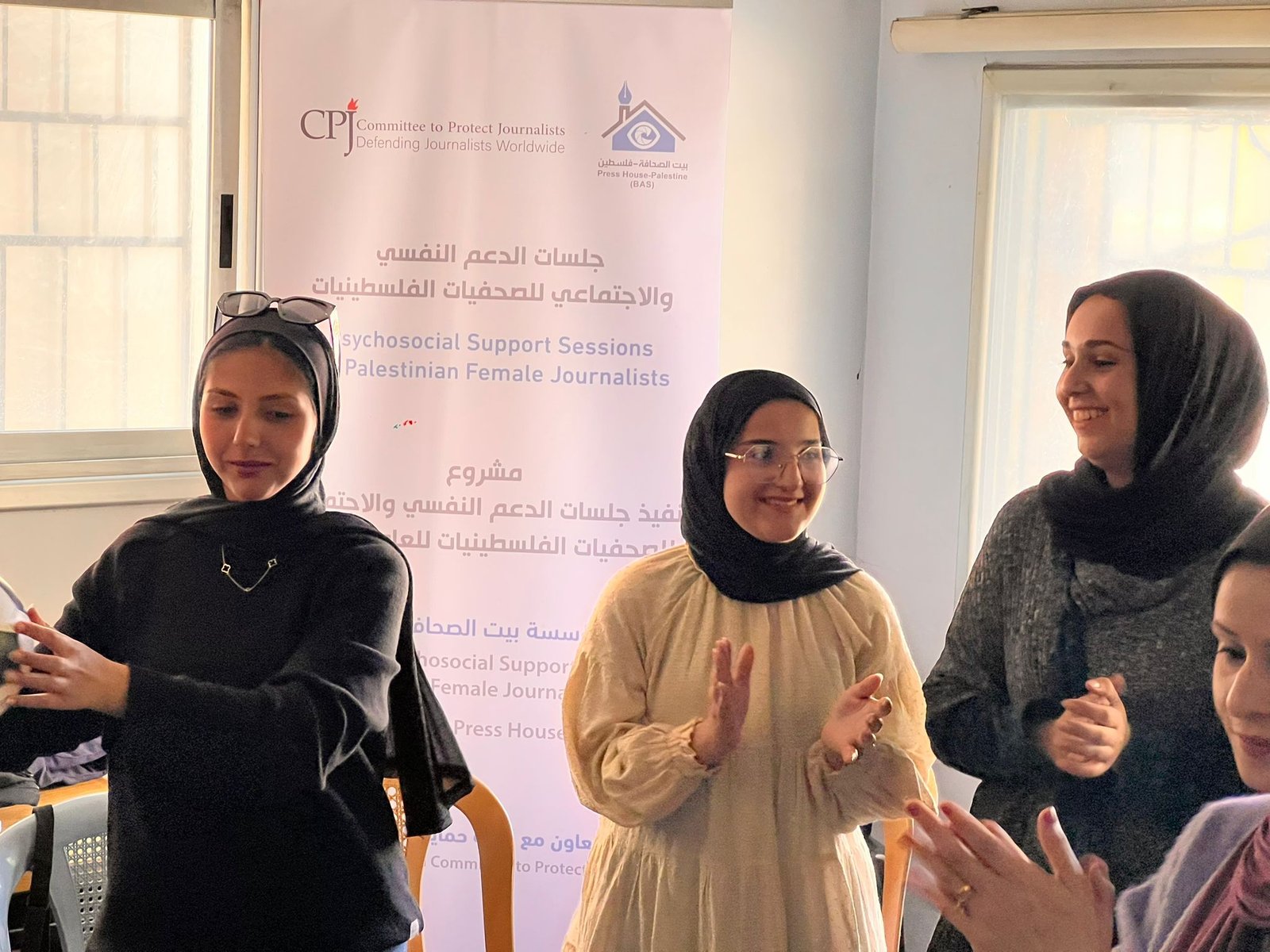
CPJ provided targeted support to local and regional organizations, including $25,000 to Press House Palestine for mental health sessions for women journalists; $45,000 to ARIJ to maintain shared workspaces in northern Gaza; and $30,700 to Filastiniyat to operate two combined work-and-rest hubs in central and southern Gaza. Together, these initiatives reached at least 307 journalists.

Gazan journalists who took part in the psychosocial support sessions organized by Press House Palestine described the program having a significant positive impact on their wellbeing. “The war in Gaza deeply affected me as a woman journalist in Gaza. I was overwhelmed and needed someone who understood what I was going through. The psychosocial support sessions at Press House helped me express myself and regain a sense of who I am,” said a Gazan journalist from Rafah. 

The brother of Mohammad al-Khaldi, who was murdered in a targeted Israeli strike on a tent housing journalists outside the main gate of Gaza City’s Al-Shifa Hospital on August 10, 2025, said the ARIJ workspace in northern Gaza was a rare safe space for the press.

“I used to speak to my brother and could tell how much that place meant to him,” he said, noting journalists could rely on the workspace for access to internet, electricity, and water. “He was at his best — mentally at ease, surrounded by his colleagues who shared his struggles. ”

CPJ also issued more than $60,000 in direct grants to 32 journalists in 2025, covering medical and post-detention recovery needs.

Partnering with trusted local organizations
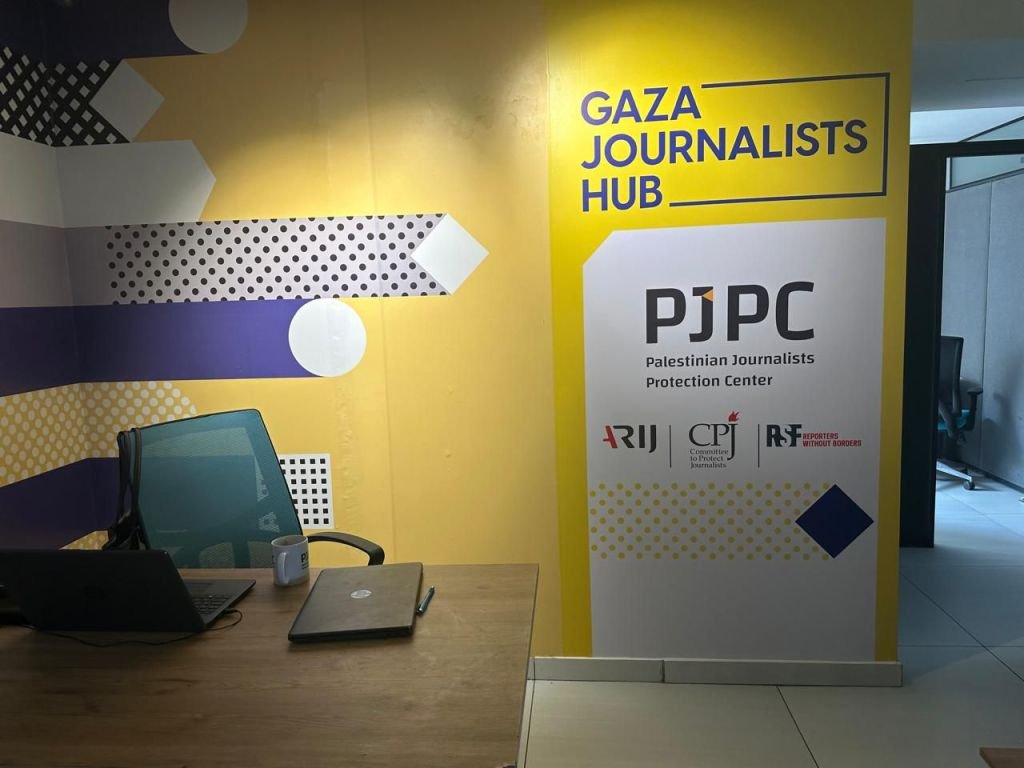
CPJ has supported several work-rest hubs across the Gaza Strip.
CPJ has supported several work-rest hubs across the Gaza Strip. (Photo: Courtesy of Arab Reporters for Investigative Journalism (ARIJ))

Since 2023, CPJ has relied on local and regional partners—ARIJ, PJS, Filastiniyat, and Press House Palestine—to deliver aid where international access remains restricted. These organizations are deeply embedded in Gaza’s journalist community, allowing for efficient aid distribution, accurate vetting, and trusted communication.

CPJ employs rigorous monitoring to ensure grants are used for their intended purposes. Partners provide regular updates and written reports on implementation and impact. Final approval for any partnership is contingent on extensive due diligence, including background checks against relevant U.S. government’s sanctions list and verification of legal registration.

“Amid the blockade and communication blackouts, we’ve maintained strict reporting requirements and continuous dialogue with our partners,” said CPJ Regional Director Sara Qudah. “Transparency is vital to ensure that journalists in Gaza receive the support they need.”

Standing with Gaza’s journalists

While the ceasefire in October has slowed large-scale fighting, Gaza’s journalists remain on the frontlines of a humanitarian catastrophe. Many continue to live in displacement, struggling to rebuild their lives while documenting the aftermath of destruction.

While relocation from Gaza remains extremely difficult due to ongoing restrictions, border closures, and limited international visa options, CPJ provides letters of support for journalists’ visa and asylum applications, as well as limited assistance once they reach another country. CPJ continues to urge governments to expand safe refuge and visa pathways for Gaza’s press workers.

“Even as relative calm sets in after over two years of genocide, journalists in Gaza still need support,” Qudah added. “They remain the world’s eyes and ears on a story they are living and documenting themselves.”

Read the full article here

Fact Checker

Verify the accuracy of this article using AI-powered analysis and real-time sources.

Get Your Fact Check Report

Enter your email to receive detailed fact-checking analysis

5 free reports remaining

Continue with Full Access

You've used your 5 free reports. Sign up for unlimited access!

Already have an account? Sign in here

Share. Facebook Twitter Pinterest LinkedIn Tumblr Email Telegram Copy Link
News Room
  • Website
  • Facebook
  • X (Twitter)
  • Instagram
  • LinkedIn

The FSNN News Room is the voice of our in-house journalists, editors, and researchers. We deliver timely, unbiased reporting at the crossroads of finance, cryptocurrency, and global politics, providing clear, fact-driven analysis free from agendas.

Related Articles

Global Free Speech

Azerbaijani prosecutors seek up to 16 years in prison for defendants in Toplum TV case

2 hours ago
Global Free Speech

In Comoros, journalist arrested for report on jailed ex-president’s health

3 hours ago
Global Free Speech

Hungary’s Sziget festival is known as a safe place to express yourself freely. Photo: Sandor Csudai/www.facebook.com/csudaisandor This article first appeared in the Spring 2026 issue of Index on Censorship, The monster unleashed: How Hungary’s illiberal vision is seducing the Western world published on 2 April 2026. Crossing Budapest’s brutalist K-Bridge across the Danube to Óbuda Island on a grey spring day feels like the last journey of a condemned prisoner. The steel truss bridge was built as a temporary measure in 1955, a year before the uprising in which university students and ordinary citizens took to the streets to protest against the Stalinist government of Mátyás Rákosi. The single set of railway tracks suggests a one-way journey. It was built to give access to Budapest’s great Ganz Danubius shipyard. The shipyard was finally closed in 2000, after years of decline. These days, the bridge acts more like a rabbit hole from Orbán’s Hungary into Wonderland. Every summer, hundreds of thousands of people young and old cross to the leafy island to be entertained by music, theatre and dance, and to be challenged by debate, art and film – the joyous week-long celebration of free expression that is the Sziget Festival. Sziget was born from the ashes of Communism. In 1993, four years after the fall of the Iron Curtain, Károly Gerendai was just 22. Thin and sporting a shock of long hair like a Hungarian David Gilmour, Gerendai had become interested in the music industry whilst in high school. As a student, he earned money fly-posting and as a tour manager. Later, he managed bands and worked for record labels. That year, he was in charge of Sziámi, one of the best-known alt-rock bands in the Hungarian underground scene. On the tour bus after a concert, he fell into conversation with Péter Müller, the band’s frontman. “We talked about how, after the political transition, the big youth events had disappeared,” Gerendai told Index. “Before the political transition of 1989–90, there were state-organised youth events, but we quickly realised that they mainly served as a way for the state to control young people. Although we could meet and have fun together, we always felt the state’s watchful eye on us.” State control extended beyond the audience and on to the stage. “In the music industry, strong state selection was also in place: there were supported, tolerated, and banned bands, so not everyone was allowed to be heard.” This is where the seed of something new was born. Post Iron Curtain Co-founder Károly Gerendai. Photo: Sziget Festival “We thought it would be great to organise a multi-day event where young people could be together – something like a holiday combined with concerts, various cultural programmes, and community activities,” he said. Gerendai and Müller approached Gábor Demszky, mayor of Budapest at the time and first of the post-Communist era, for help. “He supported the concept but told us to organise it ourselves,” Gerendai told Index. “Even though we had no experience with anything like this, we boldly jumped into the organisation.” This make-it-up-as-you-go-along approach was typical in post-Soviet eastern Europe. The mayor suggested three possible venues for the festival, one of which was Óbuda Island. The island punctuates the Danube like a giant green exclamation mark between the city’s two halves, Buda and Pest. “Two iconic music events had previously been held there, both attracting huge interest,” said Gerendai. “One was the 1980 Black Sheep concert, a rare occasion when both tolerated and banned bands were allowed to perform. Then in 1991, it was one of the venues for the ‘Goodbye, Ivan!’ event celebrating the withdrawal of Soviet troops. I had worked on that event, which is how I got to know the subcontractors we later invited to help organise our festival.” Hungary’s youth were ready for a party. After only a few months’ preparation, the festival – initially called Diáksziget, Student Island in Hungarian – attracted 43,000 visitors over seven days. “We organised the first festival with the slogan ‘We need a week together’, referring to a carefree, shared community experience. Another slogan was ‘Everything is allowed, but nothing is mandatory’, which was meant to help us leave the past behind, celebrate freedom in every sense, and express that we never again wanted to live in a dictatorship,” said Gerendai. A wobbly start The line-up for the first festival was largely made up of Hungarian artists, such as alt-rock band Kispál és a Borz, punk band Tankcsapda, and singer János Bródy. In all, 200 bands performed on the festival’s two stages, alongside open-air movies and theatre productions. Yet, as was often the case after the fall of Communism, things didn’t work out as planned. Despite receiving sponsorship from Pepsi, the country’s Nagykanizsa brewery, and some support from the city of Budapest, the festival lost money. Lots of it. “It didn’t go smoothly,” admitted Gerendai. “We faced numerous problems during the process and made serious financial miscalculations.” By the end of the festival, it had run up a huge deficit, and only survived thanks to a bailout by the city council. But after this first turbulent year, Sziget not only survived but thrived. The following year saw the number of festivalgoers – or Szitizens as they are usually known – increase to 143,000. International acts like Jethro Tull, The Birds, and Jefferson Starship started to appear on the line-up. “Sziget outgrew Hungary’s borders early on, and we consciously developed the programme lineup, services, and visual identity so that we would be seen as a unique festival on the international scene as well,” said Gerendai. A beacon of light Chappell Roan on stage at Sziget. Photo: Sziget Festival By 2019, the festival was attracting more than half a million visitors to the Hungarian capital every year. The festival’s reputation was such that it was bringing in some of the world’s biggest music acts, including Arctic Monkeys, Kendrick Lamar, Kings of Leon, P!nk, Rihanna, Muse and David Guetta. Óbuda Island has remained the home of the festival. “It’s a great location: close to downtown Budapest, yet also a green, nature-filled area. It’s also symbolic – an island surrounded by a river, where once you cross the bridge, you can leave everyday problems behind,” Gerendai told Index. “It’s the origin of the nickname given by visitors: the Island of Freedom.” This nickname comes from the festival’s commitment to allowing artists and festival goers to speak their views – and was easy to pull off in a liberal city like Budapest keen to attract to hordes of young foreign tourists to boost the economy. In Gerendai’s opinion, freedom of expression was one of the major achievements of Hungary’s political transition in the 1990s. “I believe freedom of expression is a broader concept than simply who we agree or disagree with; it’s not fundamentally our role to judge other people’s views. At Sziget, we have always provided space for differences of opinion and we respect artistic freedom of expression on stage as well. At the same time, we do set limits: we do not allow hate-inciting or human-dignity violating expressions, and we also do not give space to extremist productions whose audiences could potentially endanger the safety of festival visitors.” As well as music, the festival is a thriving forum for circus, street theatre, film, visual arts and cabaret. At the heart of the festival is an area called Think for Tomorrow. The zone addresses pressing social issues that have an impact on the lives of young people, from their own perspective. “NGOs and organisations that play an important role in social and cultural life have also had their own dedicated space at Sziget since the early days,” said Gerendai. “These groups are worth introducing to the festival audience, and their work aligns with Sziget’s core values, such as sustainability, the protection of human rights, and acceptance.” Stepping back Magic Mirror at Sziget. Photo: Kristóf Hölvényi /Rockstar Photographers www.instagram.com/kristofholvenyi/ Eight years ago, after running 25 Sziget festivals, Gerendai decided to step back and sell his interest in the festival to promoter Superstruct, owned by American private equity company KKR. “I decided to pass the baton and from then on followed the festival only as a guest,” he said. During his time at its helm, the values of the Sziget festival had grown increasingly at odds with those of Viktor Orbán’s Fidesz government. There is a huge LGBTQ+ presence at Sziget, both in visitors and artists, with the Magic Mirror venue on the site hosting themed content exploring the LGBTQ+ experience. After the Orbán government introduced anti-LGBTQ+ legislation in 2021, the festival’s new organisers came under pressure over its stance, and there were calls for them to ban under-18s from Magic Mirror. The organisers refused. Sziget’s audience has made itself heard on [former Hungarian prime minister] Orbán over the past few years. At the 2023 festival, during Hungarian rapper Krúbi’s performance the audience started chanting Mocskos Fidesz (Filthy Fidesz). This chant has since become popular common at the festival and at other music events. The Kneecap ban Friction between the festival and Orbán burst into the open in 2025 after Irish rappers Kneecap, who were due to perform at the festival that summer, were banned from the country for being a national security threat. Kneecap are outspoken critics of right-wing political ideology and are particularly scathing about the Israel-Gaza War. Kneecap (along with Bob Vylan) had performed inflammatory sets at Glastonbury the month before and Orbán, for his part, has been strengthening his strategic alliance with Israel, going so far as to declare that “Jewish communities are safer in Budapest than anywhere else in Europe”. Orbán told state broadcaster Kossuth Radio that he was angry that the band had been invited to play at Sziget. He claimed that the organisers’ decision was motivated by financial gain. “Is this damn money really that important?” Orbán asked the radio presenter. Even though they were unable to perform, Kneecap shared a message with festivalgoers gathering at the stage on which they were due to perform. The message read: “We wish we could be there with you at one of the best festivals in the world and the first European festival Kneecap ever played,” the message read. “We can’t because of one hate filled man. Viktor Orbán.” When this part of the message was displayed, a huge crowd who had been told on social media to expect something from the band started booing and chanting “Fuck Orbán”. The message continued: “We have been convicted of zero crimes in any country ever. But we will call out oppression. For calling out Israel’s genocidal campaign Viktor has banned us from your beautiful country for three years. Israel is committing a genocide against the Palestinian people. Viktor Orbán and his government support it. Viktor Orbán and his government tried to shut down Pride in Budapest. They failed. We must stand together. Oppose Orbán. Oppose Israel. Oppose genocide.” The festival’s robust stance in favour of LGBTQ+ rights has won it the European Festival Awards Take a Stand prize twice, in 2023 and 2026 (for 2025). The award recognises festivals that stand up for peaceful dialogue, humanism, tolerance, and mutual understanding – activities that do not necessarily chime with the profit imperative. Stepping forward again It is true, though, that since the Covid pandemic money has been a big problem for the Sziget festival. Like many other European music festivals, Sziget had struggled thanks to two years of cancellations, the spiralling cost of living, and sharply rising artist fees. The festival lost $5.6 million in 2023, and almost $12 million in 2024. In 2025, the company running the festival (without Gerendai) sent a letter to Budapest mayor Gergely Karácsony calling for the agreement between the festival and the city, as the island’s landowner, to be terminated. The festival seemed to be doomed. But the return of a familiar figure saved it at the last minute – its co-founder, Gerendai. “The new owner decided that they no longer wished to finance the festival, which had found itself in a difficult situation in the post-pandemic years due to economic conditions and, in my view, certain conceptual decisions as well,” said Gerendai. “They offered that if I took Sziget back, we could continue organising it under my leadership. So it was either I return – or there would be no Sziget.” “It caused me several sleepless nights, since in the meantime I had been working on completely different things,” Gerendai told Index. “But in the end, I felt that a festival that has become a cultural institution in Hungary and is also significant on the international scene simply cannot end abruptly. Besides, this is my child – I couldn’t abandon it.” Superstruct has come under huge pressure from activists and artists since its acquisition by KKR in June 2024. KKR has significant investments in Israeli companies, including some operating in the West Bank. In May 2025, a number of artists pulled out of the UK’s Field Day festival because of its Superstruct ownership. The transfer of the licence from Superstruct back to Gerendai almost didn’t happen. Budapest City Council initially blocked the transfer, with councillors from Fidesz and Péter Magyar’s opposition Tisza party abstaining from the vote. However, Hungary’s Index newspaper reports that Magyar, reacting to negative sentiment from potential voters over the news that Sziget might fold, quickly arranged a meeting with Gerendai. On 30 October, Magyar posted a picture of himself and Gerendai on Facebook, announcing that the pair would meet again at the 2026 festival after agreeing on two amendments to the proposals: first, that the costs of using the island would be paid back to the city by 2030 rather than 2035, and second, that all Hungarians under the age of 25 would get discounted tickets to the festival – a potential vote-winner among this demographic. Gerendai himself won’t be drawn on his politics. The 2026 Sziget festival is now set to go ahead from 11 to 15 August 2026, featuring Florence + The Machine, Lewis Capaldi, Sombr, Twenty One Pilots, Biffy Clyro and Underworld as well as hundreds of others including Hungarian rapper Sisi on the line-up. Gerendai said, “Many large music festivals operate primarily as business ventures focused on who is performing. In recent years, Sziget had also started to move in this direction, but I believe a festival should stand for more than that. Cultural diversity must be emphasised, as well as a commitment to core values. Reaffirming this ambition can be the key to long-term success – and this is what we aim for in the future.” The future for music festivals remains uncertain but, for now, the legendary island of freedom looks safe back in Gerendai’s hands. READ MORE

6 hours ago
Global Free Speech

CPJ welcomes conviction of 2 men for attack on Iran International journalist in London

1 day ago
Global Free Speech

CPJ welcomes Polish prosecutors’ renewed commitment to Ziętara murder case

1 day ago
Global Free Speech

Journalist, press freedom advocate Cristian Herrera Nariño killed in northern Colombia

2 days ago
Add A Comment

Comments are closed.

Editors Picks

Daily Deal: The 2026 Data Engineering Bundle featuring Databricks

25 minutes ago

Why Are Republicans and Democrats Abandoning Economic Freedom?

27 minutes ago

Ethereum (ETH) developers are exploring new token standards as privacy returns to focus

48 minutes ago

Anchorage Requests Treasury Clarification on GENIUS Act AML Rules

53 minutes ago
Latest Posts

AI Helped People Spot Fake News—Then Made Them Worse at It: MIT

57 minutes ago

Enshittification Merch That Actually Fights Enshittification 

1 hour ago

Beneath The Enshittification, Something Amazing Is Growing

1 hour ago

Subscribe to News

Get the latest news and updates directly to your inbox.

At FSNN – Free Speech News Network, we deliver unfiltered reporting and in-depth analysis on the stories that matter most. From breaking headlines to global perspectives, our mission is to keep you informed, empowered, and connected.

FSNN.net is owned and operated by GlobalBoost Media
, an independent media organization dedicated to advancing transparency, free expression, and factual journalism across the digital landscape.

Facebook X (Twitter) Discord Telegram
Latest News

🔊 Mass Surveillance for… Loud Music? | EFFector 38.11

21 minutes ago

Daily Deal: The 2026 Data Engineering Bundle featuring Databricks

25 minutes ago

Why Are Republicans and Democrats Abandoning Economic Freedom?

27 minutes ago

Subscribe to Updates

Get the latest news and updates directly to your inbox.

© 2026 GlobalBoost Media. All Rights Reserved.
  • Privacy Policy
  • Terms of Service
  • Our Authors
  • Contact

Type above and press Enter to search. Press Esc to cancel.

🍪

Cookies

We and our selected partners wish to use cookies to collect information about you for functional purposes and statistical marketing. You may not give us your consent for certain purposes by selecting an option and you can withdraw your consent at any time via the cookie icon.

Cookie Preferences

Manage Cookies

Cookies are small text that can be used by websites to make the user experience more efficient. The law states that we may store cookies on your device if they are strictly necessary for the operation of this site. For all other types of cookies, we need your permission. This site uses various types of cookies. Some cookies are placed by third party services that appear on our pages.

Your permission applies to the following domains:

  • https://fsnn.net
Necessary
Necessary cookies help make a website usable by enabling basic functions like page navigation and access to secure areas of the website. The website cannot function properly without these cookies.
Statistic
Statistic cookies help website owners to understand how visitors interact with websites by collecting and reporting information anonymously.
Preferences
Preference cookies enable a website to remember information that changes the way the website behaves or looks, like your preferred language or the region that you are in.
Marketing
Marketing cookies are used to track visitors across websites. The intention is to display ads that are relevant and engaging for the individual user and thereby more valuable for publishers and third party advertisers.