

 Freedom Index
Listen to the article
In June 1990, a charity tennis event was held in Dublin. Some of the top male players in the world took time out of their Wimbledon preparation to fly over and raise money for GOAL, a charity working to alleviate poverty in the developing world. I was then a 13-year-old tennis fan.
Ireland is a small country, and had no top-level tournaments. So I got my application in early and was thrilled to be chosen as a ball boy. When the day rolled around, things lived up to expectations. There was a grass court surrounded by a temporary stadium on the picturesque campus of Trinity College in the centre of the city.
Though he had never won a grand slam title, the star was the French player Henri Leconte, who had a reputation for stealing the show with crowd-pleasing jokes and clowning around.
He didn’t disappoint. In fact, Leconte got going straight away.
My first reaction was confusion, as I was pretty sure that there was no reason for him to be staring at me; I was only there as a ball boy and the balls hadn’t even been taken out of their tins yet. But he did appear to be looking in my direction. Then the laughter started to rise from the bleachers, getting louder as more and more people in the crowd started to get the joke.
Leconte was definitely staring right at me. He had one hand theatrically resting on his hip and had the other hand out in front of him swishing from side to side as it hung limply from his wrist. By this stage, there was no doubt in my mind what was happening. I wasn’t fully aware of what “gay” meant, but I had a dim feeling of recognition; a kind of semi-conscious knowledge that his swishy gestures were related to the vague feeling of difference from other boys that I had felt.
My main memory was a panicky what do I do now? feeling. What is the recommended course of action when the star of the show is leading a stadium full of people in mocking you for something you are only half aware of, but which makes you deeply ashamed?
In the end. I think I did what was probably the best thing I could have. I tried to pretend I was unaware of what was happening, and just stared straight ahead even though my burning cheeks must have given the game away.
Of course, Henri Leconte was soon on to the next joke, and almost no one remembered the fun at the ball-boy’s expense. My memories of the event had a kind of dream-like quality, so much so that when I thought back on it decades later, I began to wonder whether it had actually happened.
Corporate Rainbow Marketing: Too Much of a Good Thing
A recent dust-up involving NHL goalie James Reimer demonstrates the folly of pitting Pride PR against the conscience of individual actors.
However, those memories also included the seemingly surreal fact that Leconte’s antics had been mentioned the next day in The Irish Times (Ireland’s main liberal-left newspaper). After a quick look through the Times archive, there it was in the edition of 20 June 1990. Under the headline, Good-Humoured Display Gives £25,000 to GOAL, one of the paper’s main sports writers reported:
Champagne corks popped from executive boxes, people walked about noisily and all four seasons arrived in one day. All told not unlike Wimbledon really…In keeping with its tradition, this was a typically good-humoured event exhibition, with all the protagonists willingly catching the prevailing mood—invariably none more so than Henri Leconte. The showman in Leconte didn’t take long to emerge…about five seconds actually. For his first trick, he imitated an effeminate ball boy.
Though I absolutely do not want to see Leconte cancelled for this, I have to admit that I do still think badly of him. Most adults don’t find pleasure in picking on a child in front of thousands of people. But, as the Times report accurately noted, he was merely “catching the prevailing mood.” Gays were not part of society and were, at best, to be laughed at. If a ball boy looked or acted gay and was mocked by a tennis star for that, the ball boy had it coming.
Were a player of Leconte’s status to pull a similar stunt today, there would certainly be no laughing or jeering, but rather condemnations, grovelling apologies, terminated sponsorships, and promises from the main bodies in professional tennis to “do better.” I suspect the reaction of most people would not just be, “He really shouldn’t have done that,” but a genuinely shocked, “What the hell did he think was he doing?”
The social reality of 1990 is now alien to us—to the degree that even those who lived through that time struggle to remember how they perceived the world. It was a time when gay people’s lives were enveloped in a cloud of prejudice and disrespect that seemed no more remarkable than the presence of clouds in the sky or fish in the sea. Indeed, I suspect that many of those who jeered along from the stands were part of the thumping majority of Irish voters who voted yes to gay marriage in 2015 and now think they never looked down on gay people.
That is why this story should be a happy one. It serves as a reminder of the almost miraculous nature of the transformation in the fortunes of gay people that we have witnessed. Ours has been a triumph that has been comprehensive and decisive to an extent that the gays and lesbians of 1990, let alone 1950, could not have imagined.
But it still leaves me feeling ill at ease. Why? Well, although the modern West is the best time and place to be gay in recorded history, there are reasons that gay people, and gay men in particular, should feel uneasy. There are increasingly convincing grounds for thinking that the freedom that gay liberation has won for us will not be—and indeed, may never have been—sustainable.
This unsustainability has two sources, one external and one internal; which overlap in an important way.
The external source is familiar. If the general public can move in a couple of decades from laughing along with bullying, homophobic behaviour, to regarding such behaviour as utterly beyond the pale, what is to stop them switching back again? It would be foolish in the extreme to think that after centuries of persecution and concealment, a couple of decades of tolerance marks an irrevocable change, and that hostility to homosexuality has been permanently extinguished.
The no-rules-other-than-consent approach to sex that arose out of the sexual revolution, and that has been embraced with particular enthusiasm by gay men, is proving damaging to many of us.
The internal source of unsustainability is perhaps even more challenging for gay people to engage with. Gays and lesbians are used to thinking about how to defend their freedom from threats arising from the outside. After a long history of enduring discrimination and ridicule, they are understandably reluctant to engage in self-criticism. However, there are good reasons to think that gay freedom is rendered more vulnerable by the form that it has taken among gay men.
Put bluntly, the sex-positive, no-rules-other-than-consent approach to sex that arose out of the sexual revolution, and that has been embraced with particular enthusiasm by gay men, is proving damaging to many of us, and makes gay freedom in general even less politically sustainable than it would otherwise be.
This sex-positive approach starts from the reasonable premise that individuals are the best judge of what is good for them and what will make them happy. Accordingly, choice in sexual matters should be maximised. Sex should be, to use the writer Aaron Sibarium’s term, “disenchanted.” That is to say, it should be freed from restrictive taboos and should be regarded as an activity of no inherent weightiness. Free of restrictions, people should, on this logic, have naturally found the kind of sexual existence that best suits them. But the reality is more complicated.
There can be no doubt that for gay people, the freedoms of the 2020s provide a vastly better environment than the 1950s. But at the same time, a consistent message has been coming through for decades in health statistics, surveys of gay men’s lives, and gay novels—that sexual freedom, while wonderful and necessary, has its drawbacks. Too much of that freedom can hinder rather than help gay men to live the kind of lives most of them want to live in the longer term.
If gay men’s sexual culture has developed in such a way that it impedes our ability to live healthy and happy lives, and have the kind of lasting relationships that most of us say we want, that is obviously a reason to think about whether we might want to change that culture.
But this internal challenge overlaps with the external challenge: the potentially damaging impact of this sexual culture cannot be kept “in house.”
Writing back in 2008 about the gay dating website Manhunt (a pre-smartphone predecessor of Grindr), Matthew Joseph Gross wrote, “We don’t tell straight people about Manhunt. We don’t even tell them it exists. And even when we do, we usually don’t tell them what it’s really like.”
Many gay men have a desire to obscure from straight view the reality of the notably higher level of casual sex among gay men.
And he is right. Many gay men have a desire to avoid, as the journalist Owen Jones put it during the Mpox outbreak in 2022, “washing the dirty linen in public”—that is, to obscure from straight view the reality of the notably higher level of casual sex among gay men.
The reality is that for gay men (and lesbians), having straight people on side isn’t just something that is nice to have; it is existential. Gay people will always be a small minority. We are fated to rely for our freedoms on “the kindness of strangers.” That is, on the benevolence or tolerance of the vast straight majority, which, over the centuries, that majority has rarely been willing to give.
Gay men, with their notably libertine sexual culture, have placed themselves at the very outer boundary of the freedom won by the broader sexual revolution. If there is any turn in the broader culture against the sexual revolution more generally, and if the boundaries of sexual freedom come under pressure, it is gay freedom that will be one of the first outposts to fall.
There are more than a few indicators that such a backlash against the sexual revolution more generally is imminent, and may even be underway.
Political movements hostile to liberalism, to feminism, and to identity politics are in the ascendant. In the United States, the small-state conservatism that had (reluctantly) reconciled itself to gay rights is being eclipsed by a post-liberal conservatism that sees gay rights as a key target. In much of Europe, migration is driving growth in socially-conservative approaches to sex, and especially to homosexuality.
Support for same-sex marriage in U.S. falls to 54% — YouGov poll pic.twitter.com/tVEp7zG9X1
— NewsWire (@NewsWire_US) November 26, 2025
While gay male sexual culture remains resolutely libertine, an increasing number of feminists are becoming disillusioned with the impact of the anything-goes ethos of the sexual revolution on women. In a possibly related development, there is a rising awareness of the complicated, often antagonistic, relationship between people’s short-term desires and their longer-term goals.
This means that, both for the political sustainability of our freedoms and our own happiness, gay people need to take a look a fresh look at our liberation project. The maximalist approaches of recent years, which upped the demands made by the gay-rights movement—either by demanding active validation from companies and governments, or by merging gay rights into a wider LGBTQ+ movement that aims for the widespread overturning of all established norms around sex, gender, and family—will alienate moderate supporters at a time when maximising our allies needs to be the goal.
Gay men, in particular, must find a way to move our freedom back from the outermost limits of sexual liberation to safer territory further behind the front lines. This may be painful, and may involve difficult decisions about whom and what goals are feasible to fight for. Certainly, this is a less joyful project than the utopian idea that all we needed to do was harness the energy of an ever-strengthening liberalism to push our revolution ever further and achieve happiness in an ever more sexually free paradise. But times change, as do circumstances.
Abandoning the belief that your movement is bound to triumph over time is frightening. Looking honestly at the downsides of what you have achieved and adapting your goals, worldview, and political strategy is uncomfortable. People are generally most angered not by hearing things that they think are false but by hearing things that they wish were false but which they worry might be true. There is, however, no other choice. Liberalism is in crisis across the West, particularly its post-1968 version, which was particularly favourable to gay rights. A version of gay freedom that can survive in a world where liberalism is not steadily advancing is increasingly necessary.
Some of the concerns I highlight apply much more to gay men than to lesbians. However, these are of relevance to the freedom that lesbians currently enjoy. The reality is that gay men and lesbians share a joint liberation project. And because of the sexism that tends to foreground the concerns of men over those of women, issues relating to gay men have affected how both gay men and lesbians are treated. Lesbians, for example, suffered from the homophobic backlash during the AIDS crisis even though they were not an at-risk group for HIV.
After decades with the wind at our backs, the gay-rights movement in the West is heading into less favourable weather. A hubristic model that assumes that ever increasing sexual freedom is always beneficial, and that our agenda can become ever more ambitious because history will ensure our triumph in the long run, is no longer viable. A fundamental rethink of what gay freedom is for, and how we should fight for it, may end up being vital to the survival of that freedom in the long run.
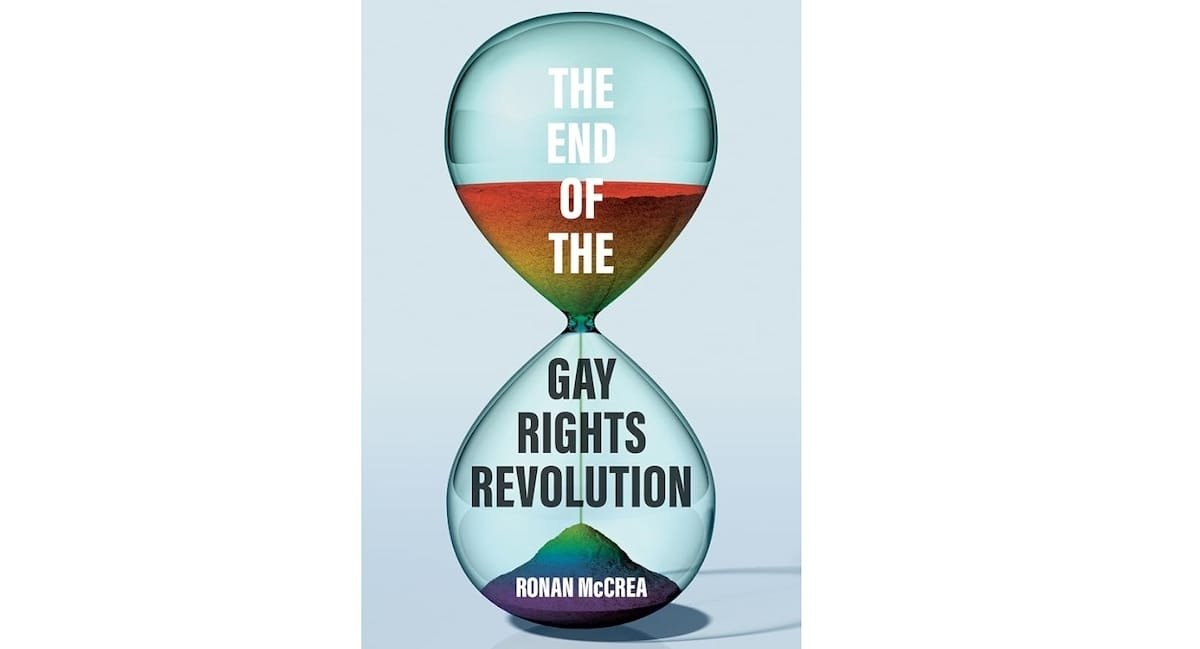
Adapted with permission of the author and publisher, from The End of the Gay Rights Revolution © Ronan McCrea, 2026, published by Polity.
Read the full article here
Fact Checker
Verify the accuracy of this article using AI-powered analysis and real-time sources.