

 Freedom Index
Listen to the article
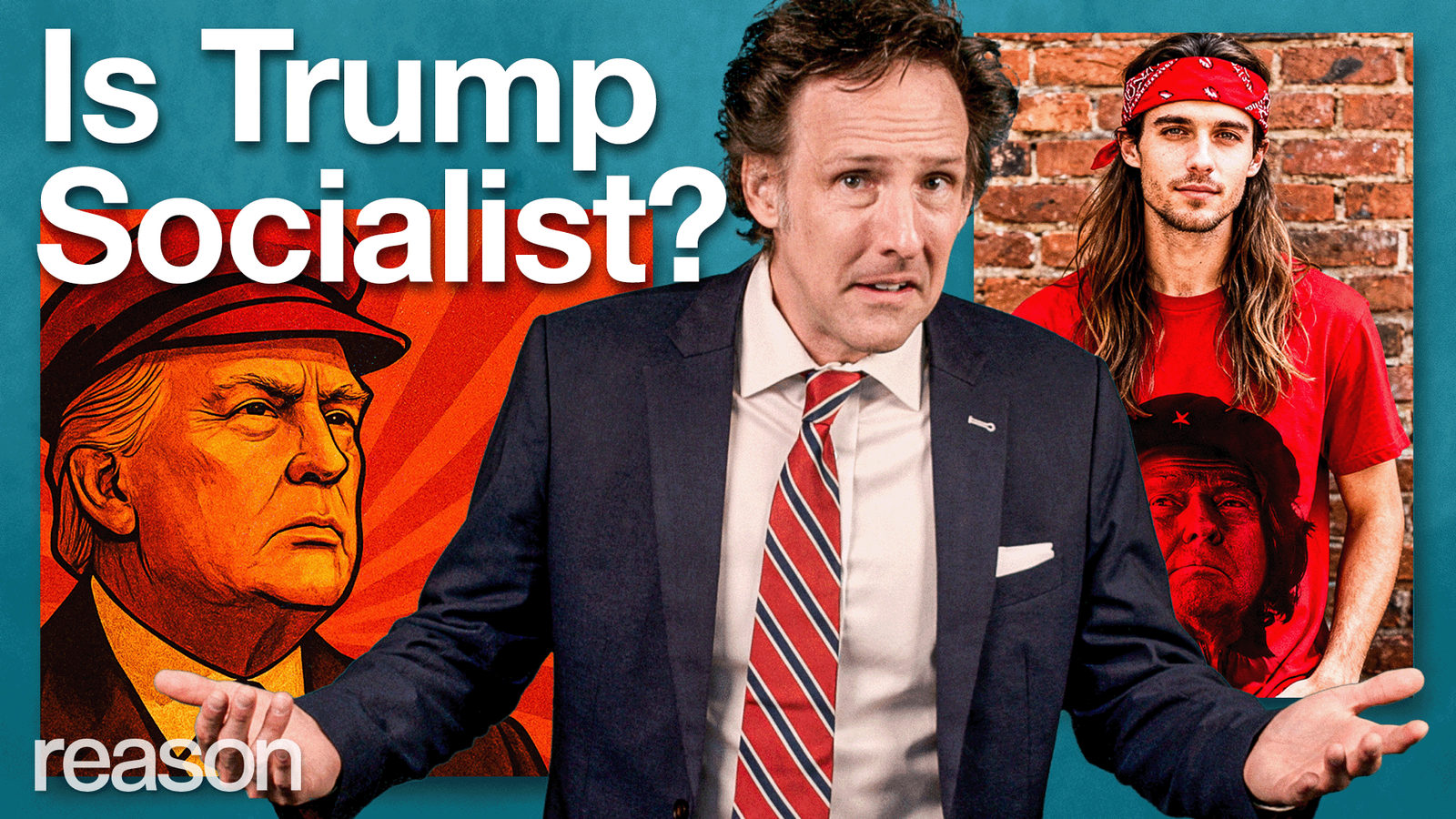
Recently, a handful of people—none of whom have ever invited me to their birthday party—accused President Donald Trump of being a socialist. Gavin Newsom, who many pundits credibly believe is the governor of California, said Trump is committing socialism by having the federal government buy stock in private companies.
At the time of writing, the government has taken shares in Intel, MP Materials, Lithium Americas, U.S. Steel, and even a Canadian mining company that mines cobalt or some other stupid mineral I hate. This raises the question:
Is Trump, as Newsom contends, a full-blown socialist? Or is he just an asymptomatic carrier of socialism, like I am with tuberculosis?
Let’s nail down what we’re talking about.
In socialism, the government owns the means of production. Instead of private companies making goods to satisfy customers and turn a profit, the state produces things to hit output quotas. That’s a lot easier to do if you cut quality. The Soviet Union literally made televisions so poorly that they sometimes exploded. Not a great incentive structure for generating stuff, even if an exploding television is still an improvement over The View.
A softer version exists in countries with national health care systems like the U.K., where doctors and nurses are government employees and hospitals are mostly run by the state. If you’re talking about nationalizing an industry that provides goods or services—that’s socialism.
By contrast, corporatism or state capitalism—or if you want to be edgy, fascism—is when private companies technically own the means of production, but the government controls the decisions. You own the shoe factory, but some bureaucrat in the capital issues diktats on what kind of shoes to make, how many, and so forth. You own the deed to the factory and you keep the profits from the factory, but the economy itself is managed from the top down by the central government.
Think China. It used to be socialist under Chairman Mao Zedong. After starving umpteen million people, it switched over to state capitalism. Today, some of China’s biggest companies are for-profit enterprises: the China Construction Bank, China Mobile, and Air China. They are technically not government agencies, but the government is a massive shareholder and steers corporate decisions.
Capitalism is when the private sector owns and controls the means of production, earns profits or losses, and the government mainly acts as a referee—enforcing contracts, preventing fraud, and stopping people from dumping toxic waste or tuberculosis into rivers. The government doesn’t manage the economy or tell businesses how to operate.
You own the shoe factory, you decide what shoes, boots, or stilettos you will make, as well as how many and how high those stilettos are. You build products based on customer demand, or you will go out of business.
There are a bunch of other economic systems, but we don’t have time to get into them. Somewhere in between, you find social democracies like Sweden or Denmark, where the government levies taxes and redistributes them as welfare and social programs. And then there is crony capitalism, where powerful companies get favors and subsidies because everyone plays golf together.
Which brings us back to Trump.
In the last few months, the Trump administration has negotiated deals that give the federal government significant ownership stakes in private firms. The federal government now owns about 10 percent of Intel. It’s a passive share, not a controlling stake. No one from Washington is voting on the board of directors or deciding which kind of computer stilettos Intel can manufacture. Similarly, the Defense Department invested $400 million in MP Materials in exchange for convertible stock.
Odd, but not unheard of. Many public pension funds do the same.
The more unusual example is the sale of U.S. Steel to Japan’s Nippon Steel. The federal government demanded a “golden share,” giving it extraordinary influence, including a seat on the board of directors and veto power over major decisions like shutting down plants, relocating headquarters, or changing the name of the company to something more cool, like Robot Flesh LTD. This isn’t socialism. But it’s a flavor of authoritarian economics.
What emerges looks much closer to corporatism: an economy where the government becomes a direct player in business decisions rather than a neutral referee.
And that is a big problem. When federal bureaucrats have a direct leadership role in the corporate governance of a private company, they will steer that company toward political decisions rather than business decisions. Will it award contracts based on efficiency and cost, or based on which choice preserves government revenue? Will companies be allowed to fail if the government owns them? Probably not.
Even passive ownership can change incentives: businesses take fewer risks, innovate less, and focus more on political approval than customer satisfaction. That’s how economies drift toward top-down control and away from free enterprise.
So is Donald Trump a socialist? No. I don’t think he is. His logic seems to be: “Instead of giving money to big companies for free, we should be getting the most out of the deal, so let’s have some stock and dividends.” But the effect of these acquisitions is that America is inching toward an economy in which the government doesn’t play referee; it’s a player on the field. And the government is a really, really stupid player.
The real question isn’t whether we’re technically socialists like Venezuela or state capitalists like China. It’s whether we want a free-enterprise system or an authoritarian system with government-guided boardrooms.
Markets work when the government referees. They stagnate when the government becomes a player.
Read the full article here
Fact Checker
Verify the accuracy of this article using AI-powered analysis and real-time sources.