Close Menu
FSNN | Free Speech News NetworkFSNN | Free Speech News Network
  • Home
  • News
    • Politics
    • Legal & Courts
    • Tech & Big Tech
    • Campus & Education
    • Media & Culture
    • Global Free Speech
  • Opinions
    • Debates
  • Video/Live
  • Community
  • Freedom Index
  • About
    • Mission
    • Contact
    • Support
Trending

Grayscale wants to bring the world’s hottest crypto trading frenzy to your brokerage account

1 hour ago

Bitcoin options signal extreme fear as downside protection premium hits new all-time high, says VanEck

2 hours ago

Announcing The Winners Of The 8th Annual Public Domain Game Jam

3 hours ago
Facebook X (Twitter) Instagram
Facebook X (Twitter) Discord Telegram
FSNN | Free Speech News NetworkFSNN | Free Speech News Network
Market Data Newsletter
Saturday, March 21
  • Home
  • News
    • Politics
    • Legal & Courts
    • Tech & Big Tech
    • Campus & Education
    • Media & Culture
    • Global Free Speech
  • Opinions
    • Debates
  • Video/Live
  • Community
  • Freedom Index
  • About
    • Mission
    • Contact
    • Support
FSNN | Free Speech News NetworkFSNN | Free Speech News Network
Home»News»Media & Culture»Trump’s Economic Fallacies Are Legally Relevant in His Tariff Case
Media & Culture

Trump’s Economic Fallacies Are Legally Relevant in His Tariff Case

News RoomBy News Room5 months agoNo Comments4 Mins Read1,250 Views
Share Facebook Twitter Pinterest Copy Link LinkedIn Tumblr Email VKontakte Telegram
Trump’s Economic Fallacies Are Legally Relevant in His Tariff Case
Share
Facebook Twitter Pinterest Email Copy Link

Listen to the article

0:00
0:00

Key Takeaways

Playback Speed

Select a Voice

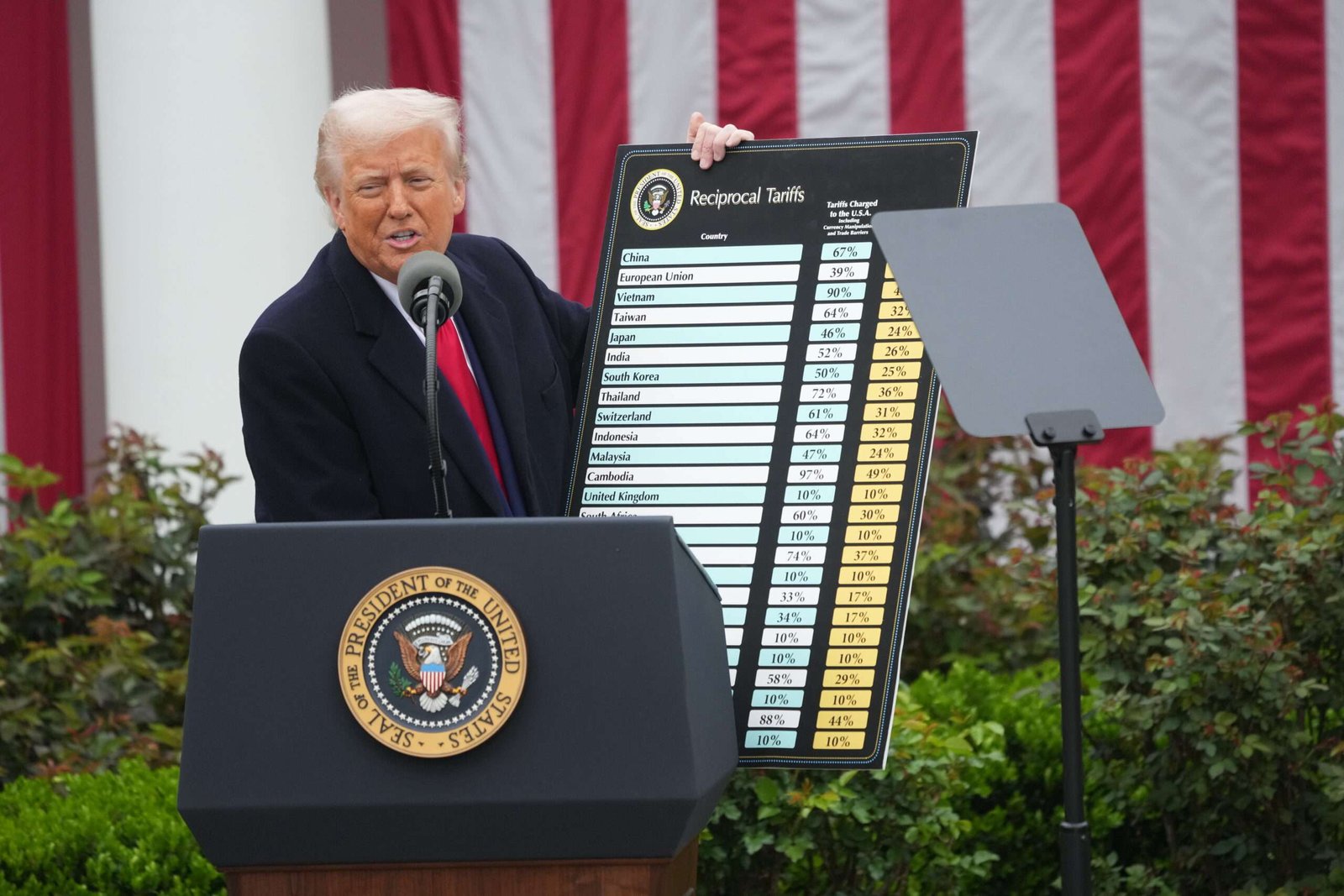
In April, President Donald Trump announced stiff tariffs on goods from nearly every country on the planet, saying they were necessary to “deal with” a “national emergency” involving an “unusual and extraordinary threat” to “the national security, foreign policy, or economy of the United States.” According to a Supreme Court brief signed by 45 American economists, Trump’s description of that huge, unilateral tax increase was fundamentally mistaken.

That assessment, which reflects what a leading textbook on international trade calls a “virtually complete consensus among economists,” should be of more than passing interest to the justices as they weigh the legality of Trump’s tariffs. It goes to the heart of the powers Trump is asserting under the International Emergency Economic Powers Act (IEEPA).

One question for the Supreme Court is whether IEEPA, a 1977 law that does not mention import taxes and has never before been used to impose them, gives the president any tariff authority at all. Assuming it does, another question is whether the law empowers him to completely rewrite the tariff schedule approved by Congress—a proposition that three lower courts have rejected.

The economists’ brief focuses on a third issue: Does Trump’s use of IEEPA meet the law’s criteria for invoking it? That depends on whether he is right to portray the “large and persistent” gap between U.S. exports and imports of goods as a national emergency.

Trade deficits “have existed consistently over the past fifty years in the United States, for extended periods in the United States in the nineteenth century, and in most countries in most years in recent decades,” the economists note. “They are thus not ‘unusual and extraordinary,’ but rather ordinary and commonplace.”

The brief adds that there is nothing inherently problematic about aggregate or bilateral trade deficits, such that they would constitute a “threat” to the United States. Even the term deficit is misleading in this context, the economists note, since the situation that Trump bemoans necessarily corresponds to a “foreign investment surplus.”

When a country “imports more than it exports,” the brief explains, that means it “receives more foreign investment than it invests abroad.” That is why “the leading explanations of the U.S. trade deficit view it as a sign of U.S. strength, not weakness.”

Trump seems to view foreign investment as a good thing. Yet “absent offsetting adjustments elsewhere,” the brief says, “these investments will increase the U.S. trade deficit.”

In addition to worrying about the overall difference between imports and exports, Trump thinks it is inherently suspicious whenever another country runs a trade surplus with the United States. But because of variations in demand, specialization, and comparative advantage, the economists note, “bilateral trade deficits are a virtual logical certainty.”

It is therefore “odd to economists, to say the least, for the United States government to attempt to rebalance trade on a country-by-country basis,” the brief says. And contrary to Trump’s presumption of unfairness, “foreign tariff rates on US exports do not correlate positively with the size of US trade deficits.”

Nor is it reasonable to expect that Trump’s tariffs will “deal with” this supposed national emergency by shrinking U.S. trade deficits. While “tariffs unambiguously reduce total trade flows,” the economists note, “they generally do so in both directions—both in and out.”

Consequently, “the volume of trade will fall,” but “the level of the trade deficits may remain unchanged.” Consistent with that observation, the U.S. trade deficit in goods rose between January and June, “despite a very large increase in tariffs.”

Although Trump’s tariffs are not working as advertised, the economists note, they will have “a massive impact across the United States,” amounting to trillions of dollars during the next decade. That fact is also legally relevant.

The “major questions” doctrine requires “clear congressional authorization” when executive agencies “claim the power to make decisions of vast economic and political significance.” If Trump’s tariffs do not fall into that category, it is hard to imagine what would.

© Copyright 2025 by Creators Syndicate Inc.

Read the full article here

Fact Checker

Verify the accuracy of this article using AI-powered analysis and real-time sources.

Get Your Fact Check Report

Enter your email to receive detailed fact-checking analysis

5 free reports remaining

Continue with Full Access

You've used your 5 free reports. Sign up for unlimited access!

Already have an account? Sign in here

Share. Facebook Twitter Pinterest LinkedIn Tumblr Email Telegram Copy Link
News Room
  • Website
  • Facebook
  • X (Twitter)
  • Instagram
  • LinkedIn

The FSNN News Room is the voice of our in-house journalists, editors, and researchers. We deliver timely, unbiased reporting at the crossroads of finance, cryptocurrency, and global politics, providing clear, fact-driven analysis free from agendas.

Related Articles

Media & Culture

Announcing The Winners Of The 8th Annual Public Domain Game Jam

3 hours ago
Media & Culture

Today in Supreme Court History: March 21, 1989

9 hours ago
Media & Culture

Seattle’s Minimum Wage Laws Backfired on Uber and Lyft. Now the Union Wants To Limit Drivers.

10 hours ago
Media & Culture

Blame U.S. Regulations for China’s Dominance in Rare-Earth Minerals

11 hours ago
Media & Culture

California Democrats May Have To Choose Between 2 Republicans in November’s Gubernatorial Race

12 hours ago
Media & Culture

Same Lies, New War: Trump and the Iraq Playbook

13 hours ago
Add A Comment

Comments are closed.

Editors Picks

Bitcoin options signal extreme fear as downside protection premium hits new all-time high, says VanEck

2 hours ago

Announcing The Winners Of The 8th Annual Public Domain Game Jam

3 hours ago

Crypto firms are ditching hundreds of workers to bet the house on AI

3 hours ago

SEC Crypto Guidance Is a Major Step, but More Is Needed: Analyst

3 hours ago
Latest Posts

How DeFi is quietly rebuilding the fixed-income stack for institutional capital

4 hours ago

Bitcoin Options Flag Traders’ Fear As Iran War Carries On

4 hours ago

Polymarket’s 5-cent signal was the only thing that got the Netanyahu rumors right

5 hours ago

Subscribe to News

Get the latest news and updates directly to your inbox.

At FSNN – Free Speech News Network, we deliver unfiltered reporting and in-depth analysis on the stories that matter most. From breaking headlines to global perspectives, our mission is to keep you informed, empowered, and connected.

FSNN.net is owned and operated by GlobalBoost Media
, an independent media organization dedicated to advancing transparency, free expression, and factual journalism across the digital landscape.

Facebook X (Twitter) Discord Telegram
Latest News

Grayscale wants to bring the world’s hottest crypto trading frenzy to your brokerage account

1 hour ago

Bitcoin options signal extreme fear as downside protection premium hits new all-time high, says VanEck

2 hours ago

Announcing The Winners Of The 8th Annual Public Domain Game Jam

3 hours ago

Subscribe to Updates

Get the latest news and updates directly to your inbox.

© 2026 GlobalBoost Media. All Rights Reserved.
  • Privacy Policy
  • Terms of Service
  • Our Authors
  • Contact

Type above and press Enter to search. Press Esc to cancel.

🍪

Cookies

We and our selected partners wish to use cookies to collect information about you for functional purposes and statistical marketing. You may not give us your consent for certain purposes by selecting an option and you can withdraw your consent at any time via the cookie icon.

Cookie Preferences

Manage Cookies

Cookies are small text that can be used by websites to make the user experience more efficient. The law states that we may store cookies on your device if they are strictly necessary for the operation of this site. For all other types of cookies, we need your permission. This site uses various types of cookies. Some cookies are placed by third party services that appear on our pages.

Your permission applies to the following domains:

  • https://fsnn.net
Necessary
Necessary cookies help make a website usable by enabling basic functions like page navigation and access to secure areas of the website. The website cannot function properly without these cookies.
Statistic
Statistic cookies help website owners to understand how visitors interact with websites by collecting and reporting information anonymously.
Preferences
Preference cookies enable a website to remember information that changes the way the website behaves or looks, like your preferred language or the region that you are in.
Marketing
Marketing cookies are used to track visitors across websites. The intention is to display ads that are relevant and engaging for the individual user and thereby more valuable for publishers and third party advertisers.