

 Freedom Index
Listen to the article
Newsrooms across the country are facing a growing wave of legal attacks aimed at silencing investigative reporting about powerful people and institutions. Especially for independent journalists or small, local newsrooms with dwindling resources, the mere potential of facing these challenges — and the financial peril that could come with fighting a costly legal battle — can force them to think twice when pursuing hard-hitting stories.
Attorneys at the Reporters Committee for Freedom of the Press regularly provide free legal vetting, or pre-publication review, for journalists and documentary filmmakers to address potential legal issues before a project is published or released, helping them get important stories out to their communities.
Our attorneys have supported dozens of investigative projects over the years, from reporting on drug overdoses in Tennessee and police shootings in Kentucky to documentary films that have premiered at prestigious film festivals like Sundance, Toronto International, Venice, Berlin, and South by Southwest.
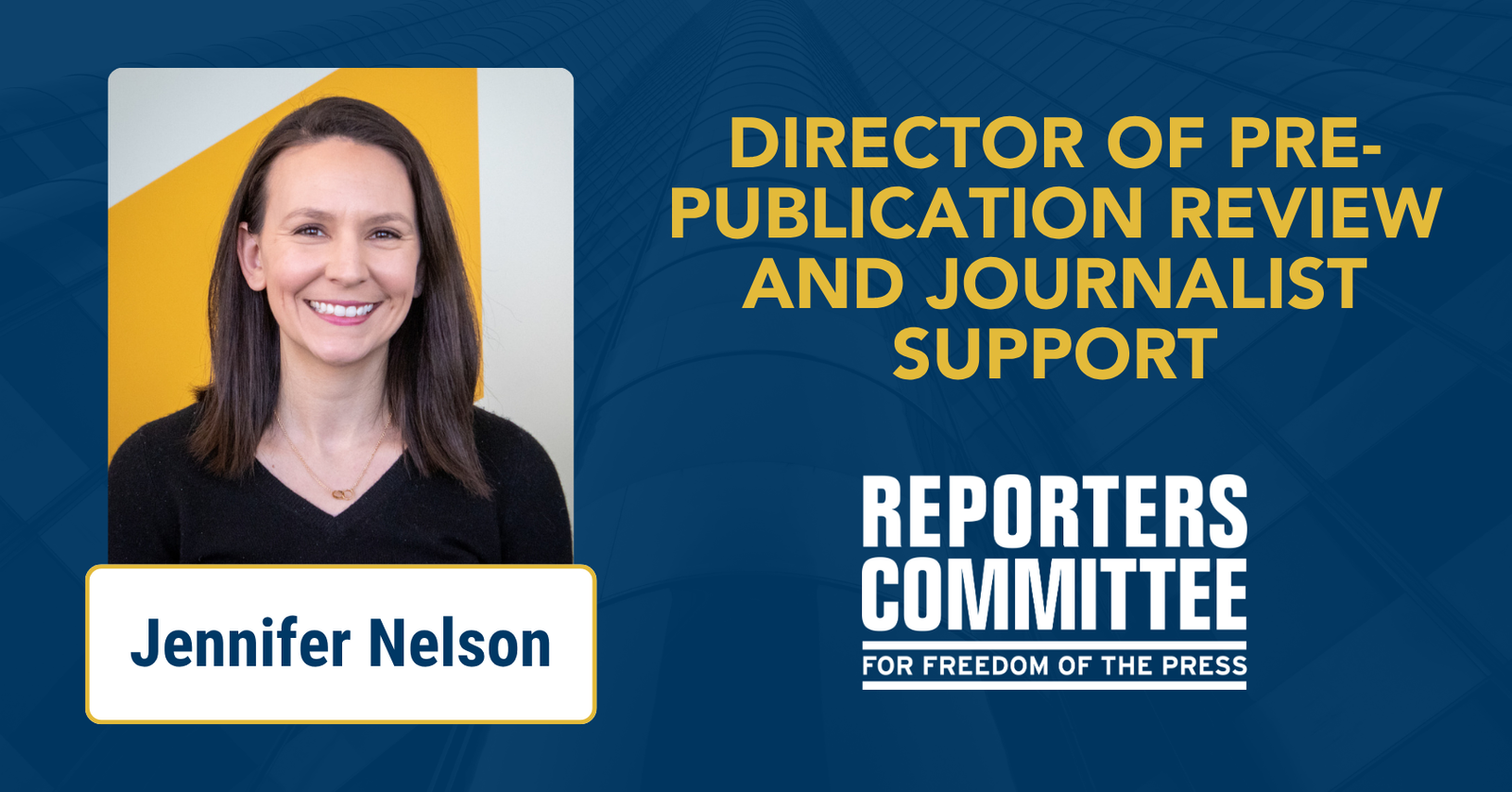
In October, attorney Jennifer Nelson stepped into the role of director of pre-publication review and journalist support at the Reporters Committee, a position in which she oversees the continued expansion of the organization’s burgeoning pre-publication review practice as well as the publication of and updates to its 200+ legal guides, its Legal Hotline for journalists, and its newsroom legal training program.
Nelson, who joined the Reporters Committee in 2017, has played a pivotal part in the pre-publication review program since its inception roughly eight years ago. In addition to accepting clients through several partnerships and, at times, our Legal Hotline, the Reporters Committee has increasingly offered free legal vetting to journalists and newsrooms in our Local Legal Initiative states.
Staff Writer and Communications Assistant Emily Vespa recently sat down with Nelson to talk about how she’s grown the program’s docket and her vision for its future. In the conversation below, Nelson discusses how she helps clients take a project “from soup to nuts,” the ways in which her background in journalism informs her work, and why pre-publication review will play an important role in the Local Legal Initiative as the program expands.
What does the process of pre-publication review look like?
I’m looking at a report or a film, and I’m trying to figure out, “Are there any vulnerabilities here that could lead to the journalist or the filmmaker facing legal action after publication or broadcast?” So it’s really an advisory role while the story itself or the film is still being crafted, and it’s to provide options to journalists and filmmakers on how to mitigate that risk. What are your options to lower any risk that you’ll face a lawsuit after the fact and ensure that you’re well-positioned to defend your work if you’re sued?
I have a lot of projects that are currently in the works — so films that are in the production stage — that maybe they’ll come to me occasionally with a court access question or a public records question or a safety question, but then I just won’t hear from them for a while. And the same goes with investigative reporting: I’ll sign with a client, and then they’re off doing their reporting. I might not see a draft for six months, 10 months, a year, but then it’ll come back around.
So I always make clear to my clients, “Look, I’m here. If you have any newsgathering related questions, keep me posted on the status of your work.” Eventually a draft will come in, and then the process really begins.
What do you enjoy about working with clients as they take a project from start to finish?
I really value the projects where I come in at the ground floor. It’s not always the case, just depending on where things are when they approach us for pre-pub review. But I do love working with filmmakers and journalists who are still in that newsgathering or content gathering stage, because you really see the process from soup to nuts, and you feel like you’re a part of it.
Before I went to law school, I was a print journalist, so there are aspects of journalism that I miss a lot, even after being a lawyer for as long as I’ve been. It kind of puts me right back in the journalist mindset, and that can be really fulfilling.
I’m helping journalists strategize how to get access to a certain record, maybe, that will really impact their work or their film, or helping them advocate for access to a courtroom so that they can film in a courtroom, or helping them shore up their digital security practices so they can be confident that the sources that they’re communicating with will remain confidential when that needs to be confidential. And so all those little things are really interesting. No two days are the same. And so handling these one off questions from clients here and there, it just keeps things really fresh and interesting. And I’m always learning, too, which is great.
Your new role comes as the Reporters Committee’s pre-publication review practice is larger than ever before. Why is pre-publication review such an in-demand resource for journalists?
Pre-publication review on a pro bono basis is hard to come by. The Reporters Committee started doing this work eight years ago, and there’s significant demand for it.
We’ve seen a lot of news outlets recently express nervousness about pursuing aggressive stories. There is absolutely a chilling effect that is happening right now where we’re seeing an increase in threats of defamation lawsuits or defamation lawsuits being filed. News organizations see what’s happening, and as a result, they are inherently less likely to pursue big stories for fear of being sued for that journalism.
The small, nonprofit news organizations and smaller outlets that our Local Legal Initiative attorneys in particular serve would be faced with bankruptcy if they have to defend themselves against a defamation lawsuit. It’s a real existential threat for them. Pre-publication review can provide them really important advice on risk, and can help them get to a point where they feel more comfortable pursuing and publishing those important stories. To be able to provide that on a pro bono basis is something that’s rare and that we’re really lucky to be able to do here at the Reporters Committee.
Looking ahead, what’s your vision for the growth of the pre-publication review practice?
There are two areas that have been our primary areas of expansion. The first is within our five Local Legal Initiative jurisdictions.
As we expand the program to four new states in the next year, I think that’s going to be another area of growth for us. I think it provides a lot of really good opportunities to find and serve new clients in these jurisdictions. Pre-publication review matters can be shorter in length than a very long litigation matter might be, and so you can establish a good relationship with a client via a few pre-publication review projects. And then later on, when they have a public records issue, or they have a court access issue, or they get subpoenaed, they’re going to come back to that Local Legal Initiative attorney that provided them that service early on.
The second area of expansion is documentary film. We’ve continued to increase our docket of documentary films, and a lot of what we are seeing now are former clients returning to us when they’re working on a new project. And that is, for me, the ultimate sign of approval — where a client comes back and says, “We loved working with you before, and we want to work with you again.” So we’ve seen that, which has been fantastic.
It’s my goal to start involving as many attorneys as we can in the practice. It was pretty narrow in scope when we first started, and has broadened a lot. There’s a lot of interest for our legal fellows to do this work, and our staff attorneys are always really interested in it. It’s just very different from litigation or from brief writing for our amicus practice. So I think it’s nice to give those opportunities to our legal fellows and more junior attorneys who might not otherwise get exposure to pre-publication review work.
Why is exposure to this kind of legal work valuable for junior attorneys? What kinds of skills can they learn?
It’s a lot more client-advice focused. So you’re giving fellows an opportunity to have face-to-face interaction with the client, and to build a relationship with them, to build a trust with them. It’s very different from being in a litigation posture; you’re not talking to opposing counsel, you’re talking to the client, and you’re advising them on options, steps that they can take within their own work product to mitigate legal risk that they could face for publishing. So it’s just a very different set of skills than litigation.
I think attorneys who are earlier in their careers tend to like pre-publication review because a lot of it is issue spotting like you do in law school. You’re reviewing a piece, and you’re trying to identify areas where there could be legal risk, and then you’re trying to convey that to the client. I think those skills are really, really important for any media lawyer. And I think getting client interaction early in one’s career is really important and harder to come by.
When I was at a big firm, I would have meetings where I was in the room with the client, but I wouldn’t be the one talking. I really try to have legal fellows not only listening in on our calls with the client, but actively providing their insight and their input and sharing their views on a piece so that they can start to develop those skills, rather than just merely listening to me talk the entire time.
When you think about the projects that Reporters Committee attorneys have vetted, what are you most proud of?
I’ve been really proud to see some of the investigative reporting that we’ve helped vet go on to win awards in the industry. We’ve had films premiere or make appearances at all of the major film festivals, and that’s really, really remarkable. It’s just been really rewarding to see the work appreciated when it’s out there in the world.
The Reporters Committee for Freedom of the Press is the leading pro bono legal services provider for journalists and news organizations in the United States, offering direct legal representation, amicus curiae support, and other legal resources to protect First Amendment freedoms and the newsgathering rights of journalists. Stay up-to-date on our work by signing up for our newsletters and following us on Bluesky, LinkedIn, Instagram, and Facebook.
Read the full article here
Fact Checker
Verify the accuracy of this article using AI-powered analysis and real-time sources.