

 Freedom Index
Listen to the article
from the kids-will-find-a-way dept
As anyone who has read Techdirt for any length of time knows full well, there’s been a years-long campaign to demonize kids and social media. Never mind that actual experts have said the data doesn’t support the claims of inherent harm, politicians around the globe are rushing to ban kids from social media as fast as they can.
But banning kids from social media has a fundamental problem: kids will find a way. They always do. And part of that is just because kids need those kinds of “third spaces” where they can communicate outside the prying eyes of parents or teachers. And if adults keep blocking off those spaces, kids are smart enough to figure out clever workarounds.
Six years ago, when schools blocked social media apps on their networks, students simply repurposed Google Docs—required for assignments—into an improvised social network which they could hide from teachers and parents by claiming they were working on homework:
Teens told me they use Google Docs to chat just about any time they need to put their phone away but know their friends will be on computers. Sometimes they’ll use the service’s live-chat function, which doesn’t open by default, and which many teachers don’t even know exists. Or they’ll take advantage of the fact that Google allows users to highlight certain phrases or words, then comment on them via a pop-up box on the right side: They’ll clone a teacher’s shared Google document, then chat in the comments, so it appears to the casual viewer that they’re just making notes on the lesson plan. If a teacher approaches to take a closer look, they can click the Resolve button, and the entire thread will disappear.
That was 2019. I’m sure things like that are still happening in Google Docs, but it’s apparently also happening in an even more absurd venue: podcast comments.
The latest “How To Do Everything” podcast from NPR featured someone who monitors comments for the TED Radio Hour. She noticed something strange: kids are flooding the comments of random old episodes, turning obscure three-year-old podcasts into makeshift chat rooms where adults won’t think to look.
Yeah, so one of my responsibilities on my team is to monitor our Spotify comments. And for the most part, we mostly get really like nice comments or people engaging with our content, giving constructive feedback or saying how much they liked it. But about 3 weeks ago, I noticed kind of a different floodgate situation. And the first instance was only about 20 comments….
20 comments on one episode that came out three years ago. Yeah. And all the comments kind of had the same like, “No, you’re so pretty. You’re so pretty.” And I was really trying to rack my brain about the content of this episode 3 years ago to be like, is there a discussion about beauty standards that they are trying to engage with?
Yeah. And then about a week later, they struck again, but this time hitting the comments hit into the 90s.
And then I kind of felt like, okay, this really needs to be something we’re flagging. And when I brought it up, it seemed like other teams had also been privately sitting on this very odd situation.
So the show’s hosts discuss this, and the sense is that they’re using these shows as a space to communicate:
GUEST: Yeah, I mean, we definitely can’t say exactly who these people are, why they’re doing this, but my sense is that they’re kids. One of the theories that some other folks have put forward is that maybe this is just a way to get around a classroom phone free situation. Like maybe they can have their laptops out but they can’t have Instagram open or Spotify is the only thing they’re allowed to have. I don’t actually know. It seems like a workaround for sure.
HOST: It’s brilliant because like what could be less worrying to a teacher or a parent might be catching, you know, a look at one of these kids’ phones that they’re listening to NPR’s TED Radio Hour with their friends.
GUEST: Oh my gosh. Yeah.
They ask for an example episode, and indeed, there’s an episode on “What Leadership Looks Like” from 2022 (there’s another one with the same title that might just be a rerun from 2024 which doesn’t have comments) and you can see comments from a few weeks ago that are clearly kids chatting.
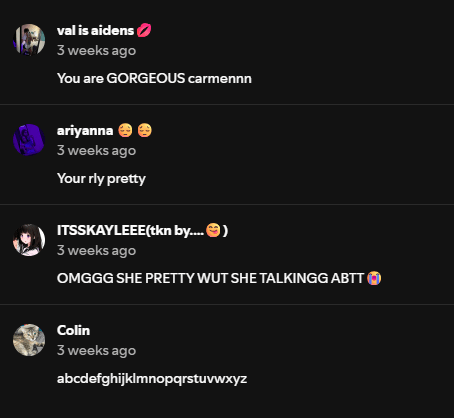
So, it seems likely that the theory is at least close to correct, that kids are just seeking out places where they can speak freely that look okay to adults at the very same time adults are trying to ban the other spaces where parents think they’ll talk and don’t like it.
As the person from TED Radio Hour (unfortunately, her name is not clearly stated and I couldn’t figure out what it was…) notes:
I think my sense from digging into it a little bit and following the usernames was effectively they make a playlist that has just one podcast and that podcast becomes kind of the graffiti space I guess of this… popup conversation.
To me, this demonstrates some of the futility of trying to ban these spaces. As I mentioned above, kids need these kinds of “third spaces” that are not school and not home in which to communicate more freely with their friends. Because of a variety of moral panics, we’ve closed off many of the real world physical spaces where that could occur, so it was no surprise that many kids gravitated to digital spaces.
But now that adults are, again, seeking to close off those spaces, kids appear to be coming up with clever ways to sneak around those bans and keep talking.
Of course, the moral panic could always follow them here too. Maybe Australia will ban kids from Spotify comments next. Then Google Docs. Then whatever random corner of the internet kids discover after that. We can keep playing whac-a-mole until we’ve legislated away every possible space where teenagers might talk to each other without adult supervision. At least it’ll feel like we’re doing something.
Or—and here’s a thought—we could stop trying to eliminate every space where kids communicate and start teaching them how to navigate those spaces safely. We could recognize that kids need room to talk, to mess up, to figure things out away from constant surveillance. That would require trusting kids to learn, rather than treating every unsupervised conversation as a crisis waiting to happen. But judging by the current trajectory, we’re more likely to see legislation banning carrier pigeons first.
Filed Under: comments, community, kids, moral panic, podcasts, social media, third space
Companies: npr, spotify
Read the full article here
Fact Checker
Verify the accuracy of this article using AI-powered analysis and real-time sources.