Close Menu
FSNN | Free Speech News NetworkFSNN | Free Speech News Network
  • Home
  • News
    • Politics
    • Legal & Courts
    • Tech & Big Tech
    • Campus & Education
    • Media & Culture
    • Global Free Speech
  • Opinions
    • Debates
  • Video/Live
  • Community
  • Freedom Index
  • About
    • Mission
    • Contact
    • Support
Trending

Elon Musk Wins Defamation Lawsuit Brought by Someone Musk Allegedly Misidentified in X Post

35 minutes ago

Ledger Hires Ex-Circle Executive as CFO, Opens NYC Office Amid US Expansion

59 minutes ago

Eightco Boosts OpenAI Investment After BitMine’s Tom Lee Joins Board

1 hour ago
Facebook X (Twitter) Instagram
Facebook X (Twitter) Discord Telegram
FSNN | Free Speech News NetworkFSNN | Free Speech News Network
Market Data Newsletter
Saturday, March 21
  • Home
  • News
    • Politics
    • Legal & Courts
    • Tech & Big Tech
    • Campus & Education
    • Media & Culture
    • Global Free Speech
  • Opinions
    • Debates
  • Video/Live
  • Community
  • Freedom Index
  • About
    • Mission
    • Contact
    • Support
FSNN | Free Speech News NetworkFSNN | Free Speech News Network
Home»News»Media & Culture»How Opioid Settlement Money Turned Into a $600K Party Fund
Media & Culture

How Opioid Settlement Money Turned Into a $600K Party Fund

News RoomBy News Room5 months agoNo Comments4 Mins Read319 Views
Share Facebook Twitter Pinterest Copy Link LinkedIn Tumblr Email VKontakte Telegram
How Opioid Settlement Money Turned Into a 0K Party Fund
Share
Facebook Twitter Pinterest Email Copy Link

Listen to the article

0:00
0:00

Key Takeaways

Playback Speed

Select a Voice

The town of Irvington in Essex County, New Jersey, was hit hard by the opioid crisis. In 2023, the county recorded 459 drug overdose deaths, 401 of them opioid-related—the most deaths of any county in the state. Despite this predicament, Irvington officials spent most of their more than $1 million share of opioid settlement funds not on treatment, prevention, or recovery programs, but on a pair of summer concerts with DJs, luxury trailers, and catered food.
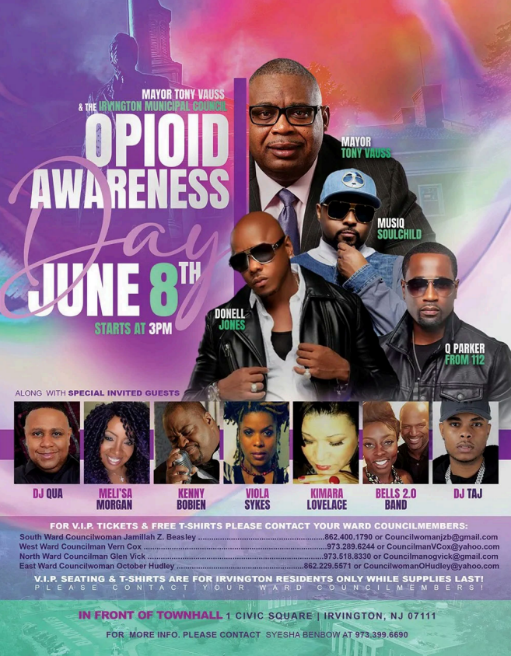
A flyer promoting Irvington’s 2024 opioid awareness concert pictured Mayor Tony Vauss. (New Jersey Office of the State Comptroller)

The town billed the concerts as “Opioid Awareness Day,” but they appeared designed more to promote awareness of Mayor Tony Vauss. His name topped the event’s promotional materials, and, as the State Comptroller later noted, “no opioid-related information appeared on stage, though two large posters of Mayor Vauss flanked it.” 

Those two concerts cost the township more than $630,000, according to the comptroller’s investigation, with much of that money going to Antoine Richardson, a DJ who was put on Irvington’s payroll following Vauss’ election in 2014. Richardson already drew an annual salary of nearly $180,000, plus full benefits, for a job called “Keyboarding Clerk 1” with no set hours. The investigation revealed that businesses owned by Richardson’s immediate family collected about $370,000 in related contracts for the concerts.

Beyond a few opioid-related “pamphlets printed from the internet” and a small table stocked with a handful of Narcan, the investigation found that there was virtually no health programming. Richardson told investigators that before his DJ set, he told the crowd to “stay clean” and “say no to drugs”—and that each performing artist said something to the effect of, “Kids, stay in school, stay away from drugs.”   

Irvington, New Jersey, is not an isolated case. Across the country, state and local governments are receiving approximately $50 billion in the next decade from settlements with opioid manufacturers, distributors, and retailers—including Johnson & Johnson, CVS, and Walmart—to remediate the overdose crisis. 

The settlements offered governments significant discretion in how to spend the money. Exhibit E of the national agreement lays out a non-exhaustive list of recommended uses—such as expanding treatment access, supporting harm reduction programs, and improving data collection—but leaves enforcement entirely up to the states. The settlements do not stipulate formal penalties for misuse; there are no clawback provisions or reporting requirements in place. 

States were required to draft a Memorandum of Agreement (MOA) with their municipalities, outlining how funds are allocated and specifying any reporting requirements. New Jersey’s MOA and state law require expenditures to be “evidence-based” or “evidence-informed,” which is what led to the city of Irvington’s trouble. Whether any of that money will be recovered—or whether officials will face consequences—remains to be seen.

Elsewhere, misuse has taken subtler forms. In Indiana’s Scott County, settlement dollars were used to pay staff salaries, freeing up local funds for other priorities. In West Virginia, more than half of all settlement spending last year went toward police vehicles, jail bills, and salaries, while only six percent supported treatment and recovery. These practices, known as supplantation, enable local governments to use new money to replace existing funds, effectively turning settlement dollars into general revenue. 

The pattern mirrors the infamous failure of the 1998 Tobacco Master Settlement Agreement. According to a Government Accountability Office report, states received more than $50 billion from tobacco companies between 2000 and 2005, but only 30 percent went to health care and smoking prevention. The rest was absorbed into state budgets, debt service, and infrastructure projects. 

Some states even securitized their future settlement payments, trading decades of public health funding for an upfront lump sum, and forfeiting long-term funding streams that could sustain treatment and prevention infrastructure in exchange for short-term priorities. The same practice is already being discussed for opioid settlements.

When governments are entrusted with funds to address a crisis that has claimed more than 800,000 lives since 1999, they carry a moral obligation to act accordingly. Every dollar wasted is a dollar not spent on expanding access to treatment, distributing naloxone, or building recovery infrastructure. The outcomes of the tobacco settlement provide clear lessons for the use of opioid settlement funds: Absent binding guardrails and rigorous transparency, both state and local governments face strong incentives to divert or front-load funds in ways that undermine their intended purpose.

Read the full article here

Fact Checker

Verify the accuracy of this article using AI-powered analysis and real-time sources.

Get Your Fact Check Report

Enter your email to receive detailed fact-checking analysis

5 free reports remaining

Continue with Full Access

You've used your 5 free reports. Sign up for unlimited access!

Already have an account? Sign in here

Share. Facebook Twitter Pinterest LinkedIn Tumblr Email Telegram Copy Link
News Room
  • Website
  • Facebook
  • X (Twitter)
  • Instagram
  • LinkedIn

The FSNN News Room is the voice of our in-house journalists, editors, and researchers. We deliver timely, unbiased reporting at the crossroads of finance, cryptocurrency, and global politics, providing clear, fact-driven analysis free from agendas.

Related Articles

Media & Culture

Elon Musk Wins Defamation Lawsuit Brought by Someone Musk Allegedly Misidentified in X Post

35 minutes ago
Cryptocurrency & Free Speech Finance

Eightco Boosts OpenAI Investment After BitMine’s Tom Lee Joins Board

1 hour ago
Media & Culture

Delilah and Me

2 hours ago
Cryptocurrency & Free Speech Finance

Nevada Becomes First State to Ban Prediction Market Kalshi—At Least for Now

2 hours ago
Media & Culture

First Amendment Precludes Title VI Liability for Harsh Anti-Israel Speech at Art Institute of Chicago

3 hours ago
Cryptocurrency & Free Speech Finance

Man Pleads Guilty to Using AI to Generate $8 Million in Fraudulent Streaming Music Royalties

3 hours ago
Add A Comment

Comments are closed.

Editors Picks

Ledger Hires Ex-Circle Executive as CFO, Opens NYC Office Amid US Expansion

59 minutes ago

Eightco Boosts OpenAI Investment After BitMine’s Tom Lee Joins Board

1 hour ago

Delilah and Me

2 hours ago

Hyperliquid oil volume booming thanks to war in Middle East: JPMorgan

2 hours ago
Latest Posts

Google Threat Intelligence Sounds Alarm on Latest Crypto Malware Threat

2 hours ago

Nevada Becomes First State to Ban Prediction Market Kalshi—At Least for Now

2 hours ago

Congress is dropping the ball with a clean extension of FISA

3 hours ago

Subscribe to News

Get the latest news and updates directly to your inbox.

At FSNN – Free Speech News Network, we deliver unfiltered reporting and in-depth analysis on the stories that matter most. From breaking headlines to global perspectives, our mission is to keep you informed, empowered, and connected.

FSNN.net is owned and operated by GlobalBoost Media
, an independent media organization dedicated to advancing transparency, free expression, and factual journalism across the digital landscape.

Facebook X (Twitter) Discord Telegram
Latest News

Elon Musk Wins Defamation Lawsuit Brought by Someone Musk Allegedly Misidentified in X Post

35 minutes ago

Ledger Hires Ex-Circle Executive as CFO, Opens NYC Office Amid US Expansion

59 minutes ago

Eightco Boosts OpenAI Investment After BitMine’s Tom Lee Joins Board

1 hour ago

Subscribe to Updates

Get the latest news and updates directly to your inbox.

© 2026 GlobalBoost Media. All Rights Reserved.
  • Privacy Policy
  • Terms of Service
  • Our Authors
  • Contact

Type above and press Enter to search. Press Esc to cancel.

🍪

Cookies

We and our selected partners wish to use cookies to collect information about you for functional purposes and statistical marketing. You may not give us your consent for certain purposes by selecting an option and you can withdraw your consent at any time via the cookie icon.

Cookie Preferences

Manage Cookies

Cookies are small text that can be used by websites to make the user experience more efficient. The law states that we may store cookies on your device if they are strictly necessary for the operation of this site. For all other types of cookies, we need your permission. This site uses various types of cookies. Some cookies are placed by third party services that appear on our pages.

Your permission applies to the following domains:

  • https://fsnn.net
Necessary
Necessary cookies help make a website usable by enabling basic functions like page navigation and access to secure areas of the website. The website cannot function properly without these cookies.
Statistic
Statistic cookies help website owners to understand how visitors interact with websites by collecting and reporting information anonymously.
Preferences
Preference cookies enable a website to remember information that changes the way the website behaves or looks, like your preferred language or the region that you are in.
Marketing
Marketing cookies are used to track visitors across websites. The intention is to display ads that are relevant and engaging for the individual user and thereby more valuable for publishers and third party advertisers.