

 Freedom Index
Listen to the article
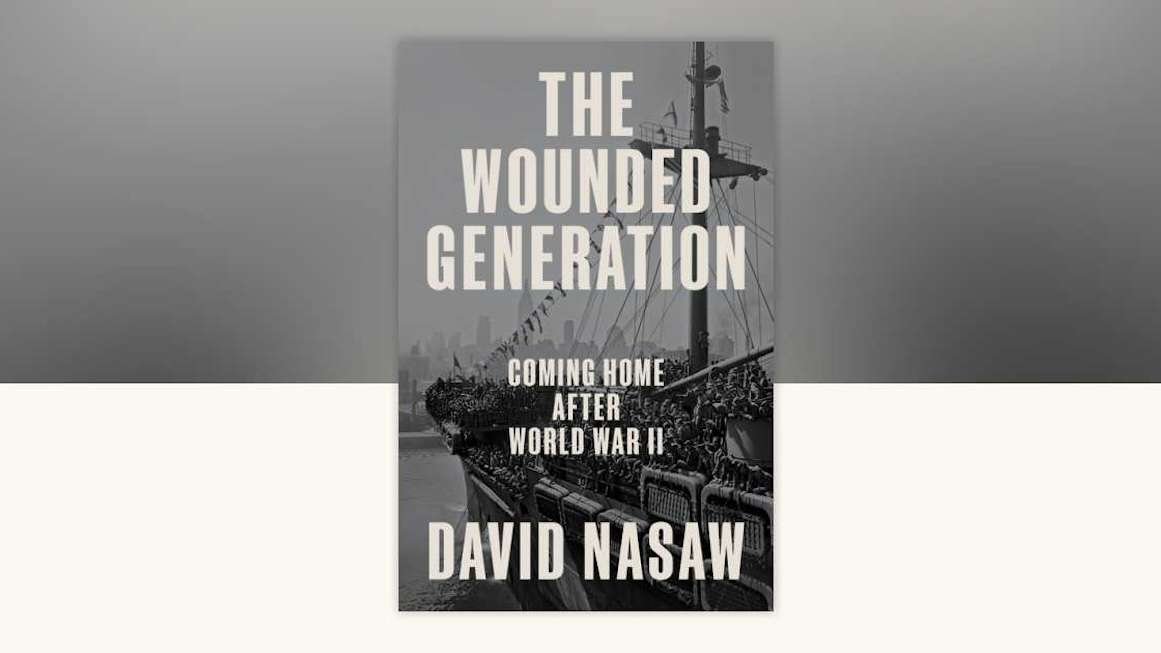
The Wounded Generation: Coming Home After World War II, by David Nasaw, Penguin Random House, 496 pages, $35
“There wasn’t any band there; there wasn’t anybody greeting me except the girl that I had [written] to while I was overseas. That was my homecoming.” That poignant moment recounted by World War II veteran Clinton Riddle is one of the many vignettes that populate David Nasaw’s new book, The Wounded Generation: Coming Home After World War II.
Nasaw, an emeritus professor of history at the City University of New York, marshals such experiences to argue that, beyond the ticker-tape parades, millions of men like Riddle filtered home to little fanfare. After returning to America, many struggled with alcohol addiction, marital problems, unemployment, crowded housing, and psychological issues that medical authorities didn’t fully understand. Nasaw’s book is a corrective to the simplistic narrative of stoicism, unity, and triumph that dominates conventional narratives of “the greatest generation.” It isn’t a work of revisionism so much as an act of recovery, one that elevates voices of pain and disquiet that were understood in the years after the war but faded from popular memory in the decades thereafter.
While the book bills itself as a history of veterans’ lives after the conflict, Nasaw adroitly begins his narrative in the thick of the fighting, tying the experiences of returning veterans to their experiences abroad. Beyond the scarring practice of combat, Nasaw illustrates a military culture awash in alcohol abuse and philandering, not to mention soldiers’ nagging concerns about spousal infidelity back home. He continues his narrative through the immediate postwar period, with two final chapters covering the individual and institutional legacies of the war.
Nasaw’s goal is to incorporate the toll on returning veterans and those who they left behind into our understanding today of the Second World War. His book joins a body of work on war and memory that corrects the one-dimensional narrative of the “good war” and restores the complexity and humanity of the Americans who fought it. As he skillfully shows, victory came at a steep cost for those who managed to survive the fighting. The romantic image of the war was largely a post hoc construction, championed not by those who did the fighting but by later generations well-removed from the burdens of the conflict.
* * *
Nasaw challenges some romantic images of postwar policy too, though not from a particularly libertarian direction. He is critical, for example, of the G.I. Bill, the federal entitlement program that afforded tuition and other forms of financial support to send returning veterans to school. Its “democratization of higher education,” he argues, was “revolutionary in establishing a new social welfare state for veterans”—but also “conservative in protecting class, gender, and racial status quos.” As a concession to Southern Democrats, the system was implemented by state and local authorities; as a result, he argues, it left female, gay, and black vets behind.
The broader suite of veterans’ readjustment programs—not just the G.I. Bill but home buying assistance and other efforts—were, the author argues, a missed opportunity for more comprehensive social welfare. Nasaw notes that during the late stages of the war, President Franklin Delano Roosevelt proposed a “second Bill of Rights” that would have extended government assistance to the full progressive shopping list of employment, housing, food, medical care, old age pensions, and so on. Social programs for veterans, he suggests, became a proxy fight over the New Deal, with a conservative coalition of Midwestern Republicans and Southern Democrats who wanted to put FDR’s domestic agenda on ice.
In Nasaw’s retelling, that coalition served as an effective roadblock, thereby undermining Roosevelt’s “aspirational” and “transformative” vision that “would have leveled the playing fields providing rich and poor, Black and White, veteran and citizen with new economic rights.” Libertarian-minded readers will shake their heads in disagreement at the idea that what the country needed was more government redistribution. But you’ll note that even here, Nasaw is challenging the liberal narrative in which the war was an unalloyed progressive force for American society.
* * *
The book shines brightest in its handling of the individual burdens shouldered by veterans and their families: heavy smoking, heavy drinking, infidelity, and, of course, the experience of combat. Behind the images of relief and the euphoria of victory, individual vets struggled to readjust, to find housing, and to reconnect with their loved ones, helping fuel a postwar divorce boom. Nasaw argues that vices and the social dynamics around them—compounded by psychological maladies, which we would now call PTSD—haunted and hamstrung veterans returning to civilian life.
On the specific matter of post-traumatic stress disorder, Nasaw offers many gripping accounts of individuals who struggled to leave the war behind them. Beyond those anecdotes, he illustrates the evolving medical comprehension of the phenomenon previously known as “battle fatigue” or “shell shock.” Psychiatrists, informed by the Freudian thinking of the day, diagnosed lingering war trauma as stemming from internal unresolved childhood suffering and not the obvious external experience of grisly combat.
Relatedly, military and veterans’ affairs doctors misunderstood and therefore misdiagnosed combat ailments now known as “traumatic brain injury.” Soldiers who endured concussive blasts from friendly and enemy fire, and who complained for years of related conditions, were diagnosed with “emotional unrest” that would resolve with the passage of time. Finding little official support, veterans often turned inward and self-medicated with alcohol and overwork.
It is in this area where Nasaw makes his most significant scholarly contributions—and offers his most gripping material on veterans’ personal struggles. His final chapter, “Aftermaths,” argues that the passage of time did not necessarily improve veterans’ mental health but often in fact made it worse. Major, jarring life events, such as retirement or the death of a spouse, could cause lingering traumas to return. Studies from the late 1970s and early ’80s found that alcoholism remained a consistent problem for WWII veterans, leading to a “mortality [that] was significantly higher.”
When greater medical recognition of veterans’ issues came along, it arrived, ironically, at the same time as a widespread desire to sweep them under the rug. Drawing on the earlier work of writers such as Studs Terkel and John Bodnar, Nasaw argues that the romanticized narrative of the “good war” fought by the “greatest generation” demanded that said generation’s lingering traumas be “disremembered.” That “good war” narrative, he shows, gained traction as the nation was “hungry for heroes after the Vietnam debacle and primed to celebrate victory after the fall of the Soviet Union.”
Modern demands for an uplifting World War II narrative mean the real, painful experiences of its veterans are often overlooked. Nasaw cites Marine veteran Eugene Sledge: “Over fifty years later, I look back on the war as though it were some giant killing machine into which we were thrown to endure fear to the brink of insanity.” By restoring these stories to the center, Nasaw shows that veterans were far more than “stick-figure avatars of progress” and that their wartime service was not merely a “character-building, maturing experience.”
According to the Department of Veterans Affairs, approximately 45,000 of the original 16 million World War II veterans are still with us today. As the last of those survivors fade away, The Wounded Generation reminds us that the horrors of war linger long after the shooting stops—it loiters in the minds, marriages, and memories of those who fought them. If even the “greatest generation” struggled after the guns fell silent, their long road home ought to give us pause before we send future generations abroad to fight wars, “good” or not.
Read the full article here
Fact Checker
Verify the accuracy of this article using AI-powered analysis and real-time sources.