In brief
- Bitchat ranked first in Jamaica’s App Store social networking category during the storm.
- The app includes a feature that lets users pin messages to specific areas, such as shelters or danger zones.
- Developer Calle told Decrypt the increase shows how the app is meant to keep people connected when infrastructure breaks down.
Downloads of Bitchat, a peer-to-peer messaging app that can operate without internet connectivity, rose in Jamaica this week as Hurricane Melissa disrupted power and telecommunications across the island.
The impact of Hurricane Melissa, described as the strongest cyclone to hit Jamaica in decades, has severely disrupted communications across the island. National connectivity has fallen to roughly 30% of normal levels, according to network data tracked by NetBlocks, with widespread outages caused by heavy winds and downed power and telecom lines.
At the time of writing, Bitchat ranked first in Jamaica’s social networking category for Apple users and second overall for free apps across both Apple and Android platforms, according to data from AppFigures.
Bitchat developer Calle wrote on X that this was the first spike “in response to a natural disaster.”
Calle, who co-developed and maintains the app with Jack Dorsey, told Decrypt the spike reflects how Bitchat was designed to function when infrastructure breaks down.
“During natural disasters like the recent hurricane in Jamaica, reliable communication becomes critical. Bitchat was created to help people stay connected even when traditional networks fail,” Calle said.
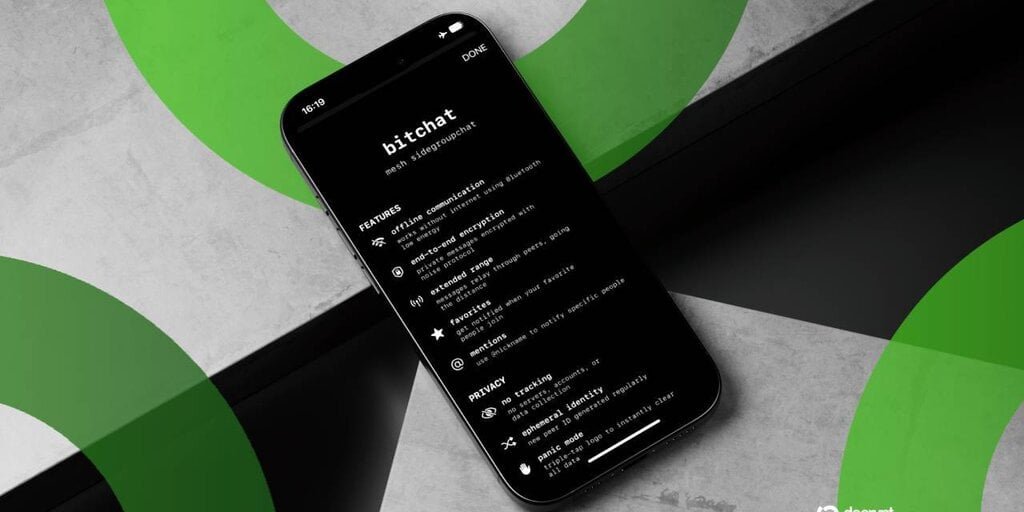
The app uses Bluetooth mesh networking “to enable hyperlocal, offline communication,” Calle explained. Every phone running Bitchat “becomes a node that can relay messages to nearby devices,” they added. This works by making messages “automatically ‘hop’ from one phone to another, extending beyond the range of any single device.”
That design “makes it possible for communities to share essential information, whether it’s warnings, safe zones, places offering help, or simply neighbors checking in on each other,” Calle said.
Bitchat also has a feature called location notes, in which messages are “pinned to specific geographic points,” Calle added. These notes, Calle explained, can “mark danger zones (‘avoid this area’), safe havens (‘shelter available here’), or even community notes (‘free water here’). Anyone nearby can see them instantly.”
Last month, Bitchat saw a similar surge in downloads across Nepal and Indonesia during periods of restricted internet access and protest-related shutdowns.
Calle noted that in late September, similar spikes in Bitchat downloads were observed in Madagascar as reports of protests after chronic blackouts and water cuts ensued. Earlier this month, Bitchat downloads similarly spiked as civil unrest in Côte d’Ivoire unfolded.
“Bitchat was designed to restore one of the most essential human freedoms: the ability to communicate without permission, infrastructure, or surveillance. Even when everything else goes offline,” Calle said.
Generally Intelligent Newsletter
A weekly AI journey narrated by Gen, a generative AI model.


 Freedom Index