

 Freedom Index
Listen to the article
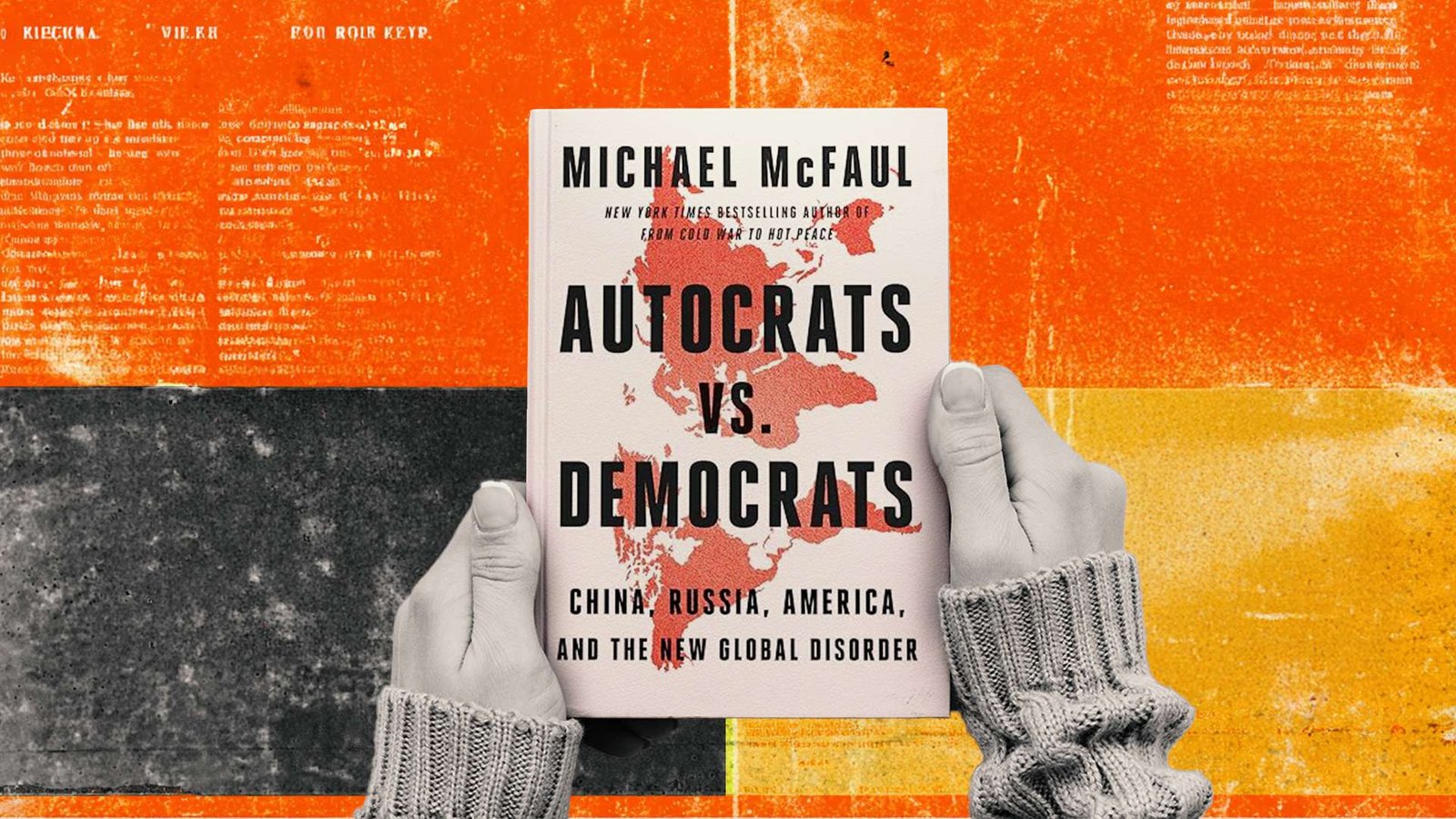
Autocrats vs. Democrats: China, Russia, America, and the New Global Disorder, by Michael McFaul, Mariner Books, 544 pages, $35
If you were looking for a human avatar of America’s unipolar moment, you couldn’t do better than Michael McFaul. Picture a youthful, energetic McFaul with a newly minted Ph.D. bounding into the suddenly post-Soviet space of the early 1990s, full of bright ideas about democracy and faith in the end of history. As McFaul himself puts it, 1991 “was a glorious moment to be a democratic, liberal, capitalist, multilateralist, and American….I was treated like a rockstar.”
History, however, was undeterred. From his perch in the Democratic Party’s foreign policy elite, McFaul had a front-row seat for the twists and turns of U.S. foreign policy. As an adviser on national security to President Barack Obama and later as Obama’s ambassador to Russia, he watched the U.S.-Russia relationship worsen; he negotiated Russia’s fateful abstention from the United Nations Security Council vote authorizing NATO intervention in Libya. He became an informal advisor to Hillary Clinton’s presidential campaign and then a commentator for MSNBC, where he drew connections between resisting President Donald Trump at home and promoting democracy overseas.
McFaul’s new book, Autocrats vs. Democrats, highlights the brighter moments of that arc while eliding or dismissing its darker ones. He sings the praises of America’s response to the Russian seizure of Crimea and of Obama’s attempts to engage overseas democracy movements, but he glosses over the excesses of the unipolar moment. He offers only a few paragraphs on Iraq (while reminding readers that he was not an Iraq war booster). On NATO expansion and its role in today’s European tensions, his book is entirely silent.
The book’s central, perhaps defining, theme is an unshakeable faith in the righteousness of post-Cold War liberal foreign policy, coupled with an unwillingness to explore the unintended consequences that emerged along the way. McFaul deplores the American public’s falling support for liberal international order—or rising “isolationism,” as he sees it—but without dwelling overmuch on why American attitudes shifted so dramatically. Nor does he question whether some of these liberal crusades contributed to the very nationalism and illiberalism that now haunt politics throughout the Western world.
In that respect, this book feels very much as though it were written in 2015, not 2025.
McFaul has a message to impart. Across 400 pages of often repetitive prose, he paints a picture of an emerging battle between democracies and autocracies (especially Russia and China) fighting “for the soul of mankind.” The book proceeds in three parts: a brief history of U.S. relations with Russia and China, a lengthy comparison of today’s global power balance, and a set of policy prescriptions meant to bring the lessons of the Cold War to bear in this conflict.
It is that last section that differentiates this from McFaul’s prior book (From Cold War to Hot Peace), which mostly relates his own experiences working in Russia policy. Autocrats vs. Democrats focuses on America’s failure to build liberal democracy in Russia and China since 1991, arguing that this failure has created a world full of dangers that can be overcome only through a reversion to Cold War strength and certainty.
Our core interests, McFaul argues, are: “(1) to protect American territory, (2) to deter attacks on our allies globally, (3) to stop Russian annexation and conquest in Europe, (4) to prevent war with the [People’s Republic of China] over Taiwan, and (5) to preserve freedom of navigation in the South China Sea.” We must do all that while avoiding overreach, he says, and while “maintaining the best military in the world.”
His policy prescriptions strongly echo the Biden administration’s approach: sustained American exceptionalism (including a unified elite that accepts that the U.S. must “lead the free world”), substantial investments in military capabilities, stronger alliances with other democracies, more forward-deployed U.S. troops overseas, and new international institutions. Some of the latter would transplant existing European institutions to Asia (i.e., the Organization for Security and Co-operation in Asia). Others would replicate existing institutions—on economics, artificial intelligence, or countering misinformation—but would be restricted to democracies only.
If you think this sweeping vision seems like a heavy lift even for the United States, you’re right. Indeed, one wonders how new democracy-centric institutions might view the United States itself. As McFaul himself writes, “Today, in contrast to the Cold War, America’s greatest threats come not from Russia or China, but within.” Trump, he argues, has “weakened or destroyed almost all” of America’s Cold War-era assets.
It is in many ways lucky for McFaul that Trump exists to serve as his foil: He blames the president for everything from democratic dysfunction to isolationism, nationalism, and protectionism. In McFaul’s Manichean account, the story of the post-Cold War period was one in which good people tried to make a better world, only to be thwarted by bad guys, who must now be contained until another opportunity to democratize them arises. There are bad guys at home too: democratic setbacks created by those who want America to be divided.
Reality is rarely this simple. Without the invasion of Iraq, would Americans be so skeptical about the use of U.S. military force overseas? Without the invasion of Libya, would Europe’s far-right nationalist parties have been able to leverage dissatisfaction with refugees and immigration to steer closer to power? Without America’s democracy promotion efforts in the post-Soviet space and the backlash they created in Moscow, would there be a war in Ukraine today?
And on the domestic front: Is lumping together Trump and those who voted for him with overseas autocrats really the best way to rebuild confidence in our democratic system? If leaders like Trump are going to arise within our political system, is it a good idea for us to vest them with the increasingly intense executive powers that McFaul’s strategy requires? Without the global war on terror, after all, Immigration and Customs Enforcement would not have the same capabilities to terrorize.
Autocrats vs. Democrats is ultimately a nostalgic read whose comforting narrative allows foreign policy elites to escape any complicity in the problems that we now face. That narrative should be hauntingly familiar to anyone who has watched liberal-leaning cable news in the last few years.
For critical readers, however, the book is likely only to prompt deeper introspection about America’s role in the world—and about whether today’s foreign policy elites can be trusted to set the right course.
Read the full article here
Fact Checker
Verify the accuracy of this article using AI-powered analysis and real-time sources.