

 Freedom Index
Listen to the article
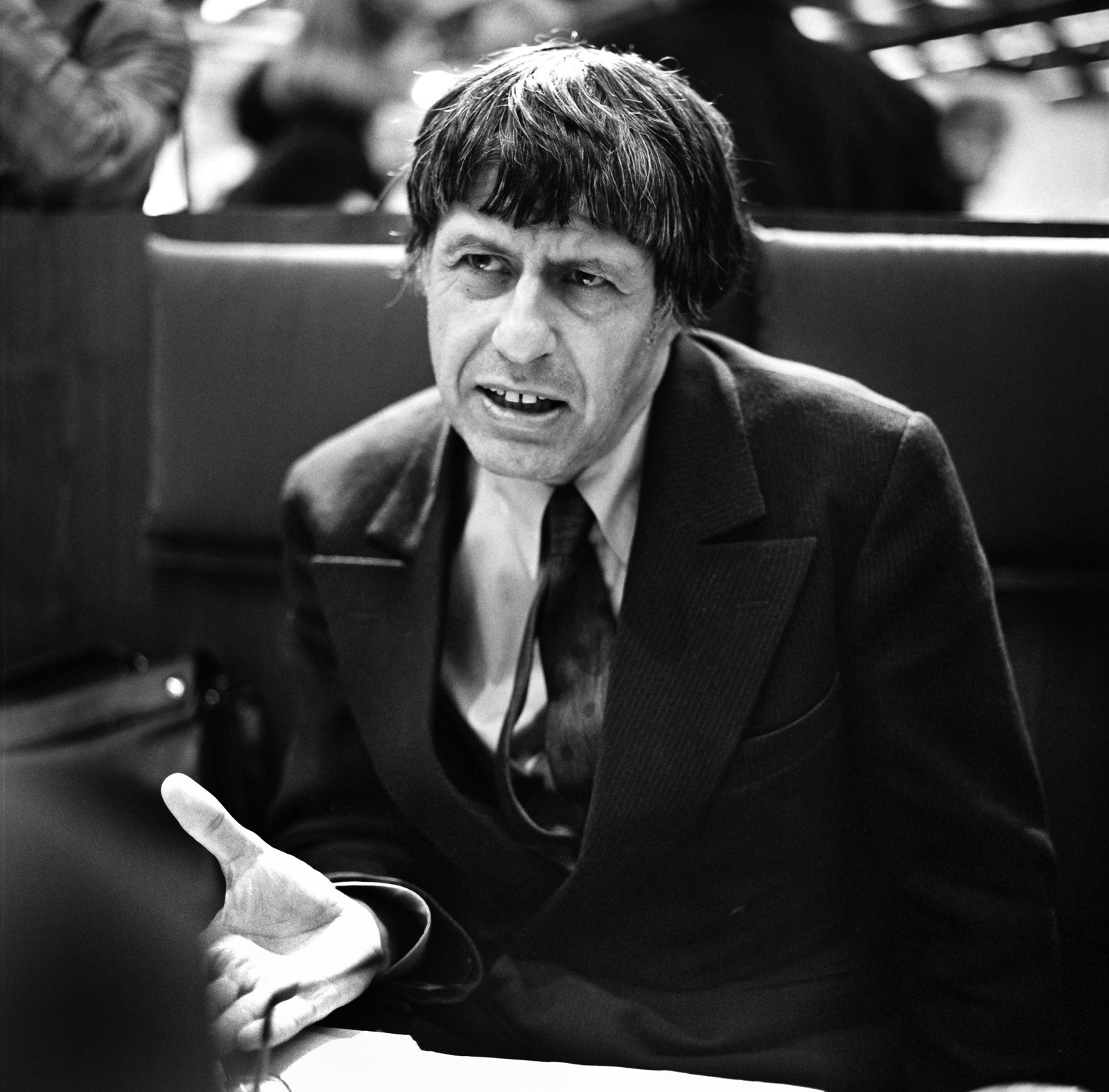
One of the great Czech writers of the 20th century, Ivan Klíma died earlier this month at the age of 94. A survivor of Nazi concentration camps, Klíma went onto stand up to communist oppression through his work. In his memory, Index revisits his short story The Girl Athlete (‘Koulařka’in Czech original) first published in the second issue of Spektrum, an unofficial Czech magazine, published in Czech in London by Index on Censorship. This story was translated by George Theiner, former editor of Index on Censorship, and published in our magazine in 1981.
The girl athlete
Vicky owed her successful career chiefly to Olda Rudinger, the well-known world recordholder in the discus (83.20m Dublin 1988). He had played his part, first and foremost, by making his good, quiet wife Mary pregnant, and then of course also by insisting that she take the recently discovered (and soon to be prohibited though still surreptitiously used) Anabol praenat. At the time dosage had not been properly tested and poor Mary had either been exceptionally susceptible to the drug, or she had simply taken excessive doses. Before she had even reached the sixth month of her pregnancy, her doctor anticipated that the foetus would be far larger than normal, and he lost no time in sending Mary to hospital.
The child, a female, was born two months premature. It weighed a full thirteen and a quarter kilograms and measured 72 centimetres. It came into the world with the aid of a Caesarian operation. Its muscles (and in particular the biceps) were so astonishingly well developed as to be monstrous; its head, on the other hand, was tiny by comparison. Indeed, its skull may even have suffered some slight deformation during the difficult birth,
but this did not impair the child’s basic physiological functions, nor its movements. The mother, however, failed to come out of the anaesthetic and died three days later. The cause of death was given as 688 (‘ Other, nonspecific, post-natal complications *), which was not exactly accurate in view of the above data.
The father decided to christen his daughter Victoria, no doubt having her future career in mind when he picked the name.
Until she was six, little Vicky was looked after by Olda’s mother, the old Mrs Rudinger. Her health and nutrition were from the beginning under the supervision of an elderly doctor from the Central Sports Institute (CSI). The child developed much as expected. At four years of age it started to jabber, at five it stopped wetting itself, at six attained a weight of a hundred kilograms, and at seven managed, for the first time, to reach 20 metres
in the shot put with a six-kilogram ball. It was then that her father decided that Vicky, who had hitherto only trained sporadically, must be removed from the none-too-suitable environment of his mother’s home and placed in the year-round care of the CSI boarding school. He himself became her coach.
Vicky accepted this change in her circumstances without demur. She was of a somewhat phlegmatic disposition, showing little interest in such matters. Even though she was now quite capable of forming short, simple sentences or shouting, in unison with the other pupils, such exhortations as ‘ Come on! Faster! Hip, hip, hurrah! Give ’em hell! ‘, she spent most of her time in complete silence, sucking the thumb of her right hand, and speaking of her own volition only at meal times whenever she wanted a second helping. On such occasions it was even possible to detect traces of emotion in her demeanour. ‘ Please, dear cook, may I have fifteen more dumplings? ‘ Once, having added a particularly large piece of meat to the girl’s plate, the elderly cook noticed that there were tears in Vicky’s eyes.’ What’s the matter, child? * she enquired.’ I love you! ‘ whispered Vicky using the phrase for the first and only time in her life.
When she was nine she consumed two kilograms of meat a day, plus the same quantity of bread and fruit, fifteen eggs, three one-litre bowls of boiled rice or potatoes, and 38 assorted pills; she drank five litres of milk and only slightly less fruit juice. She weighed 185 kilos and, with her six-kilo ball, threw 28 metres every time. She ran 30 kilometres a day, did four hundred bends and six hundred push-ups, while lifting a 50-kilo dumb-bell a
hundred times was mere child’s play to her. She could also handle some less difficult mathematical exercises (such as three plus two or four minus one), on occasion showing herself capable of more complicated sums (two times two or even four times three). As, however, any abstract mental effort tended to exhaust her, the doctor recommended that in future she be given a restricted curriculum, and so her knowledge of mathematics progressed no further. In her spare time she liked to turn the pages of picture books, and where the illustrations were accompanied by brief captions of no more than one sentence she managed to read them, when not too tired.
A simple operation, carried out shortly after her eleventh birthday, ensured that she would not, every month, have her fitness undesirably impaired. And three months later she made her international debut. Her splendid throw of 29.60m gave her second place behind the phenomenal Kulagina (30.15m), making her one of the great hopes of our athletics.
Kulagina, together with the slightly younger Hammerschlag, were her only serious rivals. She never did manage to beat Kulagina, despite the intensified training schedule which helped her overcome the 30m barrier by the time she was thirteen.
Fate was kind to her, however, for Kulagina was to collapse and die in training shortly after setting an astonishing new world record of 33.89m (sudden arrest of heart function), while Hammerschlag, having for some time suffered from cartilage trouble in her right elbow, gave up the shot put and continued her sporting career as a long-distance runner.
Thereafter, Vicky had no rivals to touch her. At fifteen she mounted the Olympic rostrum to take her first gold medal, and a year later bettered the world record of the deceased champion. From then on she could only improve on her own records, throwing an unbelievable 40m within four years of her Olympic triumph.
By this time she had, of course, grown to womanhood. She stood 207 centimetres tall and weighed 302 kilograms. When she strode towards the shot put circle, her gait measured and seemingly lumbering, the spectators usually fell silent as if in amazement, even awe, and at such times her footfalls appeared to be causing the earth to thunder. The petrified hush lasted while her gigantic body, with its comic, as if superfluous, tiny head, froze in complete concentration, while it made its heavy-footed half-turn before finally unleashing the terrible lever with the miniscule fingers at its end. And the hush continued as the heavy iron sphere sailed through the air as though it were a ping-pong ball; suddenly it gave way to a loud, mostly unarticulated roar, which grew mightier and mightier, before turning into a triumphant chant. Now she could, from time to time, make out the
constantly repeated two syllables: Vi-cky, Vi-cky! Above the heads of the crowd there rose a forest of arms, of clenched fists, raised in homage to her. At moments such as these she became aware of a feeling of intense pleasure deep down in her bowels; spasms in her vagina gave her a sensation of bliss, soft groans issued from her lips, and her own arms flew up in the air. It looked like a gesture denoting joy, or perhaps a greeting for the assembled fans, but in fact it was completely involuntary, a movement not governed by her will. The sensation of utter bliss exhilarated and exhausted her at one and the same time. She was able to bear it once more when she took her second throw, sometimes even the third, but after that all strength seemed to be drained from her body. That was why, as everyone knew, she excelled in the first three throws and never improved on the results achieved in them. As often as not, certain of her victory, she would give up after the third, provided of course her coach and father permitted her to do so.
It happened on occasion that she did not throw as well as she wished or as the crowd expected. Then, the silence would continue, interrupted only now and again by an isolated cry of dismay.
When this happened, she felt something that could be likened to the sorrow of a jilted lover. Slowly she would put on her gigantic track suit, make her way to the dressing-room and weep. She sobbed when her coach and father came in, when the reporters crowded round, she just went on crying as if she would never stop, and no one could get a word out of her.
When, however, the competition went well, she would lavish sentences, even whole clauses, on everyone within range, having laboriously been taught them beforehand by her father and coach or by the secretary for moral welfare; and once she had uttered them, they became the property of the nation, being heard on radio and TV more frequently than the words of the most prominent poets, not to mention philosophers. (‘ If it weren’t for all these marvellous people backing me, I’d never have achieved my record! ‘ ‘ You know, I really thought I wouldn’t make it, but then I said to myself I had to, the people expected it of me.” Sport is, first of all, a hard slog, and that’s why I respect everyone who puts in a good day’s work.’)
She now had a fairly good comprehension of the world in which she competed. She knew that one had to stretch to the limit in order to come first. But, of course, not everybody could get to the top, only the best made it. Those who won the most often were the very best – they were successful – and deserved the highest acclaim. She also knew that there were people who never came first, and others who didn’t even try. Even such individuals, no matter how useless their existence might seem to her, had to be treated politely.
She was given only very occasional glimpses of the non-athletic world, spending all her time between the sports field, her bedroom, and the institute canteen. When she did chance to stray beyond the bounds of the sports centre and found herself in streets full of strangely dressed people wearing all kinds of clothes unsuited to any event, where some nonsensically wasted their time queueing for potatoes, meat or cauliflower while others crammed into overcrowded trams, people would turn their heads to look at her and not infrequently called out to her. This worried her so much that she was afraid it might adversely affect her form, and she hurried back to the institute. She could not wait to get back in her track suit and jersey and make up for lost time.
She travelled a great deal and thus saw many different stadiums and, out of the windows of coaches and cars, many foreign streets, inscriptions in incomprehensible languages, and foreign crowds. All this she barely took in, dozing or eating on the coach so that, as soon as they arrived, she could be able to jump out and resume her training.
When she was twenty (she now weighed 316 kilos, the biceps of her right arm measured 97 centimetres, her chest 273 centimetres, and her world record stood at 40.60 metres) she suffered a severe blow. Crossing the athletic field, Olda Rudinger was struck by a flying hammer, which fractured his skull, and he died on the way to hospital. His daughter and protégé inherited a large collection of medals, discuses, cups, plaques, the training schedule for the following quarter, a batch of jerseys which had belonged to the greatest discus throwers, a collection of track shoes once owned by the greatest triple jumpers, the manuscript of his unfinished book, My Life with the Discus, and a three-room flat in a high-rise building in the centre of the sports complex.
She went to his funeral and wept as she was used to weeping in the corner of the dressing room when things went wrong. She was sorry she would never again hear her coach and father encouraging her, egging her on: Go to it, Vicky! You can do it! Vicky, you must! It’s now or never, Vicky! She wasn’t at all sure whether she would still be able to go to it, to do it, without that encouraging voice of her coach and father to spur her on.
The funeral took longer than expected and Vicky was two hours late for lunch. She ate thirty-seven rissoles (seven more than usual, and she wasn’t sure whether this was out of sorrow or just that she was so famished), put on her jersey and track suit and went off to train.
On her twenty-seventh lap she realised that something was missing. No one was waiting for her with a towel and a jug of lukewarm fruit juice, no one called out: ‘ Stick it out, Vicky 1 ‘ She felt a chill run down her spine and tears started to her eyes. Vicky Rudinger loped off the track and like a runaway racehorse ran across the grass until her huge foot plunged into some cavity and was trapped in it while the rest of her body, propelled by its massive momentum, continued on its course.
A bone could be heard cracking and Vicky’s bulk crashed to the ground.
They took her to hospital with a fractured femur, laid her in a specially reinforced bed, put her leg in plaster and raised it in a sling, telling her she had to remain absolutely still. That same afternoon her fellow athletes came to visit her and wish her a speedy recovery. When they left she lay there waiting for yet another visitor. And it was not till the evening that she realised she was waiting in vain, that her coach and father would never come again, and she wept once more. For supper she could only manage eight schnitzels (they had, of course, taken her to the special CST hospital) and wondered whom they would appoint as her new coach and whether she would not get out of condition after this enforced break in training.
They released her two months later. Her new coach was waiting at the hospital entrance with her training schedule. And she again ran, did callisthenics and push-ups, lifted dumbbells and put the shot as she had done before, but when, after half a year’s arduous training she only once succeeded in exceeding thirtyfive metres (the 15-year-old Kotovova had by this time brought off several forty-metre throws), it was clear to everyone that Vicky Rudinger was in all probability finished as a top athlete.
They tried sending her to several less important meetings where she finished second or even third, but when after the contest she sat weeping in the dressing-room no one came to ask how come she had not done better. They now knew she would never do better. She had several visits in her new apartment (she had left everything just as it was while her coach and father was still alive, only putting her own cups, diplomas and medals in one of the glass cases) from officials of the Athletics Association, who did their best to find out whether there were any complications in her life. She certainly did not know of any. Then they suggested that she might like to take on some coaching work. At first she declined, but after several months of inactivity she was ready to agree. They invited her to take part in a seminar, at which she was to comment on methods of training. She did not comment, and they realised that this was beyond her. After that she received no more invitations, nor did they send her to the next training camp. She still kept making her appearance at the stadium, accompanied by her coach, who gave her unnecessary advice and tried in vain to step up her training schedule; she was still given her special rations in the canteen, enough to feed ten hungry navvies; and she went on living in the sports centre where no one turned to stare after her and no one shouted at her that she was too big and too strong. Yet she felt that something was not right, that she was beginning to be different from the others – she was not performing and thus was no longer useful.
Before going to bed, having finished her last evening stint of bends and push-ups and taken her last refreshment of the day (fifteen eggs and half a loaf of bread) she sat in the armchair she had inherited from her coach and father (it had a lever on either side which could be used to press down strong steel springs in order to build muscles) and, her eyes shut, dreamt of the time when she would at last find her form, return to the shot put circle, make her throw, and the crowd would emit its triumphant roar which would fill her with bliss. When she was tested for the next competition she threw a mere thirty-one metres, and that was definitely the end. They said they could no longer afford to feed her for nothing. They rambled on about starving mankind (as if it was her fault) and that the people would not forgive them such wanton waste. They offered her several civilian jobs, all of which she turned down for she was not used to work, nor did she have time for it. She had to carry on training hard if she wished to regain her form.
Then they took away her coach and told her she had to move out of the sports centre, forbidding her entry to the CSI canteen. But since she was, after all, a former world record-holder (the 16-year-old Kotovova, that new 360-kilo superstar of world athletics, had just thrown 43.20 metres), they let her have a nice two-room attic flat on a housing estate and gave instructions that she be elected chairwoman of the local branch of the Union of Women Fighters for Lasting Peace. This post brought with it a special food ration for heavy manual workers.
And so, at twenty years of age, Vicky for the first time entered a world in which no one competed on track and field, in which instead of putting on jersey and track suit in the morning and going out on to the track, people hurried to board overcrowded buses which took them to their places of work; a world in which instead of fifteen eggs you had two slices of toast with jam (or often without) for breakfast. She gazed numbly at the queue
outside the food store, and when they put four rolls, a quarter of a loaf of bread, a quarter of salami, a jar of jam and a tin of liver paste in her basket, saying that this was her ration for the day (true, she was also entitled to sugar, rice, and flour or potatoes, but none of these was in stock today), she went red and tears came to her eyes.’ But what shall I eat? ‘ she asked the shop assistant. ‘ The same as you did before,’ replied the girl, giving her a dirty look.’ You couldn’t get as fat as this on normal rations.’
She wanted to tell them all she was Vicky Rudinger, the same Vicky they used to cheer and applaud, but she could not speak. Her massive triple chin trembled and she picked up her feather-light shopping basket and left the shop.
That afternoon, attending her first meeting of the Union of Women Fighters for Lasting Peace, she was incapable of bringing her mind to bear on anything but the terrible realisation that, having eaten the four rolls, quarter loaf of bread, quarter of salami, liver paste and jam in the morning, she would now have to spend the rest of the day and the whole night suffering the pangs of an unendurable, gnawing hunger. Fortunately, the meeting was chaired by the Vice-chairwoman. She spoke about the continuing food crisis in a world now inhabited by eight thousand million people .. . Vicky could not imagine what a thousand million people was, and so she found herself unable to concentrate. How could she get back in condition when they let her starve like this? How could they do this to her, hadn’t she always trained conscientiously? Why had they lost confidence in her?
Returning home from the meeting she saw that right behind the high-rise block of flats there was a small wood with a nice expanse of grassland which she could use for training – if .. . She was shaking with hunger. Her teeth chattered uncontrollably. She went inside the wood and chewed some blades of grass and a piece of bark she peeled off an oak-tree. Running three laps round the wood, she returned home. There she sat in the armchair she had inherited from her coach and father and stared at the glass case full of cups and medals. Somewhere in the vicinity she could hear a TV going, someone was stomping about in the flat above. An iron ball lay in the middle of the display inside the glass case, the one she had used when she beat her own last world record. Summoning up all her strength, she picked the ball up and went out to train. Grasping the ball in her hand, Vicky made her half-turn and threw it in the direction of the wood. Then she measured the distance. Twenty-six, at most twenty-seven metres. She recovered the ball, returned home, put it back in its case, sat down and cried.
In the course of the next month she lost ninety-nine kilos in weight. Her legs shook so badly that she could hardly stagger to the shop to claim her meagre food allocation. Waiting in the potato queue she fell in a dead faint. They did not even call an ambulance, just poured some water over her, and there was hatred in their voices as they talked about ‘ people who stuff themselves with food’. Why couldn’t they understand that she was starving, starving to death?
Her journeys to meetings of the Union of Women Fighters for Lasting Peace became more and more exhausting, until in the end she was forced to suggest that they hold them in her apartment. No one raised any objections, some of the members were quite curious to find out what her flat was like. The Treasurer, a buxom, always-hungry pensioner who had been manageress of a meat shop and could not now, in retirement, get used to the frugal ration for non-workers even though her successor slipped her an extra piece of gristle every week, cherished a secret hope that Vicky would provide them with refreshments. (The cow had to be getting privileged treatment, how else would she have got so fat? Though the Treasurer had to admit that she did seem to be losing a little weight just lately.) They thus all met in Vicky’s flat on the housing estate and she offered them every available chair and stool in the place, seating herself on the bed. She did not chair the meetings, and today she was feeling particularly faint, having collected her week’s ration two days ago and eaten it all up at a sitting. She had never felt so hungry in her life, and her limbs were growing weaker by the hour. She gazed at these seven alien, useless women, who were discussing meetings, banners, petitions, famine in India, collections of waste material and other, as far as Vicky was concerned, quite incomprehensible topics. Every now and again she felt she was about to doze off, or was she going to faint? She realised that nothing that was being discussed in her presence affected her in the slightest. None of it would help her get back her fitness, recover her strength, none of it would save her from starving to death. Opening her eyes with an effort, she saw in front of her the quivering, fleshy nape of the Vice-chairwoman. An idea took shape in her always sluggish and now completely exhausted brain. She closed her eyes again, but the idea was still there, as if hovering in front of her, growing increasingly more tempting. Suddenly she became aware that she was swallowing saliva in what seemed to her a loud fashion, but fortunately no one else seemed to have noticed.
Of course, she thought, it can’t be the Vice chairwoman, that wouldn’t do because who could then chair the meetings? No, she needed the Vice-chairwoman. With an access of energy she looked round the room, scanning one of her guests after another. When the meeting was over she went up to the rotund Treasurer.’ Could you stay on for a while, comrade? There’s something I’d like to discuss with you.’
It was so easy. Her huge hands with their incongruously small fingers were still strong enough to cope with the bones. But the flesh was so tough that she had to use the meat grinder. She had been without proper food for so long now that she could only manage twenty rissoles. Then she went to bed. She could not remember when she had last fallen asleep with such a feeling of well-being. The future suddenly looked rosy again.
The following morning she ate twenty-five rissoles for breakfast and, for the first time in days, took the ball and her tape measure and went out to train. She threw twenty-one metres, and the next day improved on that by a full eighty centimetres, the day after that by another metre. She trained hard, running around the wood and, back in her apartment, doing callisthenics and lifting the dumb-bell. On the seventh day her throw measured
twenty-nine metres. At the next meeting of the Committee she made the Treasurer’s apologies and asked the Secretary if she would kindly stay behind when the others left. On the tenth day she again passed the thirty metre mark. ‘ Stick it out, Vicky! ‘ she whispered to herself. ‘ You can do it! You must! It’s now or never!’ Within a month the number of Committee members was down to three. Fortunately, there was a nasty flu epidemic raging just at that time, so that the good-natured Fighters for Lasting Peace did not become suspicious. The delicious smell of fried meat came incessantly from Vicky’s apartment.
Well, just look at that, her neighbours cursed under their breath, they’re again giving her special rations! But they had long ago learned not to protest against privileges accorded to others lest they lose what remained of their own, restricted rights.
Vicky now trained like one possessed, giving up all her time to the task. Six weeks after she had resumed her training routine she again threw forty metres. When she had measured the distance, delighted with what was at last an admirable achievement, she automatically raised her arms in the air and a hoarse cry of triumph came from her lips.
She picked up the ball and the tape-measure and hurried home, for in a few minutes there was to be a meeting of the Committee. She would have to move that they co-opt some new members.
To her astonishment, a crowd had gathered outside the entrance, that large, familiar crowd which stared at her with impassioned eyes, obviously restrained only by the efforts of the men in uniform. It did not occur to her to wonder why all these people had gathered there – they could only have come on her account. Now they must have recognised her, for the silence was shattered by a strange, unarticulated roar which grew louder as she approached. And then she saw the clenched fists raised in the air and waving.., The roar intensified, and Vicky was once more conscious of that old, almost-forgotten feeling of utter bliss. This pleasurable sensation caused her to shake all over, and her arms flew up in the air. She knew now that she was destined to return to the shot-put circle and to set a new record. At least forty-five metres. She could do it! Yes, she could do it!
Translated by George Theiner
Read the full article here
Fact Checker
Verify the accuracy of this article using AI-powered analysis and real-time sources.