

 Freedom Index

Listen to the article
Key takeaways:
-
Since 2024, spot ETF inflows and outflows have been the strongest driver of Bitcoin’s green and red days.
-
With exchange balances near multi-year lows, any sizable order travels farther through the book.
-
Large holders often split trades or use OTC desks, muting visible “wallet-moved” shocks.
-
Funding rates, open interest, the dollar and yields often shape the day’s direction more than any single wallet.
Everyone “knows” whales move Bitcoin (BTC), and they can still jolt prices.
Since spot exchange-traded funds (ETFs) arrived, Bitcoin’s direction often hinges on ETF inflows and outflows. It also depends on how much tradable supply actually sits on exchanges, not on any single wallet’s whim. BlackRock’s iShares Bitcoin Trust ETF (IBIT), for instance, now holds more than 800,000 BTC on behalf of thousands of investors. Flows through that pipe can rival any one holder.
Layer in derivatives positioning and the broader risk-on/risk-off mood, and you get the real picture.
This guide cuts through the whale lore, explains the market mechanics that actually matter and gives you a quick data checklist to read the tape without chasing every viral “whale just moved” alert.
What counts as a “whale?”
In crypto, a whale refers to an onchain entity holding at least 1,000 BTC. Many dashboards specifically track the 1,000 BTC-5,000 BTC range.
An entity is a cluster of addresses controlled by the same owner, not a single wallet. Analytics firms group addresses using heuristics such as co-spends and change detection to ensure one holder isn’t counted multiple times across separate deposits.
That distinction matters because raw “rich list” address counts can exaggerate concentration. Large services such as exchanges, ETF custodians and payment processors operate thousands of wallets, and labeled clusters help separate those from end investors. Both academic and industry research have long cautioned against drawing conclusions from address data alone.
Methodologies differ. Some whale metrics include service entities such as exchanges, ETF or custody pools and corporations. Others exclude known exchange and miner clusters to focus on true investor whales.
In this guide, we use an entity-based convention of ≥1,000 BTC and clearly note where service wallets are included or excluded so you know exactly what each metric represents.
Did you know? The number of entities holding at least 1,000 BTC recently topped 1,670, the highest level since early 2021.
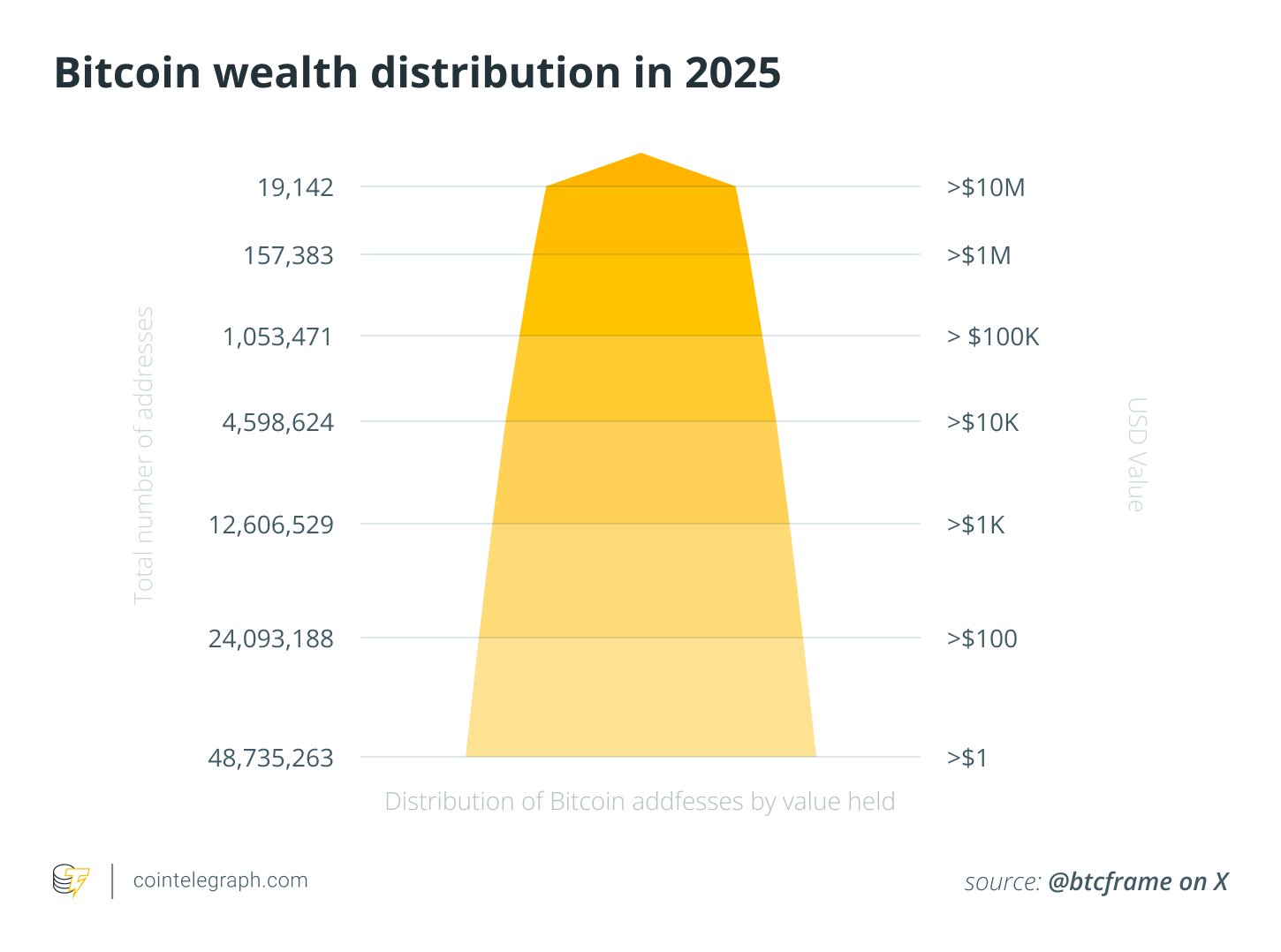
How concentrated is BTC today, and who holds it?
Since US spot ETFs launched, a large share of visible Bitcoin supply has shifted into custodial pools. BlackRock’s IBIT alone holds roughly 800,000 BTC, making it the largest known holder. However, it’s held in custody on behalf of many investors, not as a single balance.
Across issuers, US spot ETFs collectively hold about 1.66 million BTC, roughly 6.4% of the total 21 million supply. This centralizes execution even though underlying ownership remains widely distributed.
Corporations are another major group. MicroStrategy recently disclosed holdings of about 640,000 BTC. Miners, exchanges and unlabeled long-term holders make up the rest of the largest clusters.
Meanwhile, the tradable float on centralized exchanges continues to shrink. Glassnode’s tracked balances fell to a six-year low of about 2.83 million BTC in early October 2025. With fewer coins on exchanges, large orders tend to move prices more.
Bear in mind that “top address” rich lists often overstate concentration because major services operate thousands of wallets. Entity-level clustering and labeled wallets, such as those belonging to ETFs, exchanges and corporations, offer a clearer picture of who actually controls the coins.
Did you know? US spot ETFs now custody over 1.6 million BTC, representing just above 6% of the total supply held by institutions and funds.
Can whales flip the market intraday?
Big, aggressive orders can move prices sharply, especially when order-book depth thins out. During volatile periods, liquidity often disappears, and large sell blocks can punch through the book with outsized impact. That’s basic market microstructure.
Because of this, many large holders avoid “hitting the book.” They split their orders or use over-the-counter (OTC) desks to execute blocks quietly, reducing both their footprint and information leakage. In practice, a significant share of whale activity occurs off-exchange, which reduces the visible impact from any single wallet on public venues.
Across cycles, whales don’t always “pump.” Studies combining exchange and onchain data show that large holders often sell into strength, particularly when smaller traders are buying. Their flows can temper rallies rather than lead them.
A 2025 snapshot fits this pattern: As prices pushed above $120,000 alongside strong ETF inflows and broad accumulation, “mega-whales” took profits at the margin. Intraday direction often tracked ETF flows and available liquidity more than any one whale wallet.
Did you know? One well-known “OG” whale recently sold thousands of BTC to purchase nearly $4 billion in Ether (ETH).
What really turns markets green or red on most days?
Since January 2024, spot ETF flows have become one of Bitcoin’s most reliable daily signals. Strong weekly inflows have often coincided with pushes to new highs, while softer or negative prints tend to align with down days. Pair this with a live flow dashboard to track how US ETFs are leaning each session.
Liquidity on exchanges matters just as much. With balances on centralized exchanges down to about 2.83 million BTC, a six-year low, there’s now less readily tradable supply. Thinner liquidity means even routine buy or sell programs cut deeper into the order book, amplifying price swings across all participant types.
Positioning and leverage often drive intraday swings. When funding turns rich or deeply negative and open interest (OI) rebuilds after a wipeout, the path of least resistance can shift quickly.
Keep monitoring funding and OI to gauge crowding. Recently, with roughly 97% of supply in profit and a slight easing in long-term holder distribution, markets have become more sensitive to fresh flows and headlines.
Finally, macro still drives crypto beta. Dollar trends, US yields and broader risk appetite often move in step with Bitcoin’s daily direction. On quieter data days, ranges tend to compress; when macro heats up, crypto usually follows.
Quick checklist
-
ETF flows: Track yesterday’s net inflows/outflows and total turnover.
-
Liquidity: Watch exchange balance trends and order book depth across major venues.
-
Positioning: Review funding-rate heatmaps and OI rebuilds after liquidations.
-
Macro tape: Monitor the dollar index, 10-year yield and equity-market breadth.
Do whales still set Bitcoin’s tone for the day?
Whales can move prices, but they rarely decide how the day ends. When liquidity thins, a single large order can push a move further than usual. Most large holders now split trades into smaller clips or route them through OTC desks, softening the impact seen on public books.
Since 2024, spot ETF flows have been the main force behind daily direction, alongside the heavy trading volumes passing through those funds. Watching the previous day’s net flows and turnover gives a clearer sense of that bias.
With tradable supply on exchanges sitting near multi-year lows, even a marginal buyer or seller — whether a whale, market maker or retail wave — can move prices further than normal. Larger holders often sell into strength rather than “pump,” a pattern that tends to cap rallies instead of fueling them.
Macro factors still drive much of the action. Shifts in the dollar and US yields influence risk appetite, pulling Bitcoin in the same direction.
This article does not contain investment advice or recommendations. Every investment and trading move involves risk, and readers should conduct their own research when making a decision.
Read the full article here
Fact Checker
Verify the accuracy of this article using AI-powered analysis and real-time sources.