

 Freedom Index
Listen to the article
This article first appeared in Volume 54, Issue 3 of our print edition of Index on Censorship, titled Truth, trust and tricksters: Free expression in the age of AI, published on 30 September 2025. Read more about the issue here.
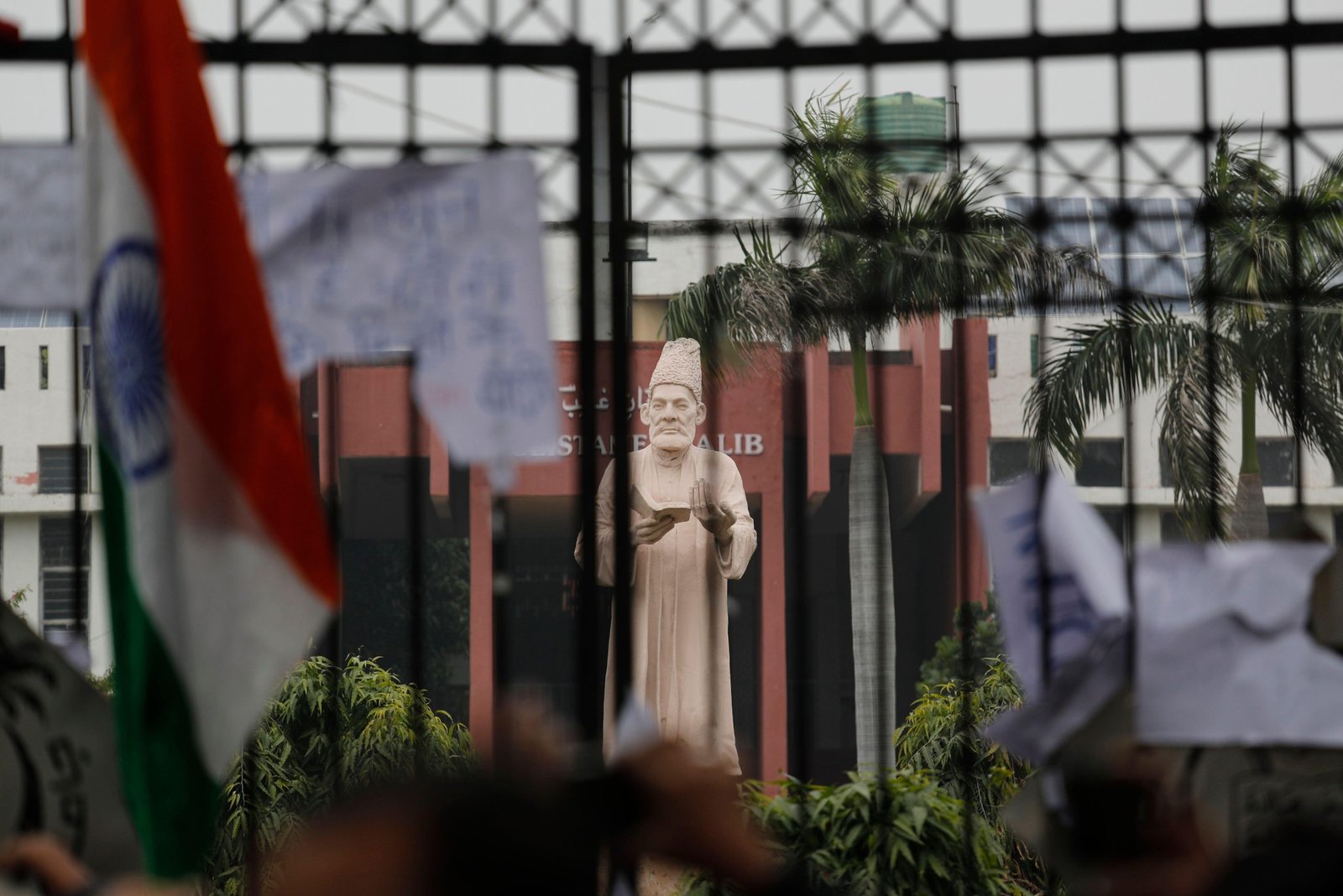
The rickshaw raced through the byways of old Delhi. My heart leaped with each serpentine turn, fearful of a crash in the cramped lanes. But I survived the kashmakash1, the rickshaw eventually depositing me at the endpoint of my pilgrimage: the erstwhile home of poet Mirza Ghalib, one of the greatest Urdu writers of the 19th century.
My ride, laced with a sense of impending doom, had uncanny parallels with the position of the Urdu language in India: dodging falls, scarred by detractors, warding off attempts to side-line it. Amidst the vast linguistic diversity of the subcontinent.
Urdu has survived each time, cared for not only by its native speakers, but also by a multitude who have embraced it as their own. It sometimes feels like there is someone, somewhere, watching Urdu and urging it to thrive. It could be the ghost of Ghalib, who wrote in a famous, self-referential poem:
huī muddat ki ‘ġhālib’ mar gayā par yaad aatā hai
vo har ik baat par kahnā ki yuuñ hotā to kyā hotā
(Though ages he’s been dead Ghalib is still thought of today. At every trice, to ask what would be, if it were this way.)
But let us set poetic musings aside for the moment, and redirect our attention towards a recent judgment by India’s supreme court, which stated: “Language is not religion. Language does not even represent religion. Language belongs to a community, to a region, to people; and not to a religion. Language is culture. Language is the yardstick to measure the civilisational march of a community and its people. So in the case of Urdu, which is the finest specimen of Ganga-Jamuni tahzib2, or the Hindustani tahzib, which is the composite cultural ethos of the plains of northern and central India.”
This judgement – in a case concerning Urdu-language usage on the signage of a new municipal building in Akola – advocated respect for the linguistic diversity of the country, and affirmed the Indian origins of the Urdu language.
Judgements in this vein are significant, aligning as they do with India’s constitutional ethos of pluralism. Even in India’s present socio-political climate where democratic values are receding and communal polarisation is commonplace, Urdu is gaining popularity. The 100-rupee note bears the legend “One Hundred Rupees” – in English, Urdu and fifteen other vernacular languages. The irony is that the Hindi and Urdu both read the same: ek saou rupaya.
The same but different
Post-partition, the newly formed nations of India and Pakistan chose Hindi and Urdu respectively as their official languages. While the lingua franca in the two countries has been promoted carefully, the authorities have consistently reminded the polity that Hindi and Urdu are distinctly different from each other, and thus incomprehensible to the non-native speaker. But Urdu speakers in Pakistan watch Hindi movies, and Hindi speakers in India savour ghazals3 often written in Urdu. The supposed incomprehensibility does not pose a challenge, it seems. With this clear evidence of mutual intelligibility, might one suppose that Hindi and Urdu are “sisters”? Given the linguistic and literary history of both, such claims seem reasonable.
Azra Naqvi, the well-known Urdu poet and translator told Index: “No language is created in a single moment or at a specific place. It evolves gradually, shaped by history, culture, and human interaction, thus the evolution of the Urdu language has been a fascinating process, with both the Deccan [the plain in the south of India] and north India playing important roles.” Naqvi continued: “Urdu is a shining example of India’s Ganga-Jamuni culture [i.e., relating to the names of the River Ganga and Yamuna], the syncretic tradition that emerged from centuries of cultural exchange between Hindus and Muslims.”
A similar point was made by Professor Mehr Afsan Farooqi, who teaches Urdu and South Asian Literature at the University of Virginia. She told Index: “The Urdu language was born in India. It is an Indian language, known as Hindi until the time the language was split in the name of script in the early 20th century. Urdu-Hindi have their base in khari boli, the dialect spoken in the area around Delhi in the western part of Uttar Pradesh. This dialect’s grammar is the same, the vocabulary is mutually intelligible in the common register or bolchal4, as we say. The high register of Urdu-Hindi was used for poetry mostly of the ghazal. On the other hand, braj bhasha5 was the language of poetry for the so-called Hindi register. The literary history of Urdu-Hindi is intertwined and can only be separated artificially.”
It is hardly a surprise that detractors of Urdu in the past – read, amongst others, the British colonisers – tried to corner Urdu by adding notions of religiosity to the language.
“We fought our freedom movement in Urdu, how can it be forgotten?” said the historian Rana Safvi. “It is after 1857 [that] the language was addressed as ‘Urdu’. However it can be traced way back to the 13th century to the times of Amir Khusraw, the legendary poet and Sufi.”
The language of the exalted
Another change evolved in the late 18th century, during the reign of Mohammed Shah, she continued. “When the poets of the court started writing in Hindi instead of Persian, it [Urdu] was addressed as Jaban -e-Urdu-e Maula (the language of the exalted).”
“Exalted” is an apposite description for Urdu. Only this seems sufficient to explain its survival despite allegations of being a “foreign language”, or it being referred to pejoratively as “the language of Muslims”.
The reality today, though, is not all bad, and the bright lamp of Urdu is well lit. New publications based on works of Mirza Ghalib and his contemporaries stand as testament to this, as does the nurturing of Urdu literature and language via organisations like the Rekhta Foundation established in 2013, which is a non-profit social impact organisation engaged with promoting the language and literature of the Indian subcontinent.
However, Urdu’s principal saviour is Bollywood. The tryst between Urdu and India’s expansive film industry, orchestrated via the latter’s vast repository of film music, is incomparable. Bollywood’s links with Urdu are as old as the industry itself, and just as durable. Today, millennials and Gen Z are also smitten by Urdu.
“The Urdu register has gained popularity among the millennials and Gen Z in India because the younger people usually go against ‘rightist’ trend. It is therefore ‘cool’ to be spouting Urdu poetry and talking with the right accent,” a sceptical Farooqi told Index. “This trend is not very deep as far social media trends go. It can be replaced with something ‘new’ tomorrow.” Farooqi’s book Ghalib: A Wilderness at My Doorstep: A Critical Biography has, however, been well received by the contemporary readers reflecting the enduring bond with Urdu in India.
Farooqi’s criticism though is pertinent. The “cool” trend she described was evident in a recent social media fad in India where thousands of users shared the text of Pakistani author Faiz Ahmed Faiz’s poem Hum Dekhenge (We Shall See). Written in 1979 as an indictment of the authoritarian rule of General Zia-ul-Haq in Pakistan, it has been co-opted over the years as an anthem of resistance across both countries. There is, though, another aspect of this somewhat spontaneous Urdu love. Emerging from a more informed interest in Urdu, this is reflected in unprecedented popularity of Jashn-e-Rekhta, the world’s largest Urdu language literary festival, held annually in New Delhi. Naqvi is closely involved with rekhta.org a more recent initiative of the foundation which has become a lifeline for students, scholars and lovers of Urdu worldwide. Originally established as a website for presenting Urdu poetry in Urdu, Hindi and Roman scripts, Rekhta has grown into the world’s largest digital repository of Urdu literature. The website features over 100,000 works by more than 4,000 poets, a vast ebook library, and a trilingual online dictionary.
Still, do initiatives like this mean Urdu will continue to live, despite facing intermittent attacks? The simple answer is “yes”. Nomaan Shauq, another eminent Urdu poet told Index: “Urdu has thrived due to its rich literary tradition, adaptability, and the deep emotional connection it fosters with its speakers. Its strength lies in its ability to express complex emotions and ideas, especially through poetry, which has sustained it through challenges.”
Safvi, the historian, echoed this sentiment: “Urdu can never die, it’s the language of love and poetry.” Farooqi, for her part, is more pragmatic: “Urdu’s strength lies in its hybridity. Languages survive when they are adaptable.” Nothing serves this adaptability better than Bollywood, which has silently walked the path of what Naqvi calls “the Urdu tradition”. She said: “In this way, Urdu has quietly seeped into the cultural fabric of India – a language of romance, resistance and refinement.”
If that that were not enough, the collective usage of Urdu, in the form of quotes from poetry, literature and ghazals by millions via social media posts, have unlocked a treasure trove. Urdu, truly, is a people’s language and something that belongs to the people cannot be curbed.
Read the full article here
Fact Checker
Verify the accuracy of this article using AI-powered analysis and real-time sources.