

 Freedom Index
Listen to the article
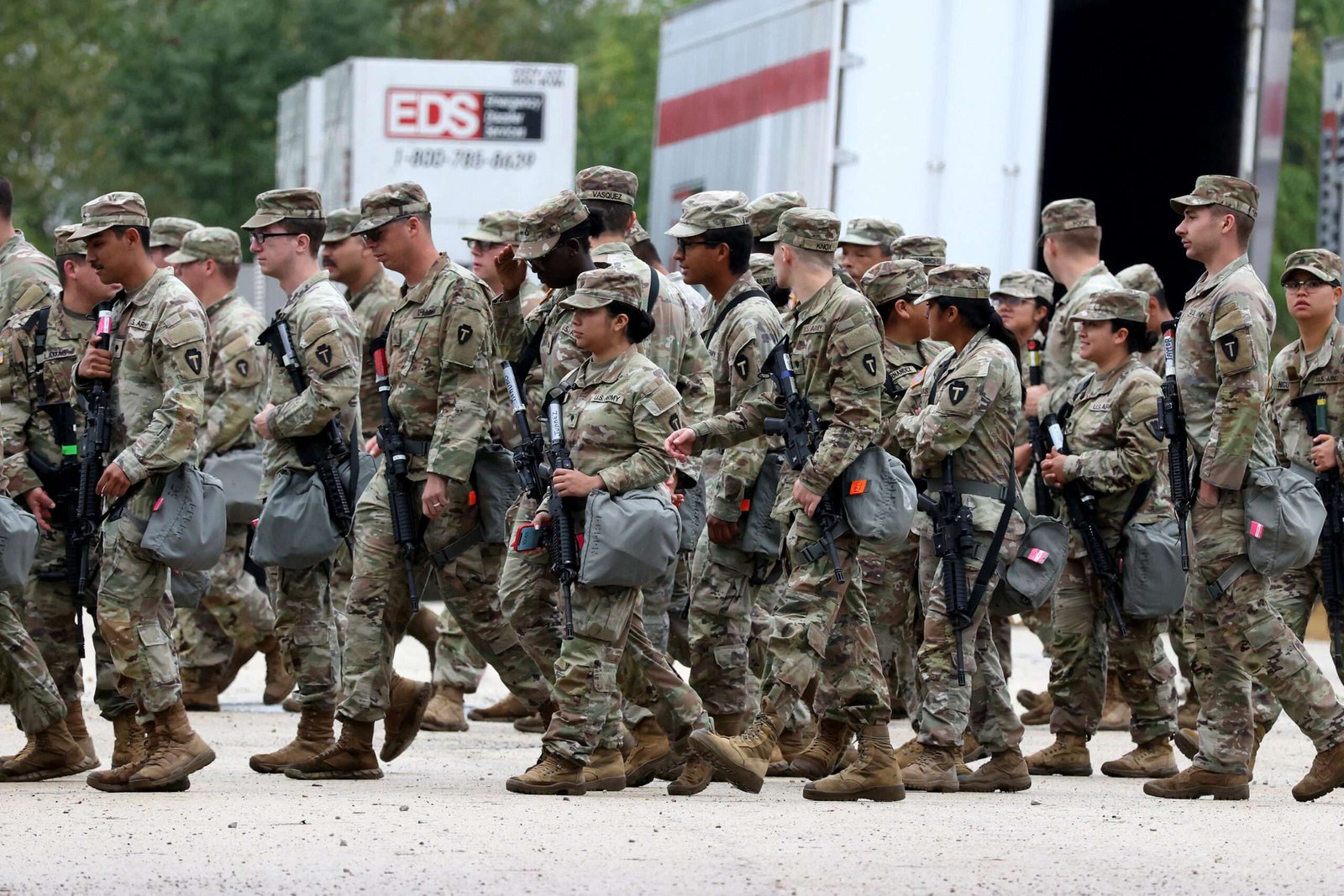
President Donald Trump’s attempts to federalize the National Guard and use it for domestic law enforcement are the subject of ongoing litigation in California, Oregon, and Illinois. What follows is a guest post on this important issue by Professor John Dehn, a leading experts on legal issues surrounding domestic use of the military. Prof. Dehn is also a former US Army officer, who spent fifteen years serving as a military judge advocate.
Building on a previous guest post, coauthored with Josh Braver, Dehn explains why judicial deference to presidential invocations of emergency powers to federalize the National Guard is not required by the Supreme Court’s 1827 decision in Martin v. Mott., which has become a central focus of contention in these cases.
I myself have written about the Illinois litigation here, California litigation here and here, and about the more general issue of judicial review of emergency powers here. What follows below was written by John Dehn, not by me (Ilya Somin), though I generally agree with it, and certainly agree on the bottom line conclusion:
The Trump administration has misinterpreted, and to this point some appellate judges have misunderstood and misapplied, the Supreme Court’s narrow decision in Martin v. Mott. The administration claims Martin establishes that presidents possess judicially unreviewable authority to determine whether exigent circumstances justifying a domestic use of the armed forces exists. This would mean that President Trump may federalize and deploy National Guard troops whenever and wherever he deems appropriate. In support, it primarily relies on one sentence of the Martin opinion, which Justice Story described as a “sound rule of [statutory] construction” rather than a doctrine of constitutional law.
“We are all of opinion [sic], that the authority to decide whether the exigency has arisen, belongs exclusively to the President, and that his decision is conclusive upon all other persons.”
Although district court Judge April Perry and a Seventh Circuit panel correctly concluded that Martin is not controlling in the context of National Guard deployments to support domestic law enforcement activities, the Ninth Circuit has twice concluded that this single, unqualified sentence represents binding Supreme Court precedent. It seems some judges and even some esteemed commentators do not appreciate the very limited context to which this sentence applied, and therefore the much narrower principle or doctrine that it should be understood to establish. Here, I want to briefly add something to what I have already written about this case (with Professor Joshua Braver) and then explain why the Supreme Court should stay its hand rather than Judge Perry’s temporary restraining order.
Martin v. Mott was a replevin action that collaterally attacked the court-martial conviction of a militiaman, Jacob Mott, who disobeyed an order to muster and whose mare had been seized by Martin, a deputy U.S. marshal, to satisfy the fine imposed. Justice Story’s opinion addressed various challenges to that order and the prior proceedings. Regarding the sentence for which he is being cited, Story’s primary concerns were the negative consequences that allowing Mott’s claims would have on: discipline in the ranks, the authority of the military chain of command, and the security of the country. His opinion did not address, and in the context of the case could not have addressed, the general ability or authority of courts to review a president’s purported justification for the mobilization and use of the armed forces under a statute, or the legality of any measures he may direct them to employ. No issues beyond the legal authority for the mobilization order, the court-martial, and the resulting seizure were raised.
Any doubts about this understanding of Story’s opinion are clarified by his citation to an 1814 opinion from the Supreme Court of New York in Vanderheyden v. Young, about which Story wrote, “the reasons in support of [the rule Story posited] were most ably expounded by Mr. Justice Spencer.” As it turns out, reviewing Spencer’s exposition of that rule is incredibly helpful to understanding Story’s opinion. In a suit for damages against an officer who presided over the court-martial of another delinquent New York militiaman, Justice Spencer more completely articulated the rule of construction on which Story relied but only partially articulated:
It is a general and sound principle, that whenever the law vests any person with a power to do an act, and constitutes him a judge of the evidence on which the act may be done, and, at the same time, contemplates that the act is to be carried into effect, through the instrumentality of agents, the person thus clothed with power is invested with discretion, and is, quoad hoc, a judge. His mandates to his legal agents, on his declaring the event to have happened, will be a protection to those agents; and it is not their duty or business to investigate the facts thus referred to their superior, and to rejudge his determination. [emphasis added]
Justice Spencer also explained that any contrary doctrine “would be monstrous” for military discipline (using terms later echoed by Justice Story). If soldiers could challenge such orders in this way, he said, “[n]o man would dare to obey the orders, either of the president, or of his superior officer, lest, peradventure, the president had either abused his authority, or misjudged, in relation to the occurrence of the fact, which authorized him to call forth the militia.”
Thus, Story’s citation to Vanderheyden establishes that the cited sentence in the Martin opinion pertains only to the military chain of command and to damages or other redress available to disobedient militiamen punished by their superiors. It is not a general statement about the authority of courts to review such presidential determinations in suits for relief from actual or impending injuries stemming from a president’s alleged misuse of statutory powers involving the armed forces.
But there are even more reasons why Martin v. Mott should not be understood as controlling in the present litigation. For example, the Act at issue in Martin has been amended and was later deconstructed and codified not only in 10 U.S.C. § 12406 but also 10 U.S.C. § 251, § 252, § 253, and § 254. The lower federal courts have yet to fully address and account for the effect of these changes, as Judge Nelson’s confused concurring opinion in the most recent Ninth Circuit decision demonstrates.
Additionally, the use of federal armed forces or federalized National Guard troops for domestic law enforcement is now generally prohibited by the Posse Comitatus Act, “except in cases and under circumstances expressly authorized by the Constitution or Act of Congress.” (emphasis added) It is also a sound rule of statutory construction that exceptions to general criminal prohibitions are to be construed narrowly, which arguably empowers courts to ensure that a president has done so. Thus, one might fairly conclude that even if the President invokes the Insurrection Act, an exception to the Posse Comitatus Act, and notwithstanding any statutory text that appears to grant broad presidential discretion to do so, courts may engage in judicial review to determine whether his invocation was proper. Dalton v. Spector is not controlling when a president exercises statutory discretion in a way that raises constitutional issues, as has been alleged in Illinois v. Trump.
Moreover, as Professor Steve Vladeck has explained, an overbroad reading of this sentence from Martin would be monstrous for the Constitution, the country, and the rule of law. Generally applying Story’s incompletely articulated rule of statutory construction to statutes authorizing domestic use of the armed forces in emergencies is not only irreconcilable with recent Supreme Court decisions addressing similar issues (e.g. Loper Bright), it also would allow a president to unilaterally militarize or supplant the Constitution’s framework for civil governance on a whim. Congress possesses no constitutional authority to grant a president such discretionary power, and courts should generally interpret statutes in a manner that avoids raising such serious constitutional issues. (E.g., Edward J. DeBartolo Corp. v. Fla. Gulf Coast Bldg. & Constr. Trades Council) For the same reasons, the Court should not interpret Mott or the present circumstances as falling within the category of a non-justiciable political question.
All of these observations provide ample reasons for the Supreme Court to stay its hand in these cases rather than the temporary order of a lower federal court. Its consideration of the complicated and, as yet, underexamined legal and factual issues in these cases would clearly benefit from further proceedings and, dare I say, additional legal scholarship that is undoubtedly in the works.
There is yet another important reason the Supreme Court should stay it hand in this case: the Trump administration’s “unclean hands.” Although an administrative stay is not technically a form of equitable relief to which the clean hands doctrine may be applied, federal courts consider similar factors when deciding whether to grant one. The heavy-handed, unconstitutional tactics of Immigration and Customs Enforcement (ICE) agents have undoubtedly increased the number and intensity of the protests against ICE operations in Chicago. In a separate case, Judge Sarah Ellis determined that federal agents in Chicago have used excessive force against protestors, members of the media, and others presenting no imminent threat of harm to the officers or others, which entail violations of (at a minimum) the First and Fourth Amendments. Upon finding that the administration may be ignoring her first order Judge Ellis amended it, granting additional relief. News reports also indicate that ICE has engaged in war zone-like operations that involve what appear to be additional violations of the Fourth Amendment and perhaps of an applicable consent decree as well. This abusive and dehumanizing behavior is not only unconstitutional but seems calculated to instigate the very outrage that the administration now claims it needs federalized National Guard troops to protect itself from. The Supreme Court should not effectively condone such reprehensible and cynical behavior by granting the administration’s request for a stay.
John Dehn is associate professor and faculty director, National Security and Civil Rights Program at Loyola Law School.
Read the full article here
Fact Checker
Verify the accuracy of this article using AI-powered analysis and real-time sources.