

 Freedom Index
Listen to the article
This article first appeared in Volume 54, Issue 3 of our print edition of Index on Censorship, titled Truth, trust and tricksters: Free expression in the age of AI, published on 30 September 2025. Read more about the issue here.
Kim Jong Un, supreme leader of the Democratic People’s Republic of North Korea – North Korea to you and me – is more afraid of Korean television drama series than he is of foreign attacks. This, amongst other things, is what defector Yuna Jung told Index about the secretive dictatorship when we met in London in June.
Index met with Jung, and with two other North Koreans who live in South Korea, at Kingston University. The three were visiting the UK as part of a speaking tour organised by Freedom Speakers International (FSI). Founded in 2013 as Teach North Korean Refugees, FSI empowers North Korean refugees to engage with the international community.
The three women who spoke with Index all wanted to talk about life in the north, how their eyes were opened through television – specifically South Korean K-dramas, as they are called – and about the hopes they have for change in their native country.
Jung, who defected from North Korea in 2006, decided to leave after K-drama showed her a different world and way of life. Sujin Kim, who defected in 2003 didn’t have enough to eat and was malnourished, and saw through smuggled dramas how different life in South Korea was. Riha Kim, a more recent defector, became disillusioned with the regime through her work as a doctor, and fled to the south in 2015.
Jung told Index that she encountered K-dramas for the first time when a classmate invited her to watch a show, romantic melodrama Autumn In My Heart, which had been smuggled into the country.
“My father had money and power, but it was forbidden. It could kill you,” Jung told Index. “But I believed my father would rescue me. So, I watched it.”
She had only intended to watch a single episode. But she couldn’t stop, and soon, she had binged the entire series. Jung recalled that people who had seen the show would sing its theme song among themselves.
“It just opened my eyes and then woke me up,” she said.
And so she fled, not telling anyone in advance.
Leaving North Korea was at that time a difficult and dangerous process, as Barbara Demick detailed in her 2009 book Nothing to Envy: Real Lives in North Korea. Defectors had to cross over into China and then obtain false passports to go from China to South Korea. Being caught by the Chinese police meant being sent back to North Korea to face months or even years in a labour camp. Most people who attempted it had money and family networks abroad to help them.
The power of K-drama
When Sujin Kim lived in North Korea, she too managed to watch K-dramas smuggled into the country. Before pressing “play”, she would cover the windows and lock the doors; she watched shows with the sound muted, to hide what she was doing. Kim was shocked by the freedom exhibited in the programmes.
Some people had access through other routes, such as television sets that could be tuned to Chinese TV.
However, Jung explained, this required a huge aerial, which cost money. The authorities soon worked out what was going on because even watching Chinese TV was forbidden.
Seeing representations of life in South Korea through K-dramas prompted Sujin Kim to question the North Korean regime. When her mother started to push her into marrying an older man, she decided that it was time for her to leave. Kim didn’t want to have children born into the same situation as her, without enough to eat. She wanted to raise children in the South Korea that she had seen on television.
She succeeded in escaping and eventually married a South Korean with whom she has had two children. But even now, years later, she still struggles when asked for her opinion. After years of being told to stay silent, voicing her thoughts does not come naturally.
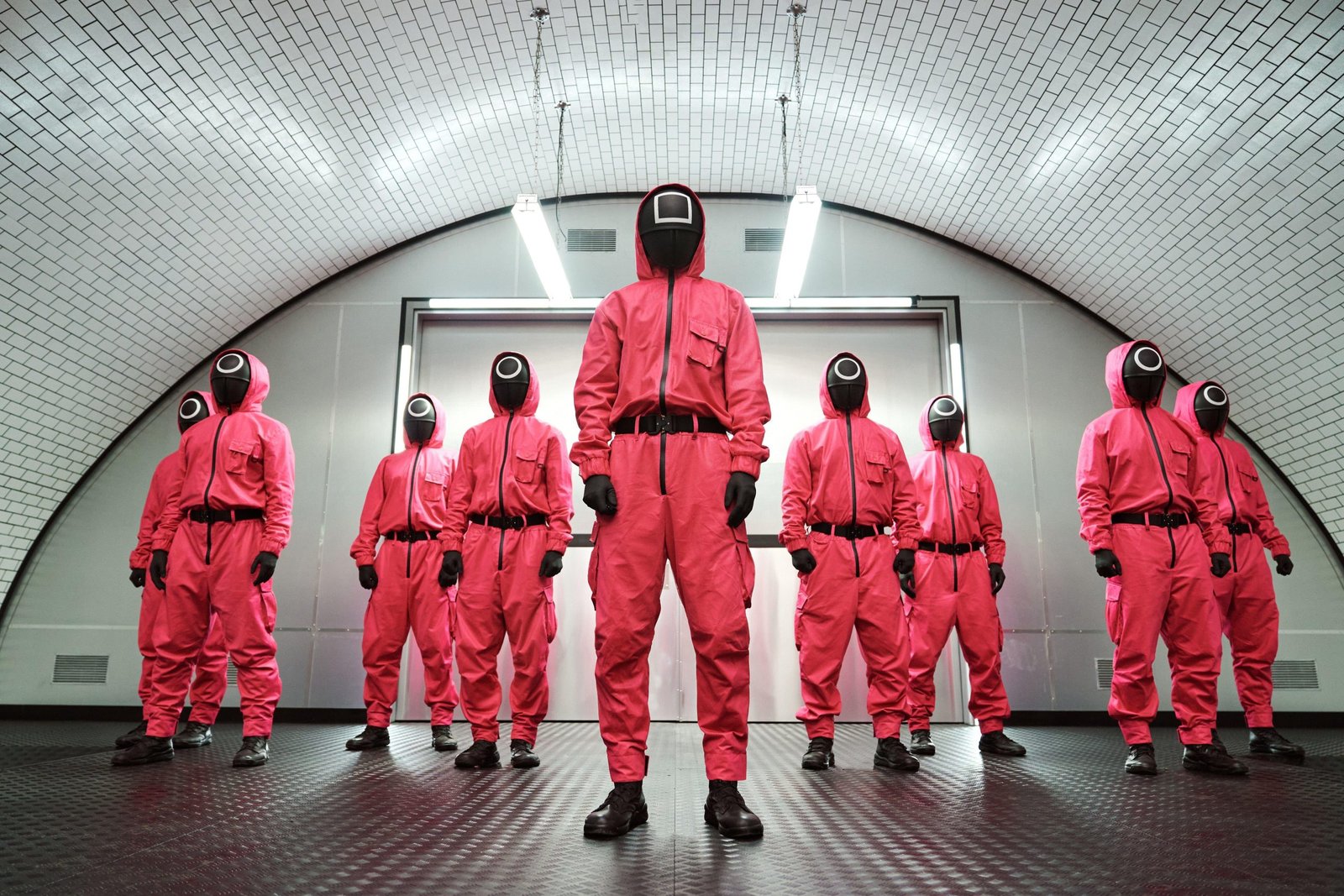
Kim and Jung fled North Korea more than a decade ago. Thanks to the reach of popular streaming services, the global popularity of K-drama has sharply risen since then, even though foreign audiences are only seeing a small segment of the shows created. In 2016, Netflix started investing in Korean productions. The violent drama Squid Game, where desperate people are lured into participating in – literally – murderous competitions, became a global phenomenon in 2021. Other Korean shows that have found international audiences include Celebrity, a thriller-romance about wealth and status; All Of Us Are Dead (below), a high school drama featuring a zombie apocalypse; and Business Proposal, an office romance.
Required watching
But K-drama hits differently in North Korea compared to the rest of the world, wielding huge influence over the way people think. Characters in these shows are not struggling to find enough food to eat, they can speak freely and are allowed to declare their love for people other than Kim Jong Un.
When the Unification Media Group (UMG), a non-profit media consortium based in Seoul, asked a group of 50 defectors in 2022 whether they had watched foreign media before leaving North Korea, 98% of respondents answered in the affirmative – up from 91% in 2019. 96% of the respondents said that they had watched South Korean drama. Some of the most popular shows were Squid Game, Penthouse, and Crash Landing On You, the last featuring a South Korean heiress stranded in the north.
There are similar parallels in recent history. Once, the divide between East and West Germany was compared to that of the two Koreas. While television programming in East Germany focused on furthering socialist politics, people were also tuning into West German TV. Many were influenced by this external media which some researchers believe hastened the fall of the Berlin Wall and German re-unification. In Romania in the 1980s, the communist leader Nicolae Ceausescu, a fan of the US TV series Dallas, allowed it to be shown on television, hoping it would demonstrate the evils of capitalism. Instead, the soap opera about oil barons and their families had the opposite effect, fuelling discontent with his regime.
K-drama inspired Jung to leave North Korea; today, she’s a popular television figure in South Korea herself, regularly appearing on Now on My Way to Meet You, a talk show featuring North Korean refugees.
One day, Jung Il Young, the singer of Autumn In My Heart’s main theme song, came on the show. Recollections of the song, and what it represented to them, brought North Koreans in the studio to tears.
Still. The supreme leader of North Korea fearing South Korean television? Quite plausible, it seems. As Jung told Index, his fear of K-drama comes from the concern that it will change people’s minds, as it did in her case. It is changing the younger generation, and it is becoming more difficult to brainwash them – and he knows this.
Risky viewing habits
As one can surmise from the subterfuge involved in accessing K-drama, watching these shows in North Korea is illegal. More and more people are taking this risk, though. According to the UMG research, it is making those who do curious about South Korean culture.
In November 2021, Radio Free Asia reported that a man who smuggled copies of Squid Game into North Korea for sale had been sentenced to death, after seven high school students were caught watching a copy of the show that he had sold to them. The student who purchased the show – stored on a USB stick – was sentenced to life imprisonment, and the other six were sentenced to five years of hard labour. Teachers and school administrators were fired and some exiled to remote areas.
Then in July 2024, South Korean news outlets claimed that the north had publicly executed 30 teenagers for watching K-dramas. This report could not be independently verified, however, and has been treated with scepticism by some experts.
Accurate or not, defectors do confirm that the crackdown on watching foreign media has indeed become harsher since 2020, when the Law on Rejecting Reactionary Thought and Culture was introduced. The punishment for viewing or distributing foreign films now is, in fact, execution. In the UMG survey, respondents were asked whether they knew of anyone around them being punished for consuming foreign radio or video content. Out of 50 respondents, 44 said “Yes”. The majority of those punished had been for watching videos.
Sujin Kim last spoke with her family in North Korea around three years ago. She tried to arrange for them to be smuggled out but failed. For a while, she was able to communicate with her family by letter, sent through brokers. A photograph served as proof that the letter had arrived, and a reply would be sent back. But the brokers on both sides of the China-North Korea border were captured by their respective governments, she told Index, and she has now lost her method of communication.
Escaping North Korea has become more difficult since the complete closure of the border in 2020 as a result of the Covid-19 pandemic. And stories of escapes have been few and far between. Though while still low, numbers have just started to rise again.
What the K-dramas give their viewers in North Korea is a sense of what life is like in the south and what is allowed, even if some of it is exaggerated – or, in the case of Squid Game, terrifying. When it comes to taking down a dictator like Kim Jong Un, perhaps the K-drama is mightier than the nuclear weapon.
Read the full article here
Fact Checker
Verify the accuracy of this article using AI-powered analysis and real-time sources.