Close Menu
FSNN | Free Speech News NetworkFSNN | Free Speech News Network
  • Home
  • News
    • Politics
    • Legal & Courts
    • Tech & Big Tech
    • Campus & Education
    • Media & Culture
    • Global Free Speech
  • Opinions
    • Debates
  • Video/Live
  • Community
  • Freedom Index
  • About
    • Mission
    • Contact
    • Support
Trending

88 people charged over 12 crypto wrench attacks in France

1 hour ago

Brickbat: Partners in Crime

2 hours ago

Myanmar junta denies journalist Sai Zaw Thaike medical care, adding to pattern of prison abuse

2 hours ago
Facebook X (Twitter) Instagram
Facebook X (Twitter) Discord Telegram
FSNN | Free Speech News NetworkFSNN | Free Speech News Network
Market Data Newsletter
Monday, April 27
  • Home
  • News
    • Politics
    • Legal & Courts
    • Tech & Big Tech
    • Campus & Education
    • Media & Culture
    • Global Free Speech
  • Opinions
    • Debates
  • Video/Live
  • Community
  • Freedom Index
  • About
    • Mission
    • Contact
    • Support
FSNN | Free Speech News NetworkFSNN | Free Speech News Network
Home»News»Media & Culture»This Year’s Nobel Winners for Economics Explained How Innovation Makes Us Rich
Media & Culture

This Year’s Nobel Winners for Economics Explained How Innovation Makes Us Rich

News RoomBy News Room7 months agoNo Comments3 Mins Read1,021 Views
Share Facebook Twitter Pinterest Copy Link LinkedIn Tumblr Email VKontakte Telegram
This Year’s Nobel Winners for Economics Explained How Innovation Makes Us Rich
Share
Facebook Twitter Pinterest Email Copy Link

Listen to the article

0:00
0:00

Key Takeaways

Playback Speed

Select a Voice

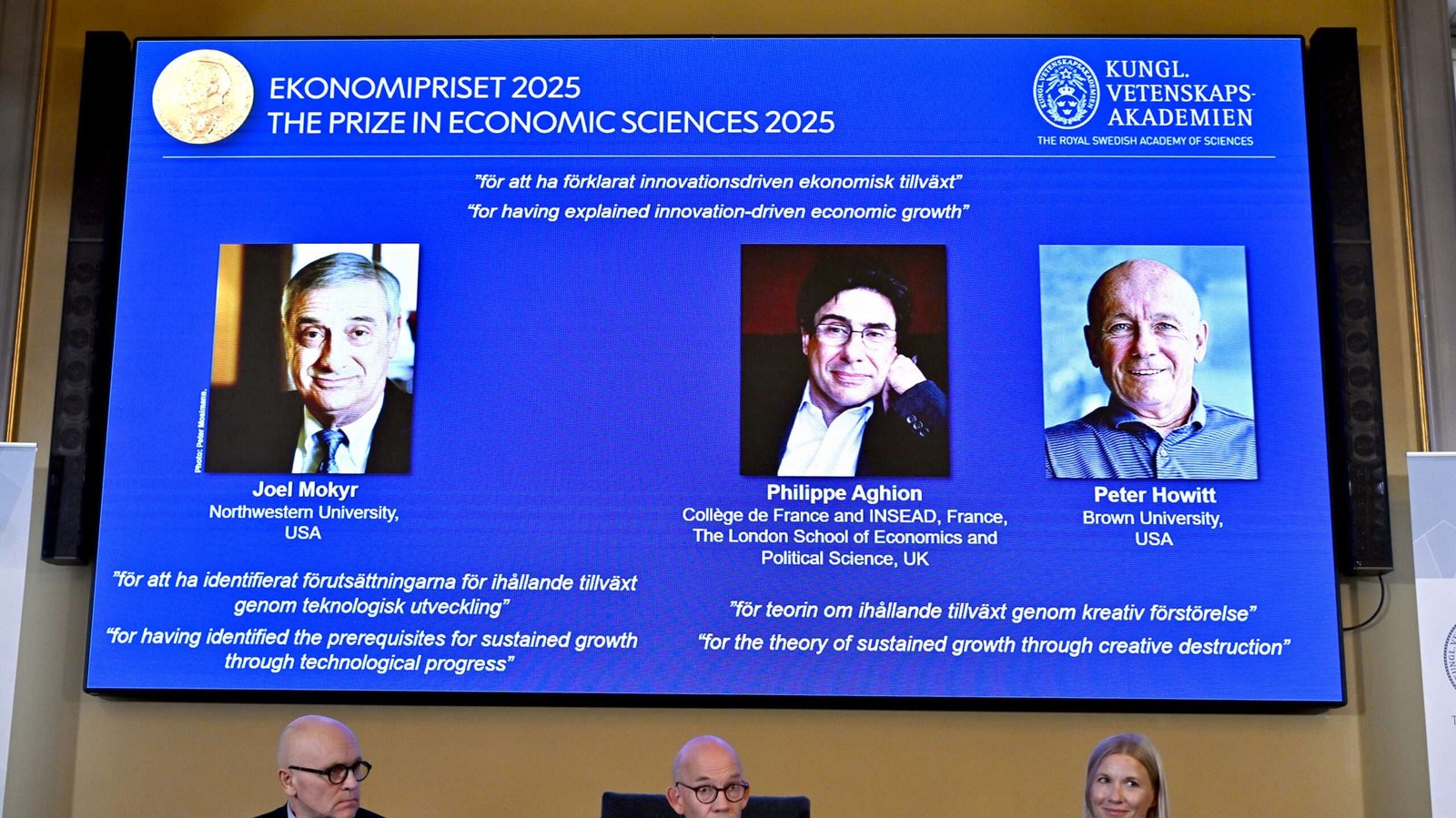
The Royal Swedish Academy of Sciences on Monday awarded the Nobel Memorial Prize in Economic Sciences to Northwestern University professor and Reason contributor Joel Mokyr “for having identified the prerequisites for sustained growth through technological progress.” He shares the prize with Philippe Aghion and Peter Howitt, who won the other half jointly “for the theory of sustained growth through creative destruction.” 

Together, the trio had explained how innovation drives economic growth, the academy said, when economic stagnation had been the rule, as opposed to the exception, for the vast majority of human history. As a result of that upswing, countless people have been lifted out of poverty.

For his part, Mokyr’s work has focused on the intersection of economics, culture, and history, emphasizing both the importance of understanding why various technologies work if they are to successfully build on each other, as well the affluence that comes from openness to new ideas. In reviewing Mokyr’s 2016 book, A Culture of Growth: The Origins of the Modern Economy, the classical liberal economist Deirdre McCloskey wrote that Mokyr “is a Nobel-worthy economic scientist, right down to his wingtip shoes.” 

At the announcement Monday for the pro-growth winners, the prize committee issued a warning against anti-growth policies, like tariffs and restrictive immigration. That the road to economic stagnation is multifaceted is something Mokyr knows well, as he outlined several times in Reason throughout the 1990s, directing his focus to certain topics in a way that would seem prescient in retrospect, and which still help elucidate problems society faces today.

“The most persuasive case against protectionism is not the standard one that undergraduate students are taught in their introductions to international economics, which goes like this: Tariffs distort the allocation of resources and impose a ‘deadweight burden,'” Mokyr wrote in the June 1996 issue of Reason. “The standard argument is certainly correct, but somehow it has failed to persuade many people since it was first enunciated by Adam Smith and David Ricardo.”

The better argument, instead, is that “protectionism and insularism impede innovation, depriving our children of the comfort and security that progress and economic growth bring,” he said. “Free trade and international competition not only lead to a better allocation of resources; they ensure that countries do not lull themselves into the technological lethargy that is the archenemy of economic growth.”

So, too, has Mokyr long understood the anxiety around technological progress, often portrayed as a form of regression. “What explains technophobia?” he asked in the January 1996 issue of Reason. He noted that while technology pessimists were “neither insane nor ignorant,” their objections were “misguided and futile,” like nostalgia, risk aversion, and social costs like pollution. Sound familiar?

Across Mokyr’s Reason pieces (others can be found here and here)—and his work broadly—is the belief that innovation is good, actually. It’s a message that has long received pushback from some of the louder voices in the room, despite it fundamentally being one of optimism and progress.

“As long as they insist, with fellow-traveler Wendell Berry, that a new contraption should be adopted only if it is cheaper, smaller, and locally made; uses less energy; does not disrupt anything good that already exists (including family and community relationships); does not infringe on the rights of other species (plants and animals alike); and does not harm the interests of the next seven generations,” he wrote in that January 1996 essay, “the ‘neo-Luddite’ movement will inspire derision rather than effective technological resistance.”

Read the full article here

Fact Checker

Verify the accuracy of this article using AI-powered analysis and real-time sources.

Get Your Fact Check Report

Enter your email to receive detailed fact-checking analysis

5 free reports remaining

Continue with Full Access

You've used your 5 free reports. Sign up for unlimited access!

Already have an account? Sign in here

Share. Facebook Twitter Pinterest LinkedIn Tumblr Email Telegram Copy Link
News Room
  • Website
  • Facebook
  • X (Twitter)
  • Instagram
  • LinkedIn

The FSNN News Room is the voice of our in-house journalists, editors, and researchers. We deliver timely, unbiased reporting at the crossroads of finance, cryptocurrency, and global politics, providing clear, fact-driven analysis free from agendas.

Related Articles

Media & Culture

Brickbat: Partners in Crime

2 hours ago
Media & Culture

What To Do With AI-Generated Legal Scholarship?: Part 2

4 hours ago
Debates

What Really Causes Recessions?

8 hours ago
Media & Culture

Bill Otis (Ringside at the Reckoning) on the SPLC Indictment

9 hours ago
Cryptocurrency & Free Speech Finance

Coachella Uses Google DeepMind AI to Test the Future of Live Entertainment

15 hours ago
Media & Culture

What Do You Do With AI-Generated Legal Scholarship?: An April 2026 Question

15 hours ago
Add A Comment

Comments are closed.

Editors Picks

Brickbat: Partners in Crime

2 hours ago

Myanmar junta denies journalist Sai Zaw Thaike medical care, adding to pattern of prison abuse

2 hours ago

Pudgy Penguins, BAYC rally masks a shrinking NFT market as volumes and users fall

2 hours ago

Prediction markets reflect 'wisdom of an informed minority,’ not crowd: Study

2 hours ago
Latest Posts

CPJ urges new Bangladesh government to fulfill poll promise and release imprisoned journalists 

3 hours ago

What is Paul Sztorc’s Bitcoin hard fork ‘eCash’ and how it affects BTC?

3 hours ago

What To Do With AI-Generated Legal Scholarship?: Part 2

4 hours ago

Subscribe to News

Get the latest news and updates directly to your inbox.

At FSNN – Free Speech News Network, we deliver unfiltered reporting and in-depth analysis on the stories that matter most. From breaking headlines to global perspectives, our mission is to keep you informed, empowered, and connected.

FSNN.net is owned and operated by GlobalBoost Media
, an independent media organization dedicated to advancing transparency, free expression, and factual journalism across the digital landscape.

Facebook X (Twitter) Discord Telegram
Latest News

88 people charged over 12 crypto wrench attacks in France

1 hour ago

Brickbat: Partners in Crime

2 hours ago

Myanmar junta denies journalist Sai Zaw Thaike medical care, adding to pattern of prison abuse

2 hours ago

Subscribe to Updates

Get the latest news and updates directly to your inbox.

© 2026 GlobalBoost Media. All Rights Reserved.
  • Privacy Policy
  • Terms of Service
  • Our Authors
  • Contact

Type above and press Enter to search. Press Esc to cancel.

🍪

Cookies

We and our selected partners wish to use cookies to collect information about you for functional purposes and statistical marketing. You may not give us your consent for certain purposes by selecting an option and you can withdraw your consent at any time via the cookie icon.

Cookie Preferences

Manage Cookies

Cookies are small text that can be used by websites to make the user experience more efficient. The law states that we may store cookies on your device if they are strictly necessary for the operation of this site. For all other types of cookies, we need your permission. This site uses various types of cookies. Some cookies are placed by third party services that appear on our pages.

Your permission applies to the following domains:

  • https://fsnn.net
Necessary
Necessary cookies help make a website usable by enabling basic functions like page navigation and access to secure areas of the website. The website cannot function properly without these cookies.
Statistic
Statistic cookies help website owners to understand how visitors interact with websites by collecting and reporting information anonymously.
Preferences
Preference cookies enable a website to remember information that changes the way the website behaves or looks, like your preferred language or the region that you are in.
Marketing
Marketing cookies are used to track visitors across websites. The intention is to display ads that are relevant and engaging for the individual user and thereby more valuable for publishers and third party advertisers.