

 Freedom Index
Listen to the article
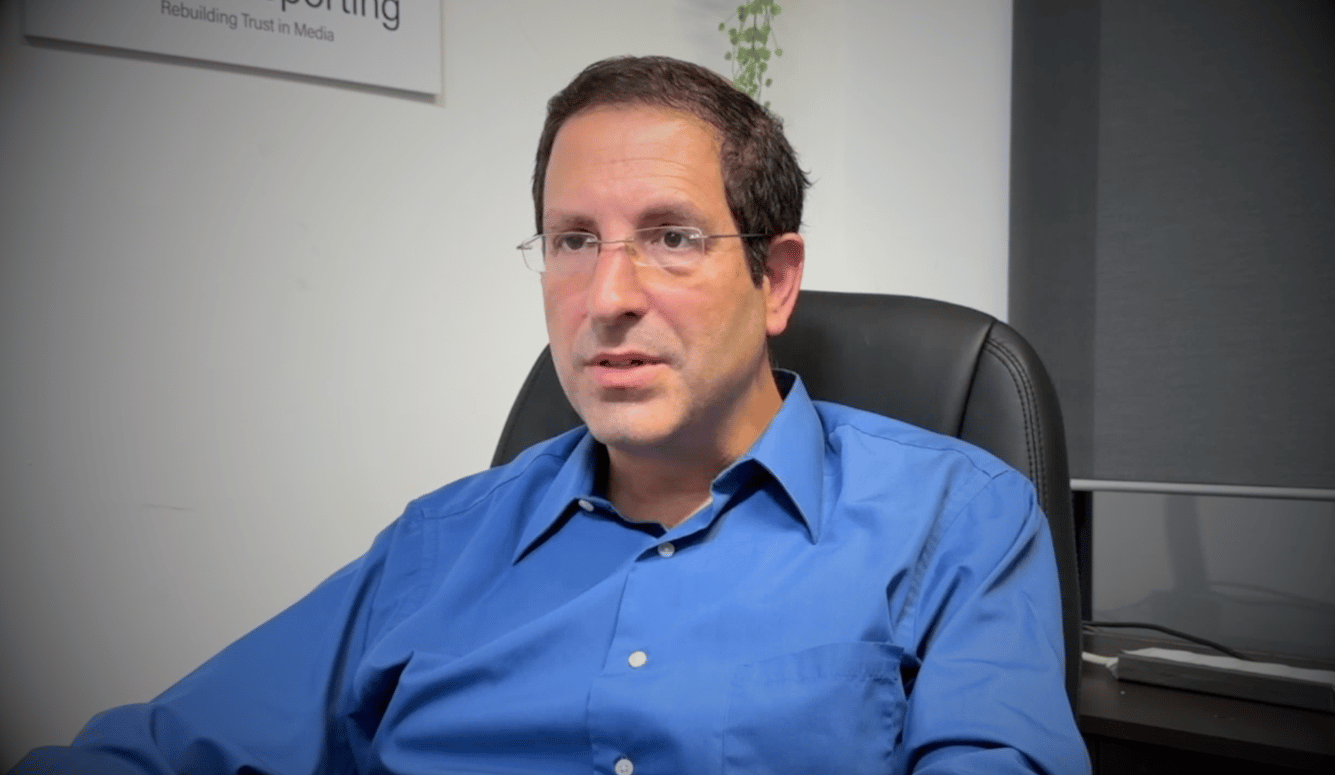
Gil Hoffman is the Executive Director of HonestReporting, a Jerusalem-based media watchdog that monitors international news coverage for bias against Israel. He previously served as the chief political correspondent and analyst for The Jerusalem Post for nearly 25 years, covering 10 Israeli election campaigns and reporting from over 40 countries. A frequent lecturer on Israeli politics and media, Hoffman has appeared on CNN, BBC, and Al Jazeera, and has been a guest lecturer at major universities around the world. He holds a degree in political science and journalism from Northwestern University and served as a reserve spokesperson for the Israel Defense Forces.
Transcript
Gil Hoffman: I’m Gil Hoffman, the Executive Director of Honest Reporting, which is a pro-Israel media watchdog based here in Jerusalem. It’s an organisation that has been around for 25 years, monitoring anti-Israel bias in the media. But since 7 October 2023, things have become much more intense, because there has been an information campaign against Israel that has been extremely effective and just as powerful as the events of 7 October. We are constantly facing blood libels against Israel that must be disproven. The media must be corrected, because this is a narrative war, and the consequences are very stark.
Pamela Paresky: We’ve just recently seen consequences, including France and other countries announcing that they will reward the actions of 7 October. Hamas said that their campaign was successful. So that’s one kind of consequence—what are the others?
GH: I unfortunately have to downplay what Macron and other world leaders think they might be accomplishing. They’re not going to be giving the Palestinians—whether led by Hamas or by the current Palestinian Authority—a state on a silver platter. It doesn’t work that way—not through declarations, not even at the UN. There are criteria for statehood, and the Palestinians do not meet any of them. All Security Council members would have to agree without a veto, and thanks to the Trump administration, that’s not going to happen.
So, in the end, that’s just lip service to the internal Muslim minorities in their countries that these world leaders are trying to appease. The real consequences are much more serious. After this war ends on the seven military fronts, there will still be the narrative war. You called it, Pamela, the eighth front. I count mainstream media, social media, and college campuses around the world—three more. I count ten. But what’s going to happen is that when the military war ends, the narrative war will continue.
It’s either: Israel becomes an international pariah, like apartheid South Africa, and it never comes back—or Israel saved the world from genocidal terrorists and an Islamic fundamentalist nuclear bomb. It’s one or the other. So if the world continues to believe the former, then terrorism is going to thrive—even in places where there are no Jews. The entire world will become more unsafe. Israelis won’t be able to travel anywhere. Jews will have to hide around the world.
But if the world understands the truth—that Israel saved the world in this war—then there’s going to be an economic rebound here. Our high-tech and tourism-based economy is going to thrive. There will be a post-war economic boom. The Abraham Accords will expand. Terror will weaken around the world, and the entire world will be safer. It’s that serious.
PP: What’s the mechanism by which the media continues to spread these falsehoods?
GH: The front page, Pamela. The mechanism is right in your face. In the beginning of the war, they tried to be nuanced and balanced and even-handed—even objective—but we haven’t seen that in a very long time. The media has adopted the Hamas narrative, hook, line and sinker, and it’s really scary. People are believing lies that are very easily disproven. They’re getting it wrong. They’re not even trying. They’re not even hiding their agenda anymore. It’s so dangerous.
PP: What’s the most recent example of that?
GH: Israel was about to reach an agreement with Hamas. It was an important step toward ending the war. Netanyahu came to the White House, and the president said we were about a week away from ending the war. Then what happened? The war didn’t end.
Soon after that, there was a campaign to make it look like Israel was purposely starving Gazan children—at a time when Israel was already bringing in more food to an enemy population than any government or army ever has in the history of warfare on this Earth. The media outlets tried to push it. They put pictures of children who looked terrible on the front pages of papers. But it turned out they weren’t starving—they had pre-existing conditions that had nothing to do with Israel or the war.
Then the media apologised—in a small, hidden, half-hearted kind of way—but the damage was already done. And they didn’t care. They advanced their narrative. They lied. It resulted in countries saying they were going to recognise a Palestinian state. It resulted in violence. It made the world more dangerous—all based on lies.
PP: And then Hamas decided not to—
GH: Hamas stopped their talks in Doha, and they haven’t really advanced since then. The war is continuing. Now Israel is preparing to take steps to defeat the last stronghold of Hamas in Gaza City. All of that could have been avoided.
You know, there are people who blame Israel—we have to differentiate between the two. Just like Americans differentiate between America and Trump for the war not ending, there are people who rightly blame Hamas, which has been using its people as human shields and doesn’t care how many of its own are killed—because their goal is to destroy Israel. I also blame the media for being irresponsible in their reporting.
PP: Is there a pathway from Hamas to, say, AP or Reuters, and then from AP or Reuters to other media outlets? Or does it go directly from Hamas plants as journalists to other outlets?
GH: Pamela, more than a decade ago, the Israeli government made a decision not to let journalists into Gaza. Your viewers can decide for themselves—there are pros and cons. It’s a “damned if you do, damned if you don’t” kind of decision. But there’s no regular journalism happening in Gaza. There are ordinary Gazans with cell phones. None of them went to the Medill School of Journalism like I did. None of them went to Columbia. All of them are beholden to Hamas. All of them know that if they don’t present Hamas’ narrative, they won’t live much longer.
So those are the people sending their stories and pictures to AP and Reuters. By the way, Reuters used to report Israel separately from the rest of the world. The bureau here used to report directly to their international headquarters in London. A few years ago, they changed that—we’re now part of the Middle East region, which means it goes via Qatar. Qatar, which funds Hamas.
So the people who decide which photographs are sent around the world by the largest news agency on Earth—Reuters—are pro-Hamas people in Qatar.
PP: Wow. Are there other examples like that—things that people wouldn’t know unless they did a lot of digging?
GH: I just don’t think people realise how they’re getting their news nowadays. The top journalists in the world parachuted into Israel right after 7 October. All the journalists who had been stationed in Ukraine were sent over here, often without any background or knowledge. But they were professionals, and that has continued. They’ve reported the good and the bad here.
You’re not getting the top journalists in the world out of Gaza, and people need to realise that. They need to filter what they’re reading. They need to be better news consumers and understand that they can’t trust any information they’re getting out of the mainstream media. What you’re really getting from Gaza is a bunch of Hamas sympathisers.
PP: What was the reasoning for not allowing journalists into Gaza, and when did that start?
GH: 2014, during the Gaza war. The reason was to avoid journalists getting killed. You know, I knew Shireen Abu Akleh, who was killed in the line of fire—an Al Jazeera reporter in the West Bank. You could have had dozens of Shireens in Gaza. They’re already accusing Israel of killing journalists in Gaza, and many of them were working for media outlets that are actually part of terrorist organisations. For example, Quds TV—that’s part of Hamas.
Many of these so-called journalists were killed while doing their “day job” as terrorists, while moonlighting as reporters. But no—Israel has not purposely killed any journalist in this war.
PP: What do you think is the mechanism—I mean, you said “the front page” when I asked earlier—but what’s the reason that there’s such credulity about the information coming out of Gaza? That information is obviously either from Hamas or blessed by Hamas. Why is there so little scepticism among mainstream media journalists?
GH: Maybe they’re pretending to be objective. If they give the Israeli point of view, then they feel they must give the Hamas point of view. But then they write things like “Israel claims…” or “Israel presents unverified evidence…” while taking what Hamas tells them as gospel. We’ve seen a lot of that in this war too.
PP: That’s one of the things you’ve pointed out—the lack of balance in the way material is presented. What are some other examples of small but significant things people might not notice, that they should be looking for?
GH: They quote the Gaza Health Ministry or “Palestinian health officials in Gaza” as if that’s a neutral health department. It isn’t. They don’t really have a functioning health ministry. What they have is a PR ministry.
There is a health department for Palestinians—but it’s based in Ramallah, under the Palestinian Authority. They offered their services to Hamas, like helping with casualty reporting, but Hamas refused. They don’t use algorithms or medical data. Nobody really knows how many Gazans have been killed in this war.
But we do know this: every Israeli and every Palestinian killed in this war—it is the fault of Hamas, for attacking Israel on 7 October.
At the time, Israel was moving full speed ahead with expanding the Abraham Accords. The Saudis had asked Israel to double the number of workers from Gaza allowed into Israel. Israel had agreed. That would have revitalised the Gaza economy. Everything was moving towards peace in the Middle East—until 6:29 a.m. on 7 October.
People don’t remember what the top global headline was in September 2023. And I’m not asking you to remember ancient history—we’re not talking about 400 BC. I’m talking about two years ago. In September 2023, the Crown Prince of Saudi Arabia went to the UN General Assembly and said he was going to normalise relations with Israel.
That’s one of the reasons Hamas attacked us on 7 October. They wanted to prevent the Abraham Accords from moving forward.
PP: Explain to people what the reasoning would be for trying to derail that process—for people who don’t really understand. What would make that such a problem for Hamas?
GH: The whole point of the Abraham Accords was to bypass the Palestinians on the way to peace in the Middle East. The old format—Bill Clinton, John Kerry, and others—was that no Arab country would normalise relations with Israel until the Israeli–Palestinian conflict was resolved.
Netanyahu said no. He thought it could work the other way around. He believed that by using Israel’s strategic and economic ties with Arab and Muslim countries—who wanted relations with Israel and were tired of waiting for the Palestinians to act—we could ignite a process that would spread throughout the region.
Then the Palestinians would realise they were being left behind. And then, perhaps, they’d want to elect the kind of leaders willing to make the necessary sacrifices for their people.
So I understand why Hamas would want to get in the way of that. They want the entire Middle East at war with Israel. They don’t want the region making peace with Israel.
Even though Iran and Hezbollah told Sinwar to wait—they said Iran was about to get the nuclear bomb and it would make more sense to attack then, on all seven fronts—Sinwar said no. He wanted to attack now. He wanted to pre-empt the Abraham Accords.
There was also another reason: the Iron Beam. Every Iron Dome missile costs $30,000 to intercept a rocket fired at Israel. The Arrow missile—used to intercept Iranian or Houthi long-range missiles in space—costs $1 million each. The Iron Beam, which is a laser defence system, runs on electricity. Three dollars per shot.
That’s another reason Hamas attacked when it did.
PP: So the Iron Beam is something that’s under development?
GH: Yes, it’s still under development. It’s been used a little bit during this war. But you need to make a lot more of it. You have to have batteries—just like with Iron Dome—you need several. And unfortunately, we’re at war on multiple borders right now. So, we’re not ready yet.
PP: You made me think of the history of the conflict with the Palestinians, and that there’s kind of a reversal now. For a long period, as I understand it, the Arab League—or whatever it was called in 1948—the Arab countries that surrounded Israel all attacked together in a coordinated effort. When they lost, they wanted to keep the Palestinians in refugee status. They were used for a time, and then the Arab states sort of lost interest and left them. And now, it seems the Palestinians don’t want to follow what those “big brother” countries want—which is to move on and accept peace. Have I got that more or less right?
GH: What’s happening is that the Palestinians have been given false hope—that one day they’ll return to where their great-grandparents lived.
1948 was a long time ago. Jews also lived in Muslim countries in the 1940s, but they were forced out. All their wealth was taken away. They arrived in Israel with only the shirts on their backs. But they built themselves up, they worked hard, and now their grandchildren are thriving.
That hasn’t happened with the Palestinians. They’ve been exploited by Arab and Muslim countries—used as a tool against Israel to try to destroy the Jewish state. They’ve deserved better than the leadership they’ve had. It’s been a long time. It’s time to move on.
Read the full article here
Fact Checker
Verify the accuracy of this article using AI-powered analysis and real-time sources.